

140
3 Experiments in Pebble Bed Heat Transfer
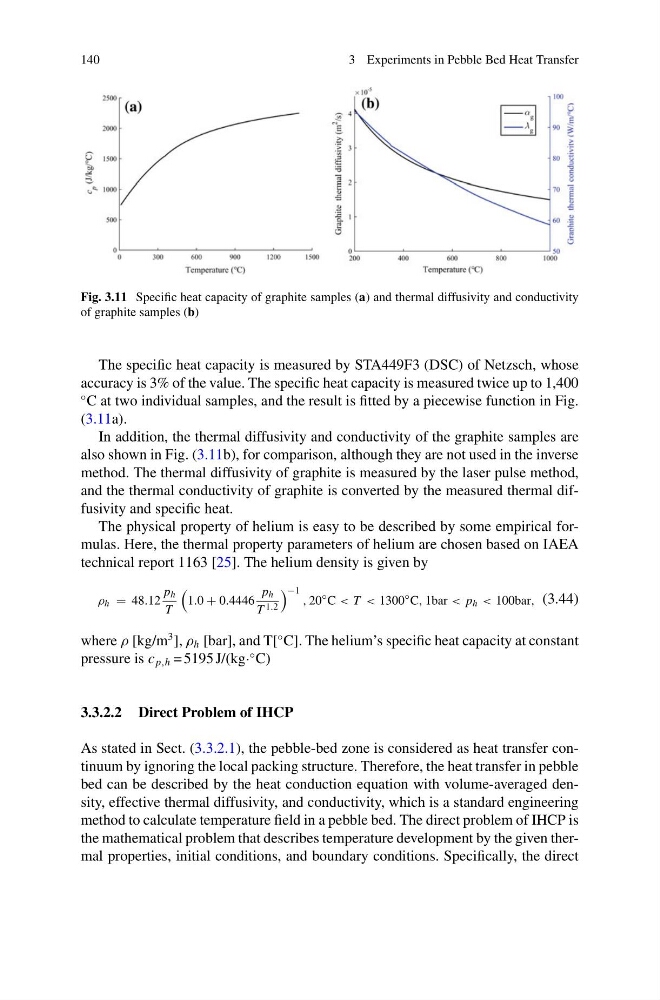
Fig. 3.11 Specific heat capacity of graphite samples (a) and thermal diffusivity and conductivity
of graphite samples (b)
The specific heat capacity is measured by STA449F3 (DSC) of Netzsch, whose
accuracy is 3% of the value. The specific heat capacity is measured twice up to 1,400
◦ C at two individual samples, and the result is fitted by a piecewise function in Fig.
(3.11a).
In addition, the thermal diffusivity and conductivity of the graphite samples are
also shown in Fig. (3.11b), for comparison, although they are not used in the inverse
method. The thermal diffusivity of graphite is measured by the laser pulse method,
and the thermal conductivity of graphite is converted by the measured thermal diffusivity and specific heat.
The physical property of helium is easy to be described by some empirical formulas. Here, the thermal property parameters of helium are chosen based on IAEA
technical report 1163 [25]. The helium density is given by
ρ h = 48.12
p h
T
1.0 + 0.4446
p h
T 1.2
−1 , 20
◦ C < T < 1300
◦ C, 1bar < p h < 100bar, (3.44)
where ρ [kg/m
3 ], ρ h [bar], and T[
◦ C]. The helium’s specific heat capacity at constant
pressure is c p,h = 5195 J/(kg·
◦ C)
3.3.2.2 Direct Problem of IHCP
As stated in Sect. (3.3.2.1), the pebble-bed zone is considered as heat transfer continuum by ignoring the local packing structure. Therefore, the heat transfer in pebble
bed can be described by the heat conduction equation with volume-averaged density, effective thermal diffusivity, and conductivity, which is a standard engineering
method to calculate temperature field in a pebble bed. The direct problem of IHCP is
the mathematical problem that describes temperature development by the given thermal properties, initial conditions, and boundary conditions. Specifically, the direct
3 Experiments in Pebble Bed Heat Transfer
Fig. 3.11 Specific heat capacity of graphite samples (a) and thermal diffusivity and conductivity
of graphite samples (b)
The specific heat capacity is measured by STA449F3 (DSC) of Netzsch, whose
accuracy is 3% of the value. The specific heat capacity is measured twice up to 1,400
◦ C at two individual samples, and the result is fitted by a piecewise function in Fig.
(3.11a).
In addition, the thermal diffusivity and conductivity of the graphite samples are
also shown in Fig. (3.11b), for comparison, although they are not used in the inverse
method. The thermal diffusivity of graphite is measured by the laser pulse method,
and the thermal conductivity of graphite is converted by the measured thermal diffusivity and specific heat.
The physical property of helium is easy to be described by some empirical formulas. Here, the thermal property parameters of helium are chosen based on IAEA
technical report 1163 [25]. The helium density is given by
ρ h = 48.12
p h
T
1.0 + 0.4446
p h
T 1.2
−1 , 20
◦ C < T < 1300
◦ C, 1bar < p h < 100bar, (3.44)
where ρ [kg/m
3 ], ρ h [bar], and T[
◦ C]. The helium’s specific heat capacity at constant
pressure is c p,h = 5195 J/(kg·
◦ C)
3.3.2.2 Direct Problem of IHCP
As stated in Sect. (3.3.2.1), the pebble-bed zone is considered as heat transfer continuum by ignoring the local packing structure. Therefore, the heat transfer in pebble
bed can be described by the heat conduction equation with volume-averaged density, effective thermal diffusivity, and conductivity, which is a standard engineering
method to calculate temperature field in a pebble bed. The direct problem of IHCP is
the mathematical problem that describes temperature development by the given thermal properties, initial conditions, and boundary conditions. Specifically, the direct