

3.2 Experimental Facility and Methodology
133
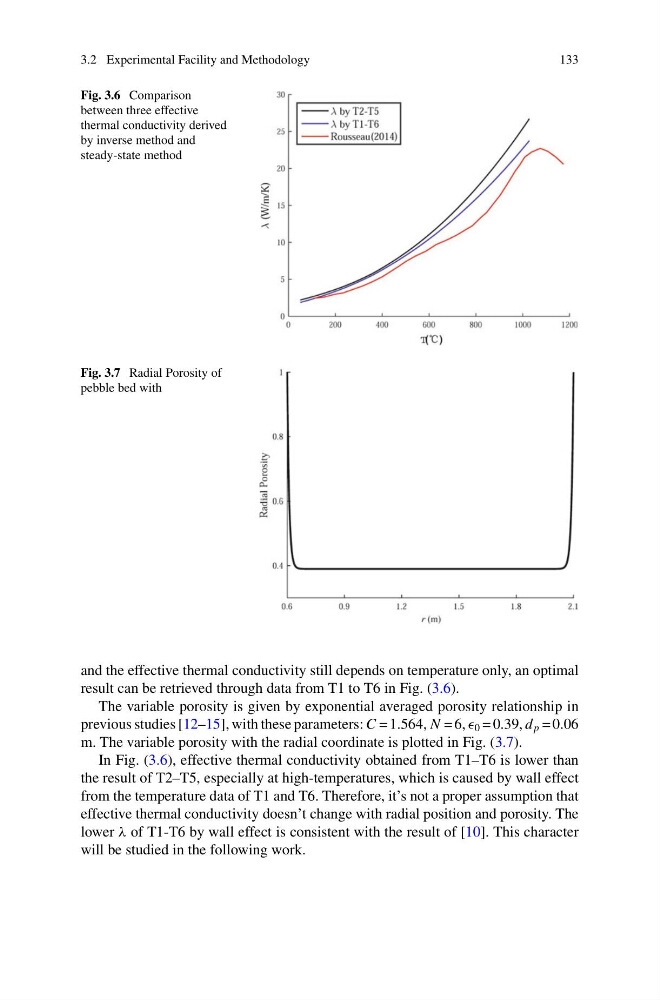
Fig. 3.6 Comparison
between three effective
thermal conductivity derived
by inverse method and
steady-state method
Fig. 3.7 Radial Porosity of
pebble bed with
and the effective thermal conductivity still depends on temperature only, an optimal
result can be retrieved through data from T1 to T6 in Fig. (3.6).
The variable porosity is given by exponential averaged porosity relationship in
previous studies [12–15], with these parameters: C = 1.564, N = 6, 0 = 0.39, d p = 0.06
m. The variable porosity with the radial coordinate is plotted in Fig. (3.7).
In Fig. (3.6), effective thermal conductivity obtained from T1–T6 is lower than
the result of T2–T5, especially at high-temperatures, which is caused by wall effect
from the temperature data of T1 and T6. Therefore, it’s not a proper assumption that
effective thermal conductivity doesn’t change with radial position and porosity. The
lower λ of T1-T6 by wall effect is consistent with the result of [10]. This character
will be studied in the following work.
133
Fig. 3.6 Comparison
between three effective
thermal conductivity derived
by inverse method and
steady-state method
Fig. 3.7 Radial Porosity of
pebble bed with
and the effective thermal conductivity still depends on temperature only, an optimal
result can be retrieved through data from T1 to T6 in Fig. (3.6).
The variable porosity is given by exponential averaged porosity relationship in
previous studies [12–15], with these parameters: C = 1.564, N = 6, 0 = 0.39, d p = 0.06
m. The variable porosity with the radial coordinate is plotted in Fig. (3.7).
In Fig. (3.6), effective thermal conductivity obtained from T1–T6 is lower than
the result of T2–T5, especially at high-temperatures, which is caused by wall effect
from the temperature data of T1 and T6. Therefore, it’s not a proper assumption that
effective thermal conductivity doesn’t change with radial position and porosity. The
lower λ of T1-T6 by wall effect is consistent with the result of [10]. This character
will be studied in the following work.