

124
3 Experiments in Pebble Bed Heat Transfer
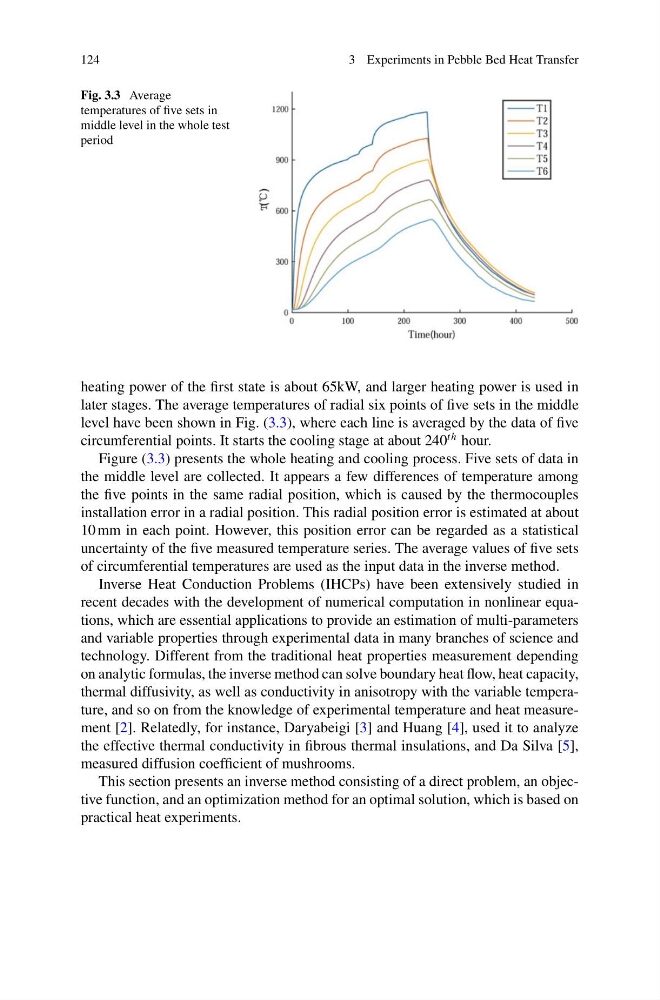
Fig. 3.3 Average
temperatures of five sets in
middle level in the whole test
period
heating power of the first state is about 65kW, and larger heating power is used in
later stages. The average temperatures of radial six points of five sets in the middle
level have been shown in Fig. (3.3), where each line is averaged by the data of five
circumferential points. It starts the cooling stage at about 240
th hour.
Figure (3.3) presents the whole heating and cooling process. Five sets of data in
the middle level are collected. It appears a few differences of temperature among
the five points in the same radial position, which is caused by the thermocouples
installation error in a radial position. This radial position error is estimated at about
10 mm in each point. However, this position error can be regarded as a statistical
uncertainty of the five measured temperature series. The average values of five sets
of circumferential temperatures are used as the input data in the inverse method.
Inverse Heat Conduction Problems (IHCPs) have been extensively studied in
recent decades with the development of numerical computation in nonlinear equations, which are essential applications to provide an estimation of multi-parameters
and variable properties through experimental data in many branches of science and
technology. Different from the traditional heat properties measurement depending
on analytic formulas, the inverse method can solve boundary heat flow, heat capacity,
thermal diffusivity, as well as conductivity in anisotropy with the variable temperature, and so on from the knowledge of experimental temperature and heat measurement [2]. Relatedly, for instance, Daryabeigi [3] and Huang [4], used it to analyze
the effective thermal conductivity in fibrous thermal insulations, and Da Silva [5],
measured diffusion coefficient of mushrooms.
This section presents an inverse method consisting of a direct problem, an objective function, and an optimization method for an optimal solution, which is based on
practical heat experiments.
3 Experiments in Pebble Bed Heat Transfer
Fig. 3.3 Average
temperatures of five sets in
middle level in the whole test
period
heating power of the first state is about 65kW, and larger heating power is used in
later stages. The average temperatures of radial six points of five sets in the middle
level have been shown in Fig. (3.3), where each line is averaged by the data of five
circumferential points. It starts the cooling stage at about 240
th hour.
Figure (3.3) presents the whole heating and cooling process. Five sets of data in
the middle level are collected. It appears a few differences of temperature among
the five points in the same radial position, which is caused by the thermocouples
installation error in a radial position. This radial position error is estimated at about
10 mm in each point. However, this position error can be regarded as a statistical
uncertainty of the five measured temperature series. The average values of five sets
of circumferential temperatures are used as the input data in the inverse method.
Inverse Heat Conduction Problems (IHCPs) have been extensively studied in
recent decades with the development of numerical computation in nonlinear equations, which are essential applications to provide an estimation of multi-parameters
and variable properties through experimental data in many branches of science and
technology. Different from the traditional heat properties measurement depending
on analytic formulas, the inverse method can solve boundary heat flow, heat capacity,
thermal diffusivity, as well as conductivity in anisotropy with the variable temperature, and so on from the knowledge of experimental temperature and heat measurement [2]. Relatedly, for instance, Daryabeigi [3] and Huang [4], used it to analyze
the effective thermal conductivity in fibrous thermal insulations, and Da Silva [5],
measured diffusion coefficient of mushrooms.
This section presents an inverse method consisting of a direct problem, an objective function, and an optimization method for an optimal solution, which is based on
practical heat experiments.