

A.3 Polarizability Approximation for Raman Tensor
77
U m
U e
=
χ m H 2
χ e E 2
χ m
χ e
1
This relation confirms that typical interaction energy with magnetic field is much
smaller than that with the electric field in ordinary nonmagnetic materials.
A.3 Polarizability Approximation for Raman Tensor
This subsection shows that the Raman tensor of Eq. (3.37) is approximated with
the polarizability in electronically off-resonant conditions [10, 11, 14]. The Raman
tensor defined in Eq. (3.37) includes the states g, n and m, which denote the
initial, intermediate and final states, respectively. These states are represented as
products of electronic and vibrational states on the basis of the Born-Oppenheimer
approximation,
|g =
g
e (r, R)
g
v (R)
,
|n =
n
e (r, R)
n
v (R)
,
|m =
m
e (r, R)
m
v (R)
=
g
e
m
v
,
(3.59)
where the superscript e designates the electronic states and v the vibrational states. r
and R denote the coordinates for electrons and nuclei, respectively. In the ordinary
Raman process illustrated in Fig. 3.4, both the initial state g and the final state m
are supposed to be the electronically ground state g e , while their vibrational states
are different. Here we assume that the ground electronic state g e is unique and
not degenerated. The total energy is also represented as the sum of electronic and
vibrational energies,
E g = E
e
g + E
v
g ,
E n = E
e
n + E
v
n ,
E m = E
e
m + E
v
m = E
e
g + E
v
m .
(3.60)
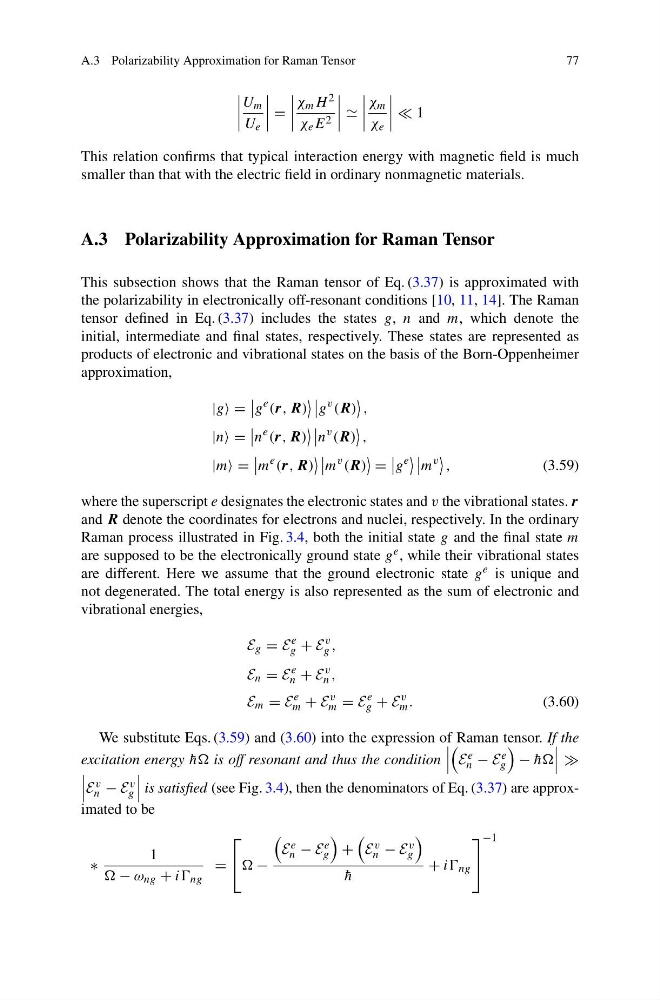
We substitute Eqs. (3.59) and (3.60) into the expression of Raman tensor. If the
excitation energy ¯
hh is off resonant and thus the condition
E e
n − E e
g
− ¯
hh
E
v
n − E v
g
is satisfied (see Fig. 3.4), then the denominators of Eq. (3.37) are approximated to be
∗
1
− ω ng + ii ng
=
⎡
⎣ −
E e
n − E e
g
+
E v
n − E v
g
¯
h
+ ii ng
⎤
⎦
−1
77
U m
U e
=
χ m H 2
χ e E 2
χ m
χ e
1
This relation confirms that typical interaction energy with magnetic field is much
smaller than that with the electric field in ordinary nonmagnetic materials.
A.3 Polarizability Approximation for Raman Tensor
This subsection shows that the Raman tensor of Eq. (3.37) is approximated with
the polarizability in electronically off-resonant conditions [10, 11, 14]. The Raman
tensor defined in Eq. (3.37) includes the states g, n and m, which denote the
initial, intermediate and final states, respectively. These states are represented as
products of electronic and vibrational states on the basis of the Born-Oppenheimer
approximation,
|g =
g
e (r, R)
g
v (R)
,
|n =
n
e (r, R)
n
v (R)
,
|m =
m
e (r, R)
m
v (R)
=
g
e
m
v
,
(3.59)
where the superscript e designates the electronic states and v the vibrational states. r
and R denote the coordinates for electrons and nuclei, respectively. In the ordinary
Raman process illustrated in Fig. 3.4, both the initial state g and the final state m
are supposed to be the electronically ground state g e , while their vibrational states
are different. Here we assume that the ground electronic state g e is unique and
not degenerated. The total energy is also represented as the sum of electronic and
vibrational energies,
E g = E
e
g + E
v
g ,
E n = E
e
n + E
v
n ,
E m = E
e
m + E
v
m = E
e
g + E
v
m .
(3.60)
We substitute Eqs. (3.59) and (3.60) into the expression of Raman tensor. If the
excitation energy ¯
hh is off resonant and thus the condition
E e
n − E e
g
− ¯
hh
E
v
n − E v
g
is satisfied (see Fig. 3.4), then the denominators of Eq. (3.37) are approximated to be
∗
1
− ω ng + ii ng
=
⎡
⎣ −
E e
n − E e
g
+
E v
n − E v
g
¯
h
+ ii ng
⎤
⎦
−1