

64
3 Microscopic Expressions of Nonlinear Polarization
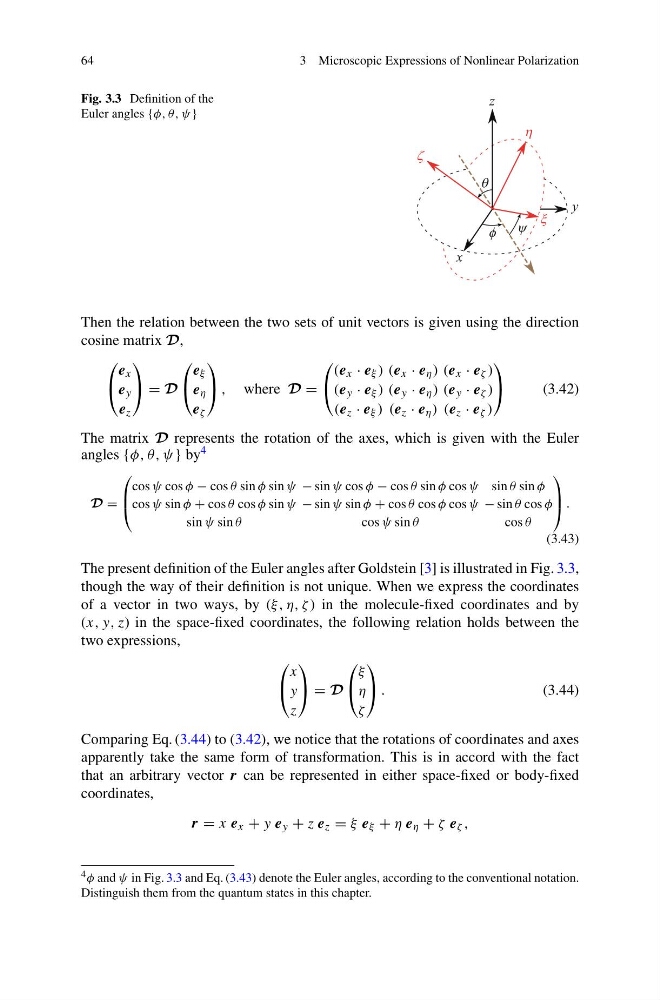
Fig. 3.3 Definition of the
Euler angles {φ, θ, ψ}
x
y
z
Then the relation between the two sets of unit vectors is given using the direction
cosine matrix D,
⎛
⎝
e x
e y
e z
⎞
⎠ = D
⎛
⎝
e ξ
e η
e ζ
⎞
⎠ , where D =
⎛
⎝
(e x · e ξ ) (e x · e η ) (e x · e ζ )
(e y · e ξ ) (e y · e η ) (e y · e ζ )
(e z · e ξ ) (e z · e η ) (e z · e ζ )
⎞
⎠
(3.42)
The matrix D represents the rotation of the axes, which is given with the Euler
angles {φ, θ, ψ} by 4
D =
⎛
⎜
⎝
cos ψ cos φ − cos θ sin φ sin ψ − sin ψ cos φ − cos θ sin φ cos ψ sin θ sin φ
cos ψ sin φ + cos θ cos φ sin ψ − sin ψ sin φ + cos θ cos φ cos ψ − sin θ cos φ
sin ψ sin θ
cos ψ sin θ
cos θ
⎞
⎟
⎠ .
(3.43)
The present definition of the Euler angles after Goldstein [3] is illustrated in Fig. 3.3,
though the way of their definition is not unique. When we express the coordinates
of a vector in two ways, by (ξ, η, ζ ) in the molecule-fixed coordinates and by
(x, y, z) in the space-fixed coordinates, the following relation holds between the
two expressions,
⎛
⎝
x
y
z
⎞
⎠ = D
⎛
⎝
ξ
η
ζ
⎞
⎠ .
(3.44)
Comparing Eq. (3.44) to (3.42), we notice that the rotations of coordinates and axes
apparently take the same form of transformation. This is in accord with the fact
that an arbitrary vector r can be represented in either space-fixed or body-fixed
coordinates,
r = x e x + y e y + z e z = ξ e ξ + η e η + ζ e ζ ,
4 φ and ψ in Fig. 3.3 and Eq. (3.43) denote the Euler angles, according to the conventional notation.
Distinguish them from the quantum states in this chapter.
3 Microscopic Expressions of Nonlinear Polarization
Fig. 3.3 Definition of the
Euler angles {φ, θ, ψ}
x
y
z
Then the relation between the two sets of unit vectors is given using the direction
cosine matrix D,
⎛
⎝
e x
e y
e z
⎞
⎠ = D
⎛
⎝
e ξ
e η
e ζ
⎞
⎠ , where D =
⎛
⎝
(e x · e ξ ) (e x · e η ) (e x · e ζ )
(e y · e ξ ) (e y · e η ) (e y · e ζ )
(e z · e ξ ) (e z · e η ) (e z · e ζ )
⎞
⎠
(3.42)
The matrix D represents the rotation of the axes, which is given with the Euler
angles {φ, θ, ψ} by 4
D =
⎛
⎜
⎝
cos ψ cos φ − cos θ sin φ sin ψ − sin ψ cos φ − cos θ sin φ cos ψ sin θ sin φ
cos ψ sin φ + cos θ cos φ sin ψ − sin ψ sin φ + cos θ cos φ cos ψ − sin θ cos φ
sin ψ sin θ
cos ψ sin θ
cos θ
⎞
⎟
⎠ .
(3.43)
The present definition of the Euler angles after Goldstein [3] is illustrated in Fig. 3.3,
though the way of their definition is not unique. When we express the coordinates
of a vector in two ways, by (ξ, η, ζ ) in the molecule-fixed coordinates and by
(x, y, z) in the space-fixed coordinates, the following relation holds between the
two expressions,
⎛
⎝
x
y
z
⎞
⎠ = D
⎛
⎝
ξ
η
ζ
⎞
⎠ .
(3.44)
Comparing Eq. (3.44) to (3.42), we notice that the rotations of coordinates and axes
apparently take the same form of transformation. This is in accord with the fact
that an arbitrary vector r can be represented in either space-fixed or body-fixed
coordinates,
r = x e x + y e y + z e z = ξ e ξ + η e η + ζ e ζ ,
4 φ and ψ in Fig. 3.3 and Eq. (3.43) denote the Euler angles, according to the conventional notation.
Distinguish them from the quantum states in this chapter.