

A.3 Fresnel Factors for Three-Layer Model
43
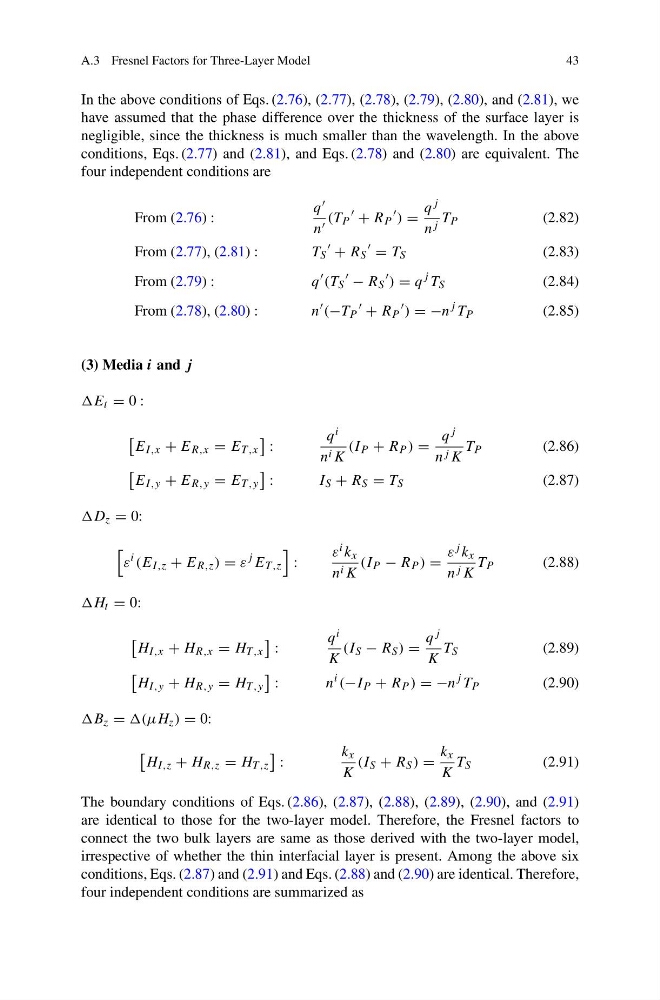
In the above conditions of Eqs. (2.76), (2.77), (2.78), (2.79), (2.80), and (2.81), we
have assumed that the phase difference over the thickness of the surface layer is
negligible, since the thickness is much smaller than the wavelength. In the above
conditions, Eqs. (2.77) and (2.81), and Eqs. (2.78) and (2.80) are equivalent. The
four independent conditions are
From (2.76) :
q
n (T P
+ R P
) =
q j
n j T P
(2.82)
From (2.77), (2.81) :
T S
+ R S
= T S
(2.83)
From (2.79) :
q
(T S
− R S
) = q
j T S
(2.84)
From (2.78), (2.80) :
n
(−T P
+ R P
) = −n
j T P
(2.85)
(3) Media i and j
E t = 0 :
E I,x + E R,x = E T ,x
:
q i
n i K
(I P + R P ) =
q j
n j K
T P
(2.86)
E I,y + E R,y = E T ,y
:
I S + R S = T S
(2.87)
D z = 0:
ε
i (E I,z + E R,z ) = ε
j E T ,z
:
ε i k x
n i K
(I P − R P ) =
ε j k x
n j K
T P
(2.88)
H t = 0:
H I,x + H R,x = H T ,x
:
q i
K
(I S − R S ) =
q j
K
T S
(2.89)
H I,y + H R,y = H T ,y
:
n
i (−I P + R P ) = −n
j T P
(2.90)
B z = (μH z ) = 0:
H I,z + H R,z = H T ,z
:
k x
K
(I S + R S ) =
k x
K
T S
(2.91)
The boundary conditions of Eqs. (2.86), (2.87), (2.88), (2.89), (2.90), and (2.91)
are identical to those for the two-layer model. Therefore, the Fresnel factors to
connect the two bulk layers are same as those derived with the two-layer model,
irrespective of whether the thin interfacial layer is present. Among the above six
conditions, Eqs. (2.87) and (2.91) and Eqs. (2.88) and (2.90) are identical. Therefore,
four independent conditions are summarized as
43
In the above conditions of Eqs. (2.76), (2.77), (2.78), (2.79), (2.80), and (2.81), we
have assumed that the phase difference over the thickness of the surface layer is
negligible, since the thickness is much smaller than the wavelength. In the above
conditions, Eqs. (2.77) and (2.81), and Eqs. (2.78) and (2.80) are equivalent. The
four independent conditions are
From (2.76) :
q
n (T P
+ R P
) =
q j
n j T P
(2.82)
From (2.77), (2.81) :
T S
+ R S
= T S
(2.83)
From (2.79) :
q
(T S
− R S
) = q
j T S
(2.84)
From (2.78), (2.80) :
n
(−T P
+ R P
) = −n
j T P
(2.85)
(3) Media i and j
E t = 0 :
E I,x + E R,x = E T ,x
:
q i
n i K
(I P + R P ) =
q j
n j K
T P
(2.86)
E I,y + E R,y = E T ,y
:
I S + R S = T S
(2.87)
D z = 0:
ε
i (E I,z + E R,z ) = ε
j E T ,z
:
ε i k x
n i K
(I P − R P ) =
ε j k x
n j K
T P
(2.88)
H t = 0:
H I,x + H R,x = H T ,x
:
q i
K
(I S − R S ) =
q j
K
T S
(2.89)
H I,y + H R,y = H T ,y
:
n
i (−I P + R P ) = −n
j T P
(2.90)
B z = (μH z ) = 0:
H I,z + H R,z = H T ,z
:
k x
K
(I S + R S ) =
k x
K
T S
(2.91)
The boundary conditions of Eqs. (2.86), (2.87), (2.88), (2.89), (2.90), and (2.91)
are identical to those for the two-layer model. Therefore, the Fresnel factors to
connect the two bulk layers are same as those derived with the two-layer model,
irrespective of whether the thin interfacial layer is present. Among the above six
conditions, Eqs. (2.87) and (2.91) and Eqs. (2.88) and (2.90) are identical. Therefore,
four independent conditions are summarized as