

A.3 Fresnel Factors for Three-Layer Model
41
T :
k T =
⎛
⎝
k x
0
−q j
⎞
⎠ , E T =
⎛
⎜
⎜
⎜
⎝
q j
n j K
T P
T S
k x
n j K
T P
⎞
⎟
⎟
⎟
⎠
,
H T =
1
K
⎛
⎝
q j T S
−n j KT P
k x T S
⎞
⎠ ,
(2.64)
where
⎧
⎨
⎩
k x
2 + (q i ) 2 = (n i K) 2 = ε i K 2
k x
2 + (q ) 2 = (n K) 2 = ε K 2
k x
2 + (q j ) 2 = (n j K) 2 = ε j K 2
(2.65)
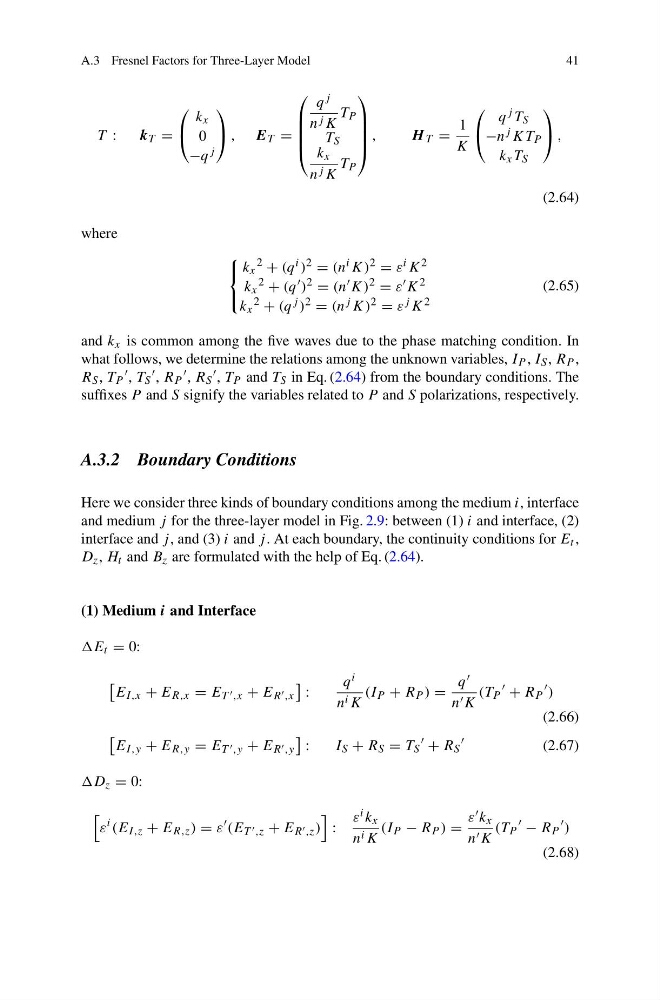
and k x is common among the five waves due to the phase matching condition. In
what follows, we determine the relations among the unknown variables, I P , I S , R P ,
R S , T P
, T S
, R P
, R S
, T P and T S in Eq. (2.64) from the boundary conditions. The
suffixes P and S signify the variables related to P and S polarizations, respectively.
A.3.2 Boundary Conditions
Here we consider three kinds of boundary conditions among the medium i, interface
and medium j for the three-layer model in Fig. 2.9: between (1) i and interface, (2)
interface and j , and (3) i and j . At each boundary, the continuity conditions for E t ,
D z , H t and B z are formulated with the help of Eq. (2.64).
(1) Medium i and Interface
E t = 0:
E I,x + E R,x = E T ,x + E R ,x
:
q i
n i K
(I P + R P ) =
q
n K
(T P
+ R P
)
(2.66)
E I,y + E R,y = E T ,y + E R ,y
:
I S + R S = T S
+ R S
(2.67)
D z = 0:
ε
i (E I,z + E R,z ) = ε
(E T ,z + E R ,z )
:
ε i k x
n i K
(I P − R P ) =
ε k x
n K
(T P
− R P
)
(2.68)
41
T :
k T =
⎛
⎝
k x
0
−q j
⎞
⎠ , E T =
⎛
⎜
⎜
⎜
⎝
q j
n j K
T P
T S
k x
n j K
T P
⎞
⎟
⎟
⎟
⎠
,
H T =
1
K
⎛
⎝
q j T S
−n j KT P
k x T S
⎞
⎠ ,
(2.64)
where
⎧
⎨
⎩
k x
2 + (q i ) 2 = (n i K) 2 = ε i K 2
k x
2 + (q ) 2 = (n K) 2 = ε K 2
k x
2 + (q j ) 2 = (n j K) 2 = ε j K 2
(2.65)
and k x is common among the five waves due to the phase matching condition. In
what follows, we determine the relations among the unknown variables, I P , I S , R P ,
R S , T P
, T S
, R P
, R S
, T P and T S in Eq. (2.64) from the boundary conditions. The
suffixes P and S signify the variables related to P and S polarizations, respectively.
A.3.2 Boundary Conditions
Here we consider three kinds of boundary conditions among the medium i, interface
and medium j for the three-layer model in Fig. 2.9: between (1) i and interface, (2)
interface and j , and (3) i and j . At each boundary, the continuity conditions for E t ,
D z , H t and B z are formulated with the help of Eq. (2.64).
(1) Medium i and Interface
E t = 0:
E I,x + E R,x = E T ,x + E R ,x
:
q i
n i K
(I P + R P ) =
q
n K
(T P
+ R P
)
(2.66)
E I,y + E R,y = E T ,y + E R ,y
:
I S + R S = T S
+ R S
(2.67)
D z = 0:
ε
i (E I,z + E R,z ) = ε
(E T ,z + E R ,z )
:
ε i k x
n i K
(I P − R P ) =
ε k x
n K
(T P
− R P
)
(2.68)