

10.1 C–H Bands of Alkyl Groups
249
C
H
H
H
H 2 C
CH 2
C
H
H
H
H 2 C
CH 2
C
H
H
H
H 2 C
CH 2
C
H
H
C
H
H
Methyl (CH -)
3
Methylene (-CH -)
2
r +
r IP
r OP
d +
d
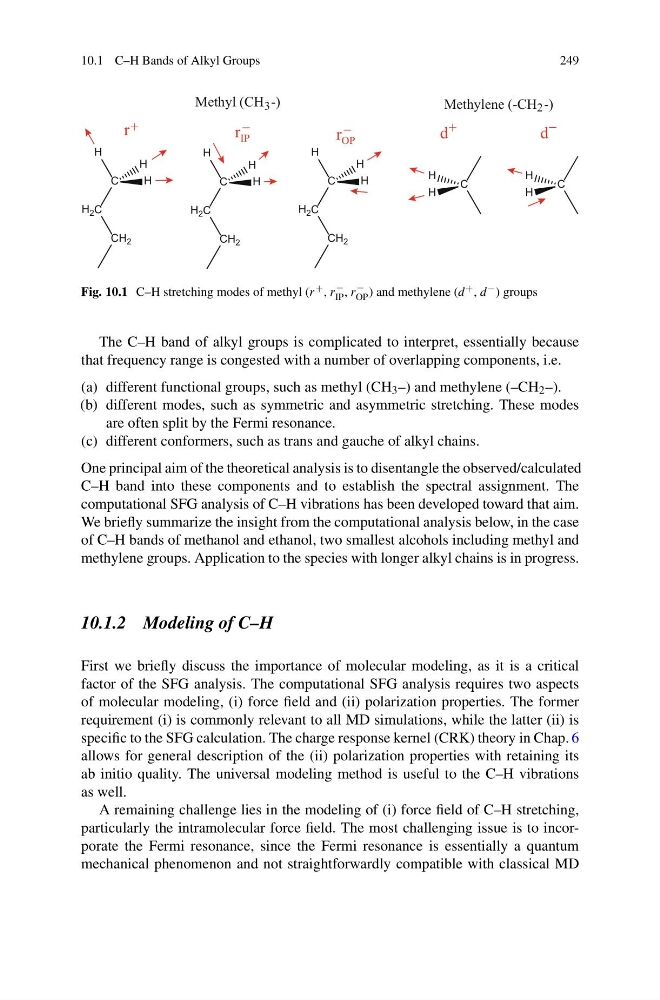
Fig. 10.1 C–H stretching modes of methyl (r + , r
−
IP , r
−
OP ) and methylene (d + , d − ) groups
The C–H band of alkyl groups is complicated to interpret, essentially because
that frequency range is congested with a number of overlapping components, i.e.
(a) different functional groups, such as methyl (CH 3 –) and methylene (–CH 2 –).
(b) different modes, such as symmetric and asymmetric stretching. These modes
are often split by the Fermi resonance.
(c) different conformers, such as trans and gauche of alkyl chains.
One principal aim of the theoretical analysis is to disentangle the observed/calculated
C–H band into these components and to establish the spectral assignment. The
computational SFG analysis of C–H vibrations has been developed toward that aim.
We briefly summarize the insight from the computational analysis below, in the case
of C–H bands of methanol and ethanol, two smallest alcohols including methyl and
methylene groups. Application to the species with longer alkyl chains is in progress.
10.1.2 Modeling of C–H
First we briefly discuss the importance of molecular modeling, as it is a critical
factor of the SFG analysis. The computational SFG analysis requires two aspects
of molecular modeling, (i) force field and (ii) polarization properties. The former
requirement (i) is commonly relevant to all MD simulations, while the latter (ii) is
specific to the SFG calculation. The charge response kernel (CRK) theory in Chap. 6
allows for general description of the (ii) polarization properties with retaining its
ab initio quality. The universal modeling method is useful to the C–H vibrations
as well.
A remaining challenge lies in the modeling of (i) force field of C–H stretching,
particularly the intramolecular force field. The most challenging issue is to incorporate the Fermi resonance, since the Fermi resonance is essentially a quantum
mechanical phenomenon and not straightforwardly compatible with classical MD
249
C
H
H
H
H 2 C
CH 2
C
H
H
H
H 2 C
CH 2
C
H
H
H
H 2 C
CH 2
C
H
H
C
H
H
Methyl (CH -)
3
Methylene (-CH -)
2
r +
r IP
r OP
d +
d
Fig. 10.1 C–H stretching modes of methyl (r + , r
−
IP , r
−
OP ) and methylene (d + , d − ) groups
The C–H band of alkyl groups is complicated to interpret, essentially because
that frequency range is congested with a number of overlapping components, i.e.
(a) different functional groups, such as methyl (CH 3 –) and methylene (–CH 2 –).
(b) different modes, such as symmetric and asymmetric stretching. These modes
are often split by the Fermi resonance.
(c) different conformers, such as trans and gauche of alkyl chains.
One principal aim of the theoretical analysis is to disentangle the observed/calculated
C–H band into these components and to establish the spectral assignment. The
computational SFG analysis of C–H vibrations has been developed toward that aim.
We briefly summarize the insight from the computational analysis below, in the case
of C–H bands of methanol and ethanol, two smallest alcohols including methyl and
methylene groups. Application to the species with longer alkyl chains is in progress.
10.1.2 Modeling of C–H
First we briefly discuss the importance of molecular modeling, as it is a critical
factor of the SFG analysis. The computational SFG analysis requires two aspects
of molecular modeling, (i) force field and (ii) polarization properties. The former
requirement (i) is commonly relevant to all MD simulations, while the latter (ii) is
specific to the SFG calculation. The charge response kernel (CRK) theory in Chap. 6
allows for general description of the (ii) polarization properties with retaining its
ab initio quality. The universal modeling method is useful to the C–H vibrations
as well.
A remaining challenge lies in the modeling of (i) force field of C–H stretching,
particularly the intramolecular force field. The most challenging issue is to incorporate the Fermi resonance, since the Fermi resonance is essentially a quantum
mechanical phenomenon and not straightforwardly compatible with classical MD