

8.2 Chiral Elements of χ (2)
213
These tensor elements are related to the following polarization combinations of sum
frequency, visible and infrared fields, as discussed in Sect. 3.3.3.
• χ
(2) of interface origin (achiral)—SSP, SPS, PSS, PPP
• χ
(2) of chiral origin—SPP, PSP, PPS
(8.23)
The above polarization combinations are mutually exclusive, which allows for
distinguishing the SFG signals of chiral origin and of interface origin by choosing
proper polarization combinations. The selection rules in Eq. (8.23) are valid for
whether the chiral χ (2) elements actually originate from the isotropic bulk (8.20) or
from the interface (8.22). The SFG spectroscopy is capable of detecting the chiral
signal in background-free condition. This feature of SFG as a chiral probe is in
contrast to other chiral probe techniques based on difference spectra by different
circular polarizations, such as circular dichroism and Raman optical activity.
8.2.2 Intensity
The χ (2) elements of chiral origin are also represented in the perturbation and time
dependent formulas in Chap. 3 in the same manner with those of interface origin.
Therefore, the computational methods of chiral SFG signals are common with those
of interface SFG described in the preceding chapters. However, there are some
differences to describe the χ (2) elements for chiral SFG.
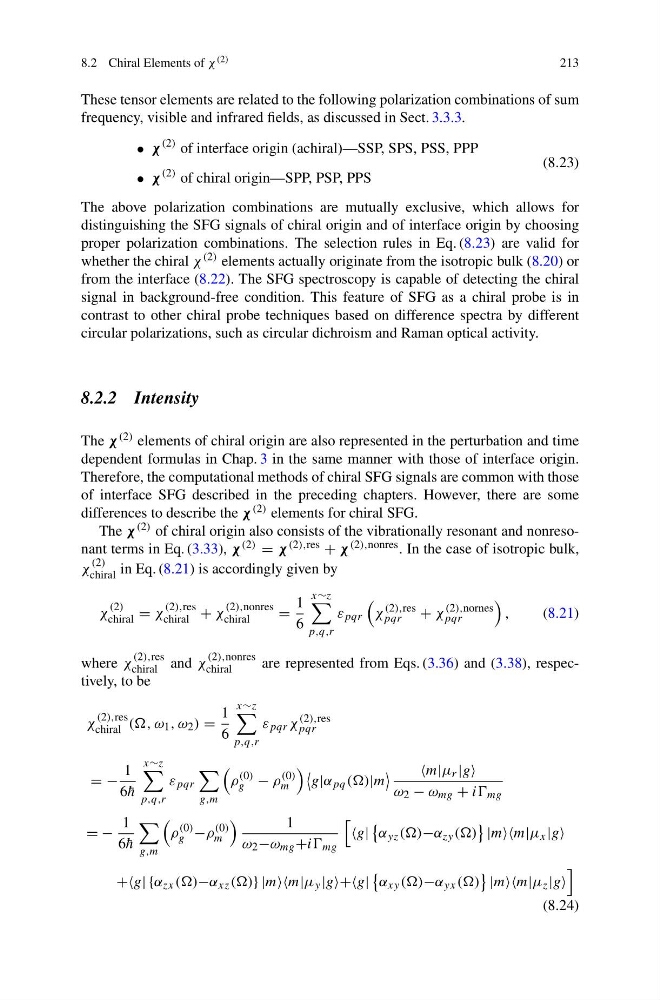
The χ (2) of chiral origin also consists of the vibrationally resonant and nonresonant terms in Eq. (3.33), χ (2) = χ (2),res + χ (2),nonres . In the case of isotropic bulk,
χ
(2)
chiral in Eq. (8.21) is accordingly given by
χ
(2)
chiral = χ
(2),res
chiral + χ
(2),nonres
chiral
=
1
6
x∼z
p,q,r
ε pqr
χ
(2),res
pqr
+ χ
(2),nornes
pqr
,
(8.21)
where χ
(2),res
chiral and χ
(2),nonres
chiral
are represented from Eqs. (3.36) and (3.38), respectively, to be
χ
(2),res
chiral ((, ω 1 , ω 2 ) =
1
6
x∼z
p,q,r
ε pqr χ
(2),res
pqr
= −
1
6 ¯
h
x∼z
p,q,r
ε pqr
g,m
ρ
(0)
g − ρ
(0)
m
g|α pq (()|m
m|μ r |g
ω 2 − ω mg + ii mg
= −
1
6 ¯
h
g,m
ρ
(0)
g −ρ
(0)
m
1
ω 2 −ω mg +ii mg
g|
α yz (()−α zy (()
|mm|μ x |g
++g| {α zx (()−α xz (()} |mm|μ y |g++g|
α xy (()−α yx (()
|mm|μ z |g
(8.24)
213
These tensor elements are related to the following polarization combinations of sum
frequency, visible and infrared fields, as discussed in Sect. 3.3.3.
• χ
(2) of interface origin (achiral)—SSP, SPS, PSS, PPP
• χ
(2) of chiral origin—SPP, PSP, PPS
(8.23)
The above polarization combinations are mutually exclusive, which allows for
distinguishing the SFG signals of chiral origin and of interface origin by choosing
proper polarization combinations. The selection rules in Eq. (8.23) are valid for
whether the chiral χ (2) elements actually originate from the isotropic bulk (8.20) or
from the interface (8.22). The SFG spectroscopy is capable of detecting the chiral
signal in background-free condition. This feature of SFG as a chiral probe is in
contrast to other chiral probe techniques based on difference spectra by different
circular polarizations, such as circular dichroism and Raman optical activity.
8.2.2 Intensity
The χ (2) elements of chiral origin are also represented in the perturbation and time
dependent formulas in Chap. 3 in the same manner with those of interface origin.
Therefore, the computational methods of chiral SFG signals are common with those
of interface SFG described in the preceding chapters. However, there are some
differences to describe the χ (2) elements for chiral SFG.
The χ (2) of chiral origin also consists of the vibrationally resonant and nonresonant terms in Eq. (3.33), χ (2) = χ (2),res + χ (2),nonres . In the case of isotropic bulk,
χ
(2)
chiral in Eq. (8.21) is accordingly given by
χ
(2)
chiral = χ
(2),res
chiral + χ
(2),nonres
chiral
=
1
6
x∼z
p,q,r
ε pqr
χ
(2),res
pqr
+ χ
(2),nornes
pqr
,
(8.21)
where χ
(2),res
chiral and χ
(2),nonres
chiral
are represented from Eqs. (3.36) and (3.38), respectively, to be
χ
(2),res
chiral ((, ω 1 , ω 2 ) =
1
6
x∼z
p,q,r
ε pqr χ
(2),res
pqr
= −
1
6 ¯
h
x∼z
p,q,r
ε pqr
g,m
ρ
(0)
g − ρ
(0)
m
g|α pq (()|m
m|μ r |g
ω 2 − ω mg + ii mg
= −
1
6 ¯
h
g,m
ρ
(0)
g −ρ
(0)
m
1
ω 2 −ω mg +ii mg
g|
α yz (()−α zy (()
|mm|μ x |g
++g| {α zx (()−α xz (()} |mm|μ y |g++g|
α xy (()−α yx (()
|mm|μ z |g
(8.24)