

7.6 Solutions to Problems
187
Characters of Nonlinear Susceptibility Terms
ID
IQ
IQB
B
(1) Origin
Dipole vs. Quadrupole
Dipole
Quadrupole
(2) Properties
Surface vs. Bulk
Surface
Bulk
(3) Separate measurement
by experiment
Inseparable
Separable
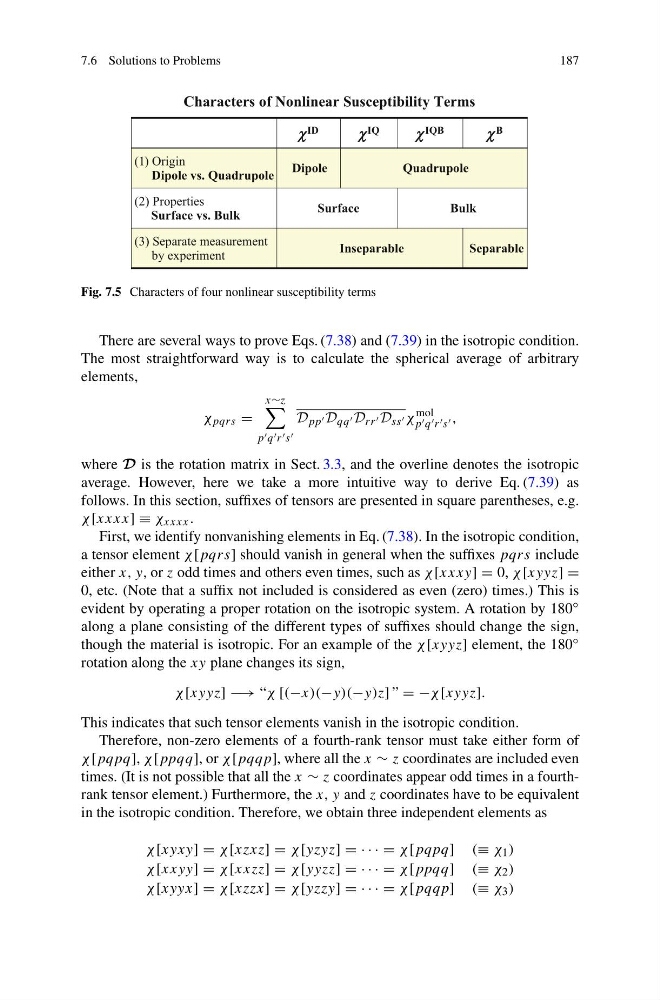
Fig. 7.5 Characters of four nonlinear susceptibility terms
There are several ways to prove Eqs. (7.38) and (7.39) in the isotropic condition.
The most straightforward way is to calculate the spherical average of arbitrary
elements,
χ pqrs =
x∼z
p q r s
D pp D qq D rr D ss χ
mol
p q r s ,
where D is the rotation matrix in Sect. 3.3, and the overline denotes the isotropic
average. However, here we take a more intuitive way to derive Eq. (7.39) as
follows. In this section, suffixes of tensors are presented in square parentheses, e.g.
χ [xxxx] ≡ χ xxxx .
First, we identify nonvanishing elements in Eq. (7.38). In the isotropic condition,
a tensor element χ [pqrs] should vanish in general when the suffixes pqrs include
either x, y, or z odd times and others even times, such as χ [xxxy] = 0, χ [xyyz] =
0, etc. (Note that a suffix not included is considered as even (zero) times.) This is
evident by operating a proper rotation on the isotropic system. A rotation by 180 ◦
along a plane consisting of the different types of suffixes should change the sign,
though the material is isotropic. For an example of the χ [xyyz] element, the 180 ◦
rotation along the xy plane changes its sign,
χ [xyyz] −→ “χ [(−x)(−y)(−y)z] ” = −χ [xyyz].
This indicates that such tensor elements vanish in the isotropic condition.
Therefore, non-zero elements of a fourth-rank tensor must take either form of
χ [pqpq], χ [ppqq], or χ [pqqp], where all the x ∼ z coordinates are included even
times. (It is not possible that all the x ∼ z coordinates appear odd times in a fourthrank tensor element.) Furthermore, the x, y and z coordinates have to be equivalent
in the isotropic condition. Therefore, we obtain three independent elements as
χ [xyxy] = χ [xzxz] = χ [yzyz] = · · · = χ [pqpq] (≡ χ 1 )
χ [xxyy] = χ [xxzz] = χ [yyzz] = · · · = χ [ppqq] (≡ χ 2 )
χ [xyyx] = χ [xzzx] = χ [yzzy] = · · · = χ [pqqp] (≡ χ 3 )
187
Characters of Nonlinear Susceptibility Terms
ID
IQ
IQB
B
(1) Origin
Dipole vs. Quadrupole
Dipole
Quadrupole
(2) Properties
Surface vs. Bulk
Surface
Bulk
(3) Separate measurement
by experiment
Inseparable
Separable
Fig. 7.5 Characters of four nonlinear susceptibility terms
There are several ways to prove Eqs. (7.38) and (7.39) in the isotropic condition.
The most straightforward way is to calculate the spherical average of arbitrary
elements,
χ pqrs =
x∼z
p q r s
D pp D qq D rr D ss χ
mol
p q r s ,
where D is the rotation matrix in Sect. 3.3, and the overline denotes the isotropic
average. However, here we take a more intuitive way to derive Eq. (7.39) as
follows. In this section, suffixes of tensors are presented in square parentheses, e.g.
χ [xxxx] ≡ χ xxxx .
First, we identify nonvanishing elements in Eq. (7.38). In the isotropic condition,
a tensor element χ [pqrs] should vanish in general when the suffixes pqrs include
either x, y, or z odd times and others even times, such as χ [xxxy] = 0, χ [xyyz] =
0, etc. (Note that a suffix not included is considered as even (zero) times.) This is
evident by operating a proper rotation on the isotropic system. A rotation by 180 ◦
along a plane consisting of the different types of suffixes should change the sign,
though the material is isotropic. For an example of the χ [xyyz] element, the 180 ◦
rotation along the xy plane changes its sign,
χ [xyyz] −→ “χ [(−x)(−y)(−y)z] ” = −χ [xyyz].
This indicates that such tensor elements vanish in the isotropic condition.
Therefore, non-zero elements of a fourth-rank tensor must take either form of
χ [pqpq], χ [ppqq], or χ [pqqp], where all the x ∼ z coordinates are included even
times. (It is not possible that all the x ∼ z coordinates appear odd times in a fourthrank tensor element.) Furthermore, the x, y and z coordinates have to be equivalent
in the isotropic condition. Therefore, we obtain three independent elements as
χ [xyxy] = χ [xzxz] = χ [yzyz] = · · · = χ [pqpq] (≡ χ 1 )
χ [xxyy] = χ [xxzz] = χ [yyzz] = · · · = χ [ppqq] (≡ χ 2 )
χ [xyyx] = χ [xzzx] = χ [yzzy] = · · · = χ [pqqp] (≡ χ 3 )