

178
7 Quadrupole Contributions from Interface and Bulk
g|q sp (()|nn|μ r |mm|μ q |g
(ω 1 − ω mg )(( − ω ng )
−
g|μ r |nn|q sp (()|mm|μ q |g
(ω 1 − ω mg )(( − ω mn )
+
g|q sp (()|nn|μ q |mm|μ r |g
(ω 2 − ω mg )(( − ω ng )
−
g|μ q |nn|q sp (()|mm|μ r |g
(ω 2 − ω mg )(( − ω mn )
,
(7.87)
The above alternative expressions are based on the sum over eigenstates for the
whole system, and will be utilized in Sect. 7.4.
7.3.2 Time-Dependent Expressions
Equations (7.79), (7.80), (7.81) for α D1 , α D2 and α Q can be converted to the equivalent formulas based on the time correlation functions. The following derivation is
analogous to that in Sect. 4.3, where χ (2) (or α D0 ) is given with the time correlation
function of the polarizability α and the dipole moment μ.
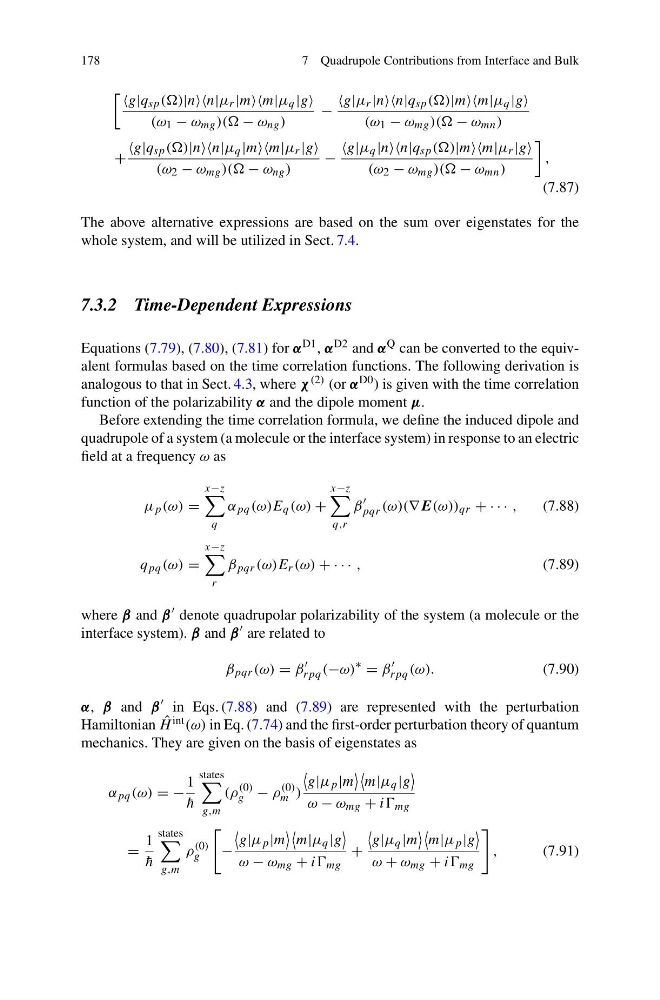
Before extending the time correlation formula, we define the induced dipole and
quadrupole of a system (a molecule or the interface system) in response to an electric
field at a frequency ω as
μ p (ω) =
x−z
q
α pq (ω)E q (ω) +
x−z
q,r
β
pqr (ω)(∇E(ω)) qr + · · · ,
(7.88)
q pq (ω) =
x−z
r
β pqr (ω)E r (ω) + · · · ,
(7.89)
where β and β
denote quadrupolar polarizability of the system (a molecule or the
interface system). β and β
are related to
β pqr (ω) = β
rpq (−ω)
∗
= β
rpq (ω).
(7.90)
α, β and β
in Eqs. (7.88) and (7.89) are represented with the perturbation
Hamiltonian ˆ
H int (ω) in Eq. (7.74) and the first-order perturbation theory of quantum
mechanics. They are given on the basis of eigenstates as
α pq (ω) = −
1
¯
h
states
g,m
(ρ
(0)
g − ρ
(0)
m )
g|μ p |m
m|μ q |g
ω − ω mg + ii mg
=
1
¯
h
states
g,m
ρ
(0)
g
−
g|μ p |m
m|μ q |g
ω − ω mg + ii mg
+
g|μ q |m
m|μ p |g
ω + ω mg + ii mg
,
(7.91)
7 Quadrupole Contributions from Interface and Bulk
g|q sp (()|nn|μ r |mm|μ q |g
(ω 1 − ω mg )(( − ω ng )
−
g|μ r |nn|q sp (()|mm|μ q |g
(ω 1 − ω mg )(( − ω mn )
+
g|q sp (()|nn|μ q |mm|μ r |g
(ω 2 − ω mg )(( − ω ng )
−
g|μ q |nn|q sp (()|mm|μ r |g
(ω 2 − ω mg )(( − ω mn )
,
(7.87)
The above alternative expressions are based on the sum over eigenstates for the
whole system, and will be utilized in Sect. 7.4.
7.3.2 Time-Dependent Expressions
Equations (7.79), (7.80), (7.81) for α D1 , α D2 and α Q can be converted to the equivalent formulas based on the time correlation functions. The following derivation is
analogous to that in Sect. 4.3, where χ (2) (or α D0 ) is given with the time correlation
function of the polarizability α and the dipole moment μ.
Before extending the time correlation formula, we define the induced dipole and
quadrupole of a system (a molecule or the interface system) in response to an electric
field at a frequency ω as
μ p (ω) =
x−z
q
α pq (ω)E q (ω) +
x−z
q,r
β
pqr (ω)(∇E(ω)) qr + · · · ,
(7.88)
q pq (ω) =
x−z
r
β pqr (ω)E r (ω) + · · · ,
(7.89)
where β and β
denote quadrupolar polarizability of the system (a molecule or the
interface system). β and β
are related to
β pqr (ω) = β
rpq (−ω)
∗
= β
rpq (ω).
(7.90)
α, β and β
in Eqs. (7.88) and (7.89) are represented with the perturbation
Hamiltonian ˆ
H int (ω) in Eq. (7.74) and the first-order perturbation theory of quantum
mechanics. They are given on the basis of eigenstates as
α pq (ω) = −
1
¯
h
states
g,m
(ρ
(0)
g − ρ
(0)
m )
g|μ p |m
m|μ q |g
ω − ω mg + ii mg
=
1
¯
h
states
g,m
ρ
(0)
g
−
g|μ p |m
m|μ q |g
ω − ω mg + ii mg
+
g|μ q |m
m|μ p |g
ω + ω mg + ii mg
,
(7.91)