

7.2 Extended Nonlinear Susceptibility
167
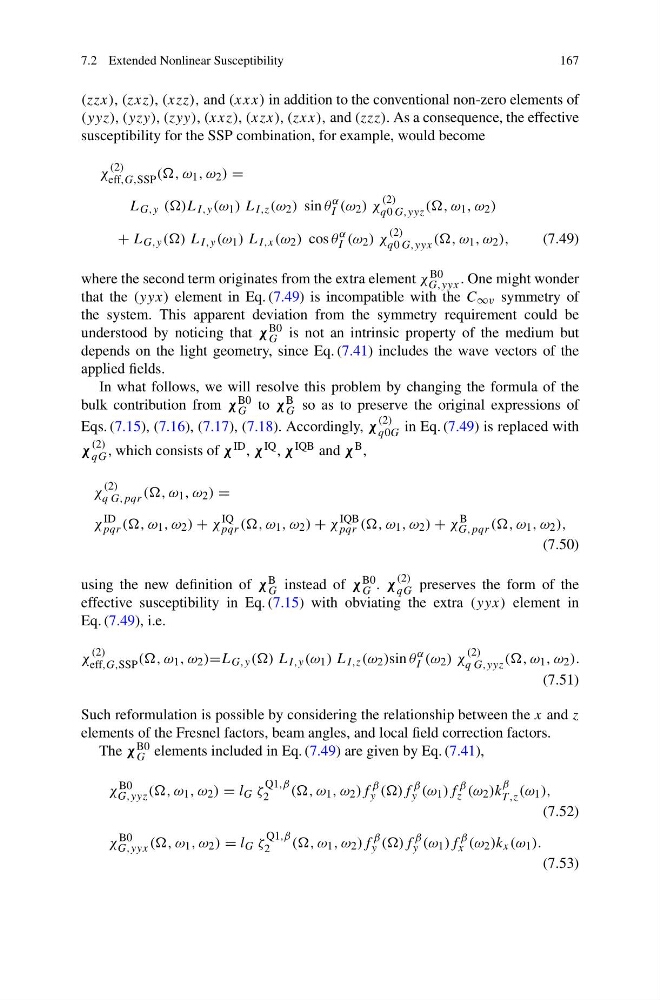
(zzx), (zxz), (xzz), and (xxx) in addition to the conventional non-zero elements of
(yyz), (yzy), (zyy), (xxz), (xzx), (zxx), and (zzz). As a consequence, the effective
susceptibility for the SSP combination, for example, would become
χ
(2)
eff,G,SSP ((, ω 1 , ω 2 ) =
L G,y (()L I,y (ω 1 ) L I,z (ω 2 ) sin θ
α
I (ω 2 ) χ
(2)
q0 G,yyz ((, ω 1 , ω 2 )
+ L G,y (() L I,y (ω 1 ) L I,x (ω 2 ) cos θ
α
I (ω 2 ) χ
(2)
q0 G,yyx ((, ω 1 , ω 2 ),
(7.49)
where the second term originates from the extra element χ B0
G,yyx . One might wonder
that the (yyx) element in Eq. (7.49) is incompatible with the C ∞v symmetry of
the system. This apparent deviation from the symmetry requirement could be
understood by noticing that χ B0
G is not an intrinsic property of the medium but
depends on the light geometry, since Eq. (7.41) includes the wave vectors of the
applied fields.
In what follows, we will resolve this problem by changing the formula of the
bulk contribution from χ B0
G to χ B
G so as to preserve the original expressions of
Eqs. (7.15), (7.16), (7.17), (7.18). Accordingly, χ
(2)
q0G in Eq. (7.49) is replaced with
χ
(2)
qG , which consists of χ ID , χ IQ , χ IQB and χ B ,
χ
(2)
q G,pqr ((, ω 1 , ω 2 ) =
χ
ID
pqr ((, ω 1 , ω 2 ) + χ
IQ
pqr ((, ω 1 , ω 2 ) + χ
IQB
pqr ((, ω 1 , ω 2 ) + χ
B
G,pqr ((, ω 1 , ω 2 ),
(7.50)
using the new definition of χ B
G instead of χ B0
G . χ
(2)
qG preserves the form of the
effective susceptibility in Eq. (7.15) with obviating the extra (yyx) element in
Eq. (7.49), i.e.
χ
(2)
eff,G,SSP ((, ω 1 , ω 2 )=L G,y (() L I,y (ω 1 ) L I,z (ω 2 )sin θ
α
I (ω 2 ) χ
(2)
q G,yyz ((, ω 1 , ω 2 ).
(7.51)
Such reformulation is possible by considering the relationship between the x and z
elements of the Fresnel factors, beam angles, and local field correction factors.
The χ B0
G elements included in Eq. (7.49) are given by Eq. (7.41),
χ
B0
G,yyz ((, ω 1 , ω 2 ) = l G ζ
Q1,β
2
((, ω 1 , ω 2 )f
β
y (()f
β
y (ω 1 )f
β
z (ω 2 )k
β
T ,z (ω 1 ),
(7.52)
χ
B0
G,yyx ((, ω 1 , ω 2 ) = l G ζ
Q1,β
2
((, ω 1 , ω 2 )f
β
y (()f
β
y (ω 1 )f
β
x (ω 2 )k x (ω 1 ).
(7.53)
167
(zzx), (zxz), (xzz), and (xxx) in addition to the conventional non-zero elements of
(yyz), (yzy), (zyy), (xxz), (xzx), (zxx), and (zzz). As a consequence, the effective
susceptibility for the SSP combination, for example, would become
χ
(2)
eff,G,SSP ((, ω 1 , ω 2 ) =
L G,y (()L I,y (ω 1 ) L I,z (ω 2 ) sin θ
α
I (ω 2 ) χ
(2)
q0 G,yyz ((, ω 1 , ω 2 )
+ L G,y (() L I,y (ω 1 ) L I,x (ω 2 ) cos θ
α
I (ω 2 ) χ
(2)
q0 G,yyx ((, ω 1 , ω 2 ),
(7.49)
where the second term originates from the extra element χ B0
G,yyx . One might wonder
that the (yyx) element in Eq. (7.49) is incompatible with the C ∞v symmetry of
the system. This apparent deviation from the symmetry requirement could be
understood by noticing that χ B0
G is not an intrinsic property of the medium but
depends on the light geometry, since Eq. (7.41) includes the wave vectors of the
applied fields.
In what follows, we will resolve this problem by changing the formula of the
bulk contribution from χ B0
G to χ B
G so as to preserve the original expressions of
Eqs. (7.15), (7.16), (7.17), (7.18). Accordingly, χ
(2)
q0G in Eq. (7.49) is replaced with
χ
(2)
qG , which consists of χ ID , χ IQ , χ IQB and χ B ,
χ
(2)
q G,pqr ((, ω 1 , ω 2 ) =
χ
ID
pqr ((, ω 1 , ω 2 ) + χ
IQ
pqr ((, ω 1 , ω 2 ) + χ
IQB
pqr ((, ω 1 , ω 2 ) + χ
B
G,pqr ((, ω 1 , ω 2 ),
(7.50)
using the new definition of χ B
G instead of χ B0
G . χ
(2)
qG preserves the form of the
effective susceptibility in Eq. (7.15) with obviating the extra (yyx) element in
Eq. (7.49), i.e.
χ
(2)
eff,G,SSP ((, ω 1 , ω 2 )=L G,y (() L I,y (ω 1 ) L I,z (ω 2 )sin θ
α
I (ω 2 ) χ
(2)
q G,yyz ((, ω 1 , ω 2 ).
(7.51)
Such reformulation is possible by considering the relationship between the x and z
elements of the Fresnel factors, beam angles, and local field correction factors.
The χ B0
G elements included in Eq. (7.49) are given by Eq. (7.41),
χ
B0
G,yyz ((, ω 1 , ω 2 ) = l G ζ
Q1,β
2
((, ω 1 , ω 2 )f
β
y (()f
β
y (ω 1 )f
β
z (ω 2 )k
β
T ,z (ω 1 ),
(7.52)
χ
B0
G,yyx ((, ω 1 , ω 2 ) = l G ζ
Q1,β
2
((, ω 1 , ω 2 )f
β
y (()f
β
y (ω 1 )f
β
x (ω 2 )k x (ω 1 ).
(7.53)