

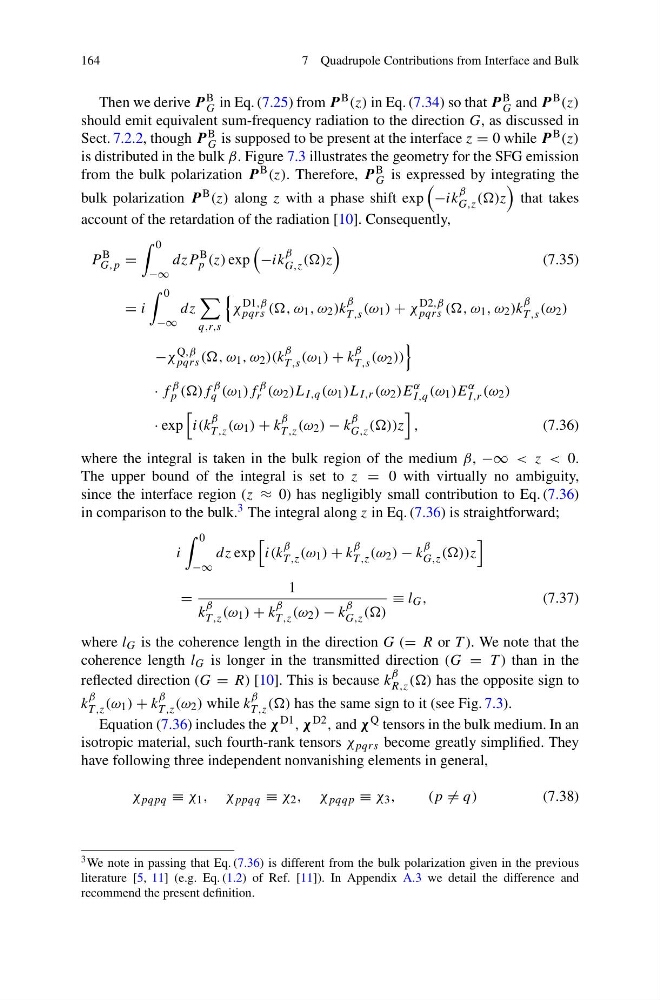
164
7 Quadrupole Contributions from Interface and Bulk
Then we derive P B
G in Eq. (7.25) from P B (z) in Eq. (7.34) so that P B
G and P B (z)
should emit equivalent sum-frequency radiation to the direction G, as discussed in
Sect. 7.2.2, though P B
G is supposed to be present at the interface z = 0 while P B (z)
is distributed in the bulk β. Figure 7.3 illustrates the geometry for the SFG emission
from the bulk polarization P B (z). Therefore, P B
G is expressed by integrating the
bulk polarization P B (z) along z with a phase shift exp
−ik
β
G,z (()z
that takes
account of the retardation of the radiation [10]. Consequently,
P
B
G,p =
0
−∞
dzP
B
p (z) exp
−ik
β
G,z (()z
(7.35)
= i
0
−∞
dz
q,r,s
χ
D1,β
pqrs ((, ω 1 , ω 2 )k
β
T ,s (ω 1 ) + χ
D2,β
pqrs ((, ω 1 , ω 2 )k
β
T ,s (ω 2 )
−χ
Q,β
pqrs ((, ω 1 , ω 2 )(k
β
T ,s (ω 1 ) + k
β
T ,s (ω 2 ))
· f
β
p (()f
β
q (ω 1 )f
β
r (ω 2 )L I,q (ω 1 )L I,r (ω 2 )E
α
I,q (ω 1 )E
α
I,r (ω 2 )
· exp
i(k
β
T ,z (ω 1 ) + k
β
T ,z (ω 2 ) − k
β
G,z (())z
,
(7.36)
where the integral is taken in the bulk region of the medium β, −∞ < z < 0.
The upper bound of the integral is set to z = 0 with virtually no ambiguity,
since the interface region (z ≈ 0) has negligibly small contribution to Eq. (7.36)
in comparison to the bulk. 3 The integral along z in Eq. (7.36) is straightforward;
i
0
−∞
dz exp
i(k
β
T ,z (ω 1 ) + k
β
T ,z (ω 2 ) − k
β
G,z (())z
=
1
k
β
T ,z (ω 1 ) + k
β
T ,z (ω 2 ) − k
β
G,z (()
≡ l G ,
(7.37)
where l G is the coherence length in the direction G (= R or T ). We note that the
coherence length l G is longer in the transmitted direction (G = T ) than in the
reflected direction (G = R) [10]. This is because k
β
R,z (() has the opposite sign to
k
β
T ,z (ω 1 ) + k
β
T ,z (ω 2 ) while k
β
T ,z (() has the same sign to it (see Fig. 7.3).
Equation (7.36) includes the χ D1 , χ D2 , and χ Q tensors in the bulk medium. In an
isotropic material, such fourth-rank tensors χ pqrs become greatly simplified. They
have following three independent nonvanishing elements in general,
χ pqpq ≡ χ 1 , χ ppqq ≡ χ 2 , χ pqqp ≡ χ 3 ,
(p = q)
(7.38)
3 We note in passing that Eq. (7.36) is different from the bulk polarization given in the previous
literature [5, 11] (e.g. Eq. (1.2) of Ref. [11]). In Appendix A.3 we detail the difference and
recommend the present definition.
7 Quadrupole Contributions from Interface and Bulk
Then we derive P B
G in Eq. (7.25) from P B (z) in Eq. (7.34) so that P B
G and P B (z)
should emit equivalent sum-frequency radiation to the direction G, as discussed in
Sect. 7.2.2, though P B
G is supposed to be present at the interface z = 0 while P B (z)
is distributed in the bulk β. Figure 7.3 illustrates the geometry for the SFG emission
from the bulk polarization P B (z). Therefore, P B
G is expressed by integrating the
bulk polarization P B (z) along z with a phase shift exp
−ik
β
G,z (()z
that takes
account of the retardation of the radiation [10]. Consequently,
P
B
G,p =
0
−∞
dzP
B
p (z) exp
−ik
β
G,z (()z
(7.35)
= i
0
−∞
dz
q,r,s
χ
D1,β
pqrs ((, ω 1 , ω 2 )k
β
T ,s (ω 1 ) + χ
D2,β
pqrs ((, ω 1 , ω 2 )k
β
T ,s (ω 2 )
−χ
Q,β
pqrs ((, ω 1 , ω 2 )(k
β
T ,s (ω 1 ) + k
β
T ,s (ω 2 ))
· f
β
p (()f
β
q (ω 1 )f
β
r (ω 2 )L I,q (ω 1 )L I,r (ω 2 )E
α
I,q (ω 1 )E
α
I,r (ω 2 )
· exp
i(k
β
T ,z (ω 1 ) + k
β
T ,z (ω 2 ) − k
β
G,z (())z
,
(7.36)
where the integral is taken in the bulk region of the medium β, −∞ < z < 0.
The upper bound of the integral is set to z = 0 with virtually no ambiguity,
since the interface region (z ≈ 0) has negligibly small contribution to Eq. (7.36)
in comparison to the bulk. 3 The integral along z in Eq. (7.36) is straightforward;
i
0
−∞
dz exp
i(k
β
T ,z (ω 1 ) + k
β
T ,z (ω 2 ) − k
β
G,z (())z
=
1
k
β
T ,z (ω 1 ) + k
β
T ,z (ω 2 ) − k
β
G,z (()
≡ l G ,
(7.37)
where l G is the coherence length in the direction G (= R or T ). We note that the
coherence length l G is longer in the transmitted direction (G = T ) than in the
reflected direction (G = R) [10]. This is because k
β
R,z (() has the opposite sign to
k
β
T ,z (ω 1 ) + k
β
T ,z (ω 2 ) while k
β
T ,z (() has the same sign to it (see Fig. 7.3).
Equation (7.36) includes the χ D1 , χ D2 , and χ Q tensors in the bulk medium. In an
isotropic material, such fourth-rank tensors χ pqrs become greatly simplified. They
have following three independent nonvanishing elements in general,
χ pqpq ≡ χ 1 , χ ppqq ≡ χ 2 , χ pqqp ≡ χ 3 ,
(p = q)
(7.38)
3 We note in passing that Eq. (7.36) is different from the bulk polarization given in the previous
literature [5, 11] (e.g. Eq. (1.2) of Ref. [11]). In Appendix A.3 we detail the difference and
recommend the present definition.