

Bibliography
149
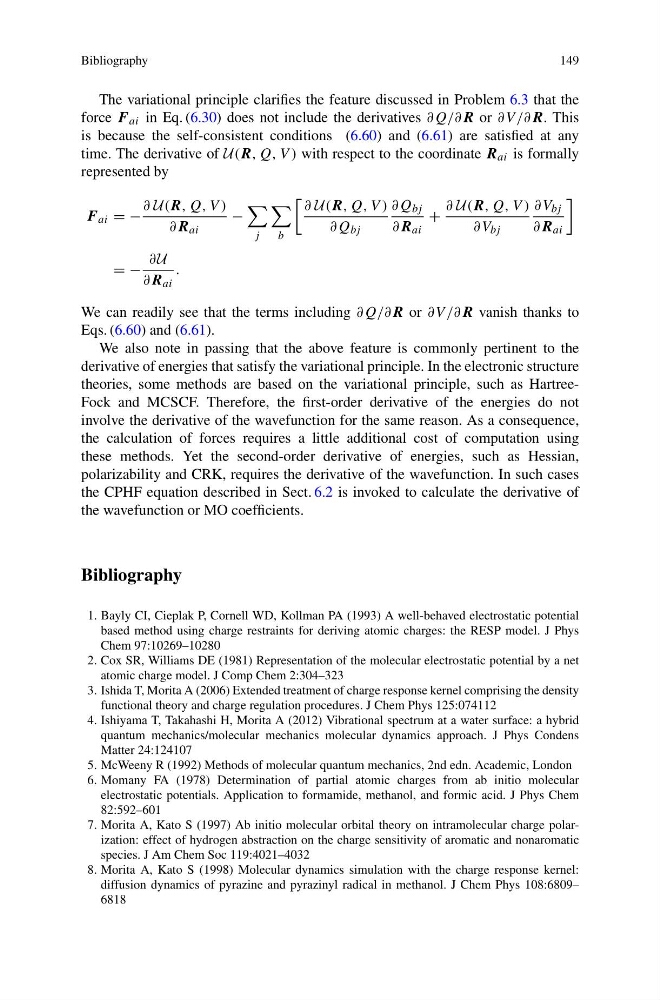
The variational principle clarifies the feature discussed in Problem 6.3 that the
force F ai in Eq. (6.30) does not include the derivatives ∂Q/∂R or ∂V /∂R. This
is because the self-consistent conditions (6.60) and (6.61) are satisfied at any
time. The derivative of U (R, Q, V ) with respect to the coordinate R ai is formally
represented by
F ai = −
∂ U (R, Q, V )
∂R ai
−
j
b
∂ U (R, Q, V )
∂Q bj
∂Q bj
∂R ai
+
∂ U (R, Q, V )
∂V bj
∂V bj
∂R ai
= −
∂U
∂R ai
.
We can readily see that the terms including ∂Q/∂R or ∂V /∂R vanish thanks to
Eqs. (6.60) and (6.61).
We also note in passing that the above feature is commonly pertinent to the
derivative of energies that satisfy the variational principle. In the electronic structure
theories, some methods are based on the variational principle, such as HartreeFock and MCSCF. Therefore, the first-order derivative of the energies do not
involve the derivative of the wavefunction for the same reason. As a consequence,
the calculation of forces requires a little additional cost of computation using
these methods. Yet the second-order derivative of energies, such as Hessian,
polarizability and CRK, requires the derivative of the wavefunction. In such cases
the CPHF equation described in Sect. 6.2 is invoked to calculate the derivative of
the wavefunction or MO coefficients.
Bibliography
1. Bayly CI, Cieplak P, Cornell WD, Kollman PA (1993) A well-behaved electrostatic potential
based method using charge restraints for deriving atomic charges: the RESP model. J Phys
Chem 97:10269–10280
2. Cox SR, Williams DE (1981) Representation of the molecular electrostatic potential by a net
atomic charge model. J Comp Chem 2:304–323
3. Ishida T, Morita A (2006) Extended treatment of charge response kernel comprising the density
functional theory and charge regulation procedures. J Chem Phys 125:074112
4. Ishiyama T, Takahashi H, Morita A (2012) Vibrational spectrum at a water surface: a hybrid
quantum mechanics/molecular mechanics molecular dynamics approach. J Phys Condens
Matter 24:124107
5. McWeeny R (1992) Methods of molecular quantum mechanics, 2nd edn. Academic, London
6. Momany FA (1978) Determination of partial atomic charges from ab initio molecular
electrostatic potentials. Application to formamide, methanol, and formic acid. J Phys Chem
82:592–601
7. Morita A, Kato S (1997) Ab initio molecular orbital theory on intramolecular charge polarization: effect of hydrogen abstraction on the charge sensitivity of aromatic and nonaromatic
species. J Am Chem Soc 119:4021–4032
8. Morita A, Kato S (1998) Molecular dynamics simulation with the charge response kernel:
diffusion dynamics of pyrazine and pyrazinyl radical in methanol. J Chem Phys 108:6809–
6818
149
The variational principle clarifies the feature discussed in Problem 6.3 that the
force F ai in Eq. (6.30) does not include the derivatives ∂Q/∂R or ∂V /∂R. This
is because the self-consistent conditions (6.60) and (6.61) are satisfied at any
time. The derivative of U (R, Q, V ) with respect to the coordinate R ai is formally
represented by
F ai = −
∂ U (R, Q, V )
∂R ai
−
j
b
∂ U (R, Q, V )
∂Q bj
∂Q bj
∂R ai
+
∂ U (R, Q, V )
∂V bj
∂V bj
∂R ai
= −
∂U
∂R ai
.
We can readily see that the terms including ∂Q/∂R or ∂V /∂R vanish thanks to
Eqs. (6.60) and (6.61).
We also note in passing that the above feature is commonly pertinent to the
derivative of energies that satisfy the variational principle. In the electronic structure
theories, some methods are based on the variational principle, such as HartreeFock and MCSCF. Therefore, the first-order derivative of the energies do not
involve the derivative of the wavefunction for the same reason. As a consequence,
the calculation of forces requires a little additional cost of computation using
these methods. Yet the second-order derivative of energies, such as Hessian,
polarizability and CRK, requires the derivative of the wavefunction. In such cases
the CPHF equation described in Sect. 6.2 is invoked to calculate the derivative of
the wavefunction or MO coefficients.
Bibliography
1. Bayly CI, Cieplak P, Cornell WD, Kollman PA (1993) A well-behaved electrostatic potential
based method using charge restraints for deriving atomic charges: the RESP model. J Phys
Chem 97:10269–10280
2. Cox SR, Williams DE (1981) Representation of the molecular electrostatic potential by a net
atomic charge model. J Comp Chem 2:304–323
3. Ishida T, Morita A (2006) Extended treatment of charge response kernel comprising the density
functional theory and charge regulation procedures. J Chem Phys 125:074112
4. Ishiyama T, Takahashi H, Morita A (2012) Vibrational spectrum at a water surface: a hybrid
quantum mechanics/molecular mechanics molecular dynamics approach. J Phys Condens
Matter 24:124107
5. McWeeny R (1992) Methods of molecular quantum mechanics, 2nd edn. Academic, London
6. Momany FA (1978) Determination of partial atomic charges from ab initio molecular
electrostatic potentials. Application to formamide, methanol, and formic acid. J Phys Chem
82:592–601
7. Morita A, Kato S (1997) Ab initio molecular orbital theory on intramolecular charge polarization: effect of hydrogen abstraction on the charge sensitivity of aromatic and nonaromatic
species. J Am Chem Soc 119:4021–4032
8. Morita A, Kato S (1998) Molecular dynamics simulation with the charge response kernel:
diffusion dynamics of pyrazine and pyrazinyl radical in methanol. J Chem Phys 108:6809–
6818