

140
6 Charge Response Kernel for Electronic Polarization
=
j ( =i)
b
Q ai Q bj (R(ai) − R(bj ))
|R(ai) − R(bj )| 3
−
j
k( =j)
b
c
1
|R(bj ) − R(ck)|
∂Q bj
∂R(ai)
Q ck
+
j
b,c
K bc V bj
∂V cj
∂R(ai)
=
j ( =i)
b
Q ai Q bj (R(ai) − R(bj ))
|R(ai) − R(bj )| 3
−
j
b
⎧
⎨
⎩
k( =j)
c
Q ck
|R(bj ) − R(ck)|
⎫
⎬
⎭
∂Q bj
∂R(ai)
+
j
b
c
K bc
∂V cj
∂R(ai)
V bj
(6.47)
=
j ( =i)
b
Q ai Q bj (R(ai) − R(bj ))
|R(ai) − R(bj )| 3
−
j
b
V bj
∂Q bj
∂R(ai)
+
j
b
∂Q bj
∂R(ai)
V bj
(6.48)
=
j ( =i)
b
Q ai Q bj (R(ai) − R(bj ))
|R(ai) − R(bj )| 3
.
(6.30)
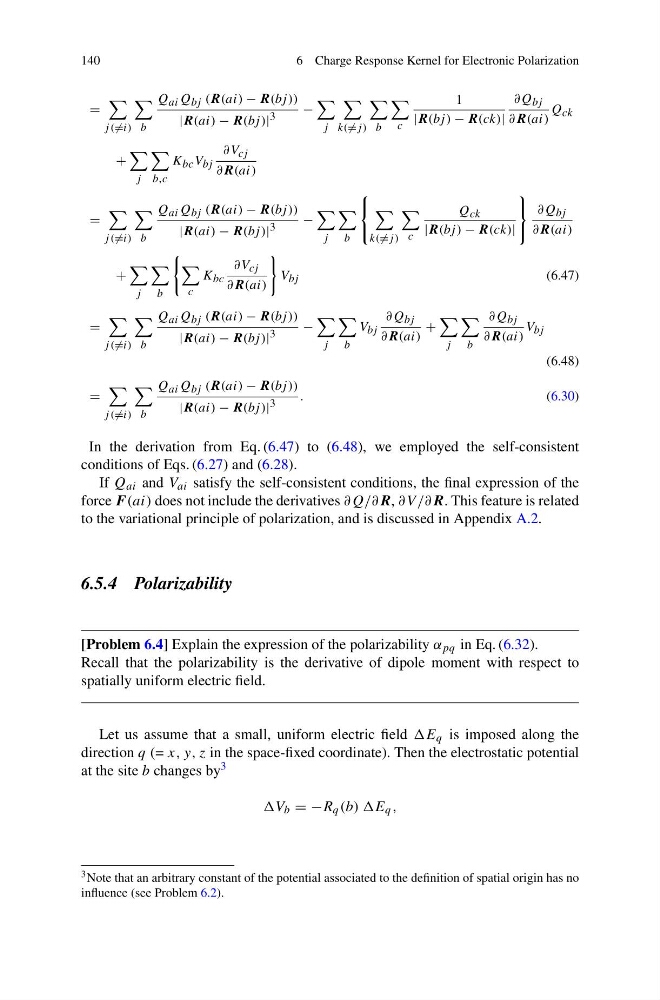
In the derivation from Eq. (6.47) to (6.48), we employed the self-consistent
conditions of Eqs. (6.27) and (6.28).
If Q ai and V ai satisfy the self-consistent conditions, the final expression of the
force F (ai) does not include the derivatives ∂Q/∂R, ∂V /∂R. This feature is related
to the variational principle of polarization, and is discussed in Appendix A.2.
6.5.4 Polarizability
[Problem 6.4] Explain the expression of the polarizability α pq in Eq. (6.32).
Recall that the polarizability is the derivative of dipole moment with respect to
spatially uniform electric field.
Let us assume that a small, uniform electric field E q is imposed along the
direction q (= x, y, z in the space-fixed coordinate). Then the electrostatic potential
at the site b changes by 3
V b = −R q (b) )E q ,
3 Note that an arbitrary constant of the potential associated to the definition of spatial origin has no
influence (see Problem 6.2).
6 Charge Response Kernel for Electronic Polarization
=
j ( =i)
b
Q ai Q bj (R(ai) − R(bj ))
|R(ai) − R(bj )| 3
−
j
k( =j)
b
c
1
|R(bj ) − R(ck)|
∂Q bj
∂R(ai)
Q ck
+
j
b,c
K bc V bj
∂V cj
∂R(ai)
=
j ( =i)
b
Q ai Q bj (R(ai) − R(bj ))
|R(ai) − R(bj )| 3
−
j
b
⎧
⎨
⎩
k( =j)
c
Q ck
|R(bj ) − R(ck)|
⎫
⎬
⎭
∂Q bj
∂R(ai)
+
j
b
c
K bc
∂V cj
∂R(ai)
V bj
(6.47)
=
j ( =i)
b
Q ai Q bj (R(ai) − R(bj ))
|R(ai) − R(bj )| 3
−
j
b
V bj
∂Q bj
∂R(ai)
+
j
b
∂Q bj
∂R(ai)
V bj
(6.48)
=
j ( =i)
b
Q ai Q bj (R(ai) − R(bj ))
|R(ai) − R(bj )| 3
.
(6.30)
In the derivation from Eq. (6.47) to (6.48), we employed the self-consistent
conditions of Eqs. (6.27) and (6.28).
If Q ai and V ai satisfy the self-consistent conditions, the final expression of the
force F (ai) does not include the derivatives ∂Q/∂R, ∂V /∂R. This feature is related
to the variational principle of polarization, and is discussed in Appendix A.2.
6.5.4 Polarizability
[Problem 6.4] Explain the expression of the polarizability α pq in Eq. (6.32).
Recall that the polarizability is the derivative of dipole moment with respect to
spatially uniform electric field.
Let us assume that a small, uniform electric field E q is imposed along the
direction q (= x, y, z in the space-fixed coordinate). Then the electrostatic potential
at the site b changes by 3
V b = −R q (b) )E q ,
3 Note that an arbitrary constant of the potential associated to the definition of spatial origin has no
influence (see Problem 6.2).