

Bibliography
121
=
ε + 2
3ε
E
ext
z = f z E
ext
z ,
(5.37)
where P z =
ε − 1
4π
(E
ext
z − 4πP z ) =
ε − 1
4πε
E
ext
z . We note that the induced charge at
the surface of the slab is involved in case (b). By comparing Eqs. (5.36) and (5.37),
the dielectric constant ε corresponds to the ratio of the two local fields, ε = f x /f z .
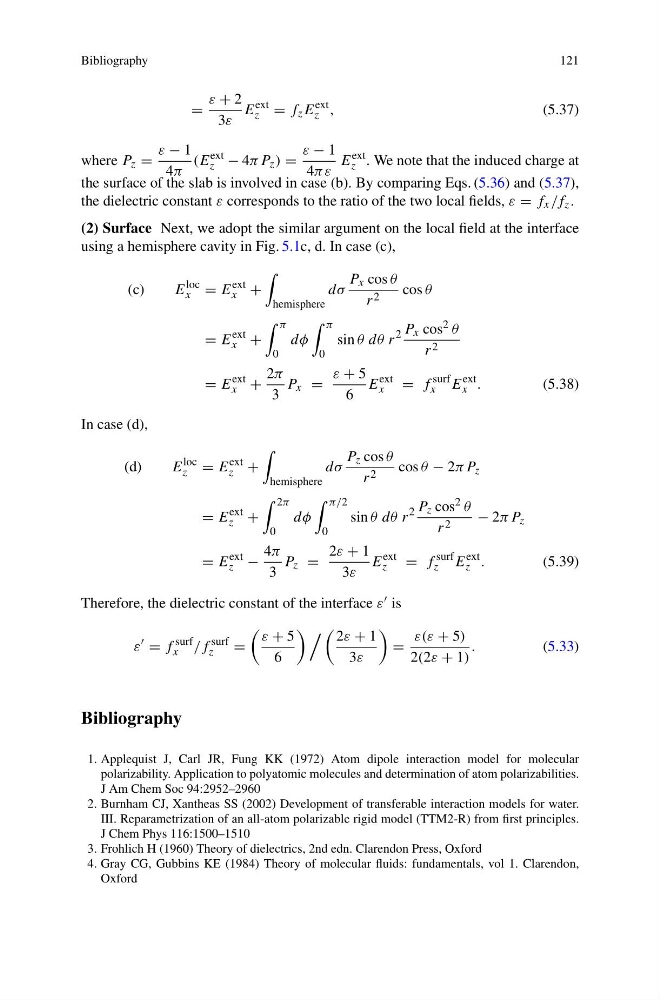
(2) Surface Next, we adopt the similar argument on the local field at the interface
using a hemisphere cavity in Fig. 5.1c, d. In case (c),
(c)
E
loc
x = E
ext
x +
hemisphere
dσ
P x cos θ
r 2
cos θ
= E
ext
x +
π
0
dφ
π
0
sin θ dθ r
2 P x cos 2 θ
r 2
= E
ext
x +
2π
3
P x =
ε + 5
6
E
ext
x
= f
surf
x E
ext
x .
(5.38)
In case (d),
(d)
E
loc
z = E
ext
z +
hemisphere
dσ
P z cos θ
r 2
cos θ − 2πP z
= E
ext
z +
2π
0
dφ
π/2
0
sin θ dθ r
2 P z cos 2 θ
r 2
− 2πP z
= E
ext
z −
4π
3
P z =
2ε + 1
3ε
E
ext
z
= f
surf
z E
ext
z .
(5.39)
Therefore, the dielectric constant of the interface ε is
ε
= f
surf
x /f
surf
z
=
ε + 5
6
2ε + 1
3ε
=
ε(ε + 5)
2(2ε + 1)
.
(5.33)
Bibliography
1. Applequist J, Carl JR, Fung KK (1972) Atom dipole interaction model for molecular
polarizability. Application to polyatomic molecules and determination of atom polarizabilities.
J Am Chem Soc 94:2952–2960
2. Burnham CJ, Xantheas SS (2002) Development of transferable interaction models for water.
III. Reparametrization of an all-atom polarizable rigid model (TTM2-R) from first principles.
J Chem Phys 116:1500–1510
3. Frohlich H (1960) Theory of dielectrics, 2nd edn. Clarendon Press, Oxford
4. Gray CG, Gubbins KE (1984) Theory of molecular fluids: fundamentals, vol 1. Clarendon,
Oxford
121
=
ε + 2
3ε
E
ext
z = f z E
ext
z ,
(5.37)
where P z =
ε − 1
4π
(E
ext
z − 4πP z ) =
ε − 1
4πε
E
ext
z . We note that the induced charge at
the surface of the slab is involved in case (b). By comparing Eqs. (5.36) and (5.37),
the dielectric constant ε corresponds to the ratio of the two local fields, ε = f x /f z .
(2) Surface Next, we adopt the similar argument on the local field at the interface
using a hemisphere cavity in Fig. 5.1c, d. In case (c),
(c)
E
loc
x = E
ext
x +
hemisphere
dσ
P x cos θ
r 2
cos θ
= E
ext
x +
π
0
dφ
π
0
sin θ dθ r
2 P x cos 2 θ
r 2
= E
ext
x +
2π
3
P x =
ε + 5
6
E
ext
x
= f
surf
x E
ext
x .
(5.38)
In case (d),
(d)
E
loc
z = E
ext
z +
hemisphere
dσ
P z cos θ
r 2
cos θ − 2πP z
= E
ext
z +
2π
0
dφ
π/2
0
sin θ dθ r
2 P z cos 2 θ
r 2
− 2πP z
= E
ext
z −
4π
3
P z =
2ε + 1
3ε
E
ext
z
= f
surf
z E
ext
z .
(5.39)
Therefore, the dielectric constant of the interface ε is
ε
= f
surf
x /f
surf
z
=
ε + 5
6
2ε + 1
3ε
=
ε(ε + 5)
2(2ε + 1)
.
(5.33)
Bibliography
1. Applequist J, Carl JR, Fung KK (1972) Atom dipole interaction model for molecular
polarizability. Application to polyatomic molecules and determination of atom polarizabilities.
J Am Chem Soc 94:2952–2960
2. Burnham CJ, Xantheas SS (2002) Development of transferable interaction models for water.
III. Reparametrization of an all-atom polarizable rigid model (TTM2-R) from first principles.
J Chem Phys 116:1500–1510
3. Frohlich H (1960) Theory of dielectrics, 2nd edn. Clarendon Press, Oxford
4. Gray CG, Gubbins KE (1984) Theory of molecular fluids: fundamentals, vol 1. Clarendon,
Oxford