

4.3 Time-Dependent Representation
93
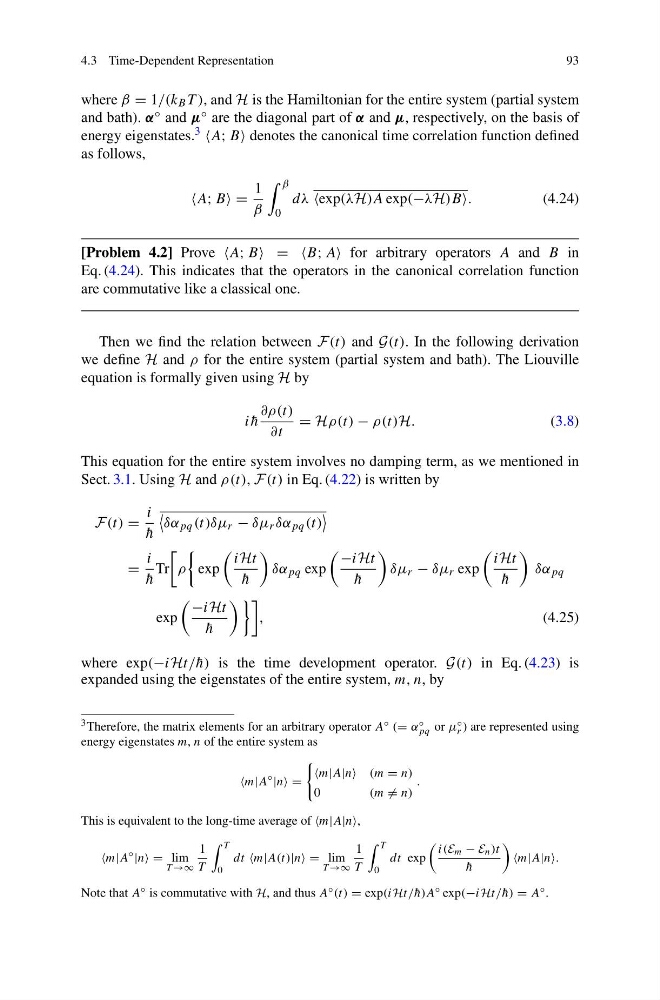
where β = 1/(k B T ), and H is the Hamiltonian for the entire system (partial system
and bath). α ◦ and μ ◦ are the diagonal part of α and μ, respectively, on the basis of
energy eigenstates. 3 A; B denotes the canonical time correlation function defined
as follows,
A; B =
1
β
β
0
dλ exp(λH)A exp(−λH)B.
(4.24)
[Problem 4.2] Prove A; B = B; A for arbitrary operators A and B in
Eq. (4.24). This indicates that the operators in the canonical correlation function
are commutative like a classical one.
Then we find the relation between F(t) and G(t). In the following derivation
we define H and ρ for the entire system (partial system and bath). The Liouville
equation is formally given using H by
i ¯
h
∂ρ(t)
∂t
= Hρ(t) − ρ(t)H.
(3.8)
This equation for the entire system involves no damping term, as we mentioned in
Sect. 3.1. Using H and ρ(t), F(t) in Eq. (4.22) is written by
F(t) =
i
¯
h
δα pq (t)δμ r − δμ r δα pq (t)
=
i
¯
h
Tr
ρ
exp
iHt
¯
h
δα pq exp
−iHt
¯
h
δμ r − δμ r exp
iHt
¯
h
δα pq
exp
−iHt
¯
h
,
(4.25)
where exp(−iHt/ ¯
h) is the time development operator. G(t) in Eq. (4.23) is
expanded using the eigenstates of the entire system, m, n, by
3 Therefore, the matrix elements for an arbitrary operator A ◦ (= α ◦
pq or μ ◦
r ) are represented using
energy eigenstates m, n of the entire system as
m|A
◦ |n =
m|A|n (m = n)
0
(m = n)
.
This is equivalent to the long-time average of m|A|n,
m|A
◦ |n = lim
T →∞
1
T
T
0
dt m|A(t)|n = lim
T →∞
1
T
T
0
dt exp
i(E m − E n )t
¯
h
m|A|n.
Note that A ◦ is commutative with H, and thus A ◦ (t) = exp(iHt/ ¯
h)A ◦ exp(−iHt/ ¯
h) = A ◦ .
93
where β = 1/(k B T ), and H is the Hamiltonian for the entire system (partial system
and bath). α ◦ and μ ◦ are the diagonal part of α and μ, respectively, on the basis of
energy eigenstates. 3 A; B denotes the canonical time correlation function defined
as follows,
A; B =
1
β
β
0
dλ exp(λH)A exp(−λH)B.
(4.24)
[Problem 4.2] Prove A; B = B; A for arbitrary operators A and B in
Eq. (4.24). This indicates that the operators in the canonical correlation function
are commutative like a classical one.
Then we find the relation between F(t) and G(t). In the following derivation
we define H and ρ for the entire system (partial system and bath). The Liouville
equation is formally given using H by
i ¯
h
∂ρ(t)
∂t
= Hρ(t) − ρ(t)H.
(3.8)
This equation for the entire system involves no damping term, as we mentioned in
Sect. 3.1. Using H and ρ(t), F(t) in Eq. (4.22) is written by
F(t) =
i
¯
h
δα pq (t)δμ r − δμ r δα pq (t)
=
i
¯
h
Tr
ρ
exp
iHt
¯
h
δα pq exp
−iHt
¯
h
δμ r − δμ r exp
iHt
¯
h
δα pq
exp
−iHt
¯
h
,
(4.25)
where exp(−iHt/ ¯
h) is the time development operator. G(t) in Eq. (4.23) is
expanded using the eigenstates of the entire system, m, n, by
3 Therefore, the matrix elements for an arbitrary operator A ◦ (= α ◦
pq or μ ◦
r ) are represented using
energy eigenstates m, n of the entire system as
m|A
◦ |n =
m|A|n (m = n)
0
(m = n)
.
This is equivalent to the long-time average of m|A|n,
m|A
◦ |n = lim
T →∞
1
T
T
0
dt m|A(t)|n = lim
T →∞
1
T
T
0
dt exp
i(E m − E n )t
¯
h
m|A|n.
Note that A ◦ is commutative with H, and thus A ◦ (t) = exp(iHt/ ¯
h)A ◦ exp(−iHt/ ¯
h) = A ◦ .