

270
H. Schulz
treatment, carotenoids occurring in single pollen grains were examined achieving
both, high detection sensitivity and structural selectivity.
the special advantages of Raman spectroscopy over classical chemical analysis
methods especially for industrial purposes were pointed out by [102]. here, a rapid
and inexpensive quantitative Raman analysis is presented for the determination of
carotenoids in inflorescences of Tagetes erecta. other authors mention that Raman
spectroscopy is a very useful technique for rapid and reliable characterization of
newly isolated plant carotenoids.
9.3.5 Polyacetylenes
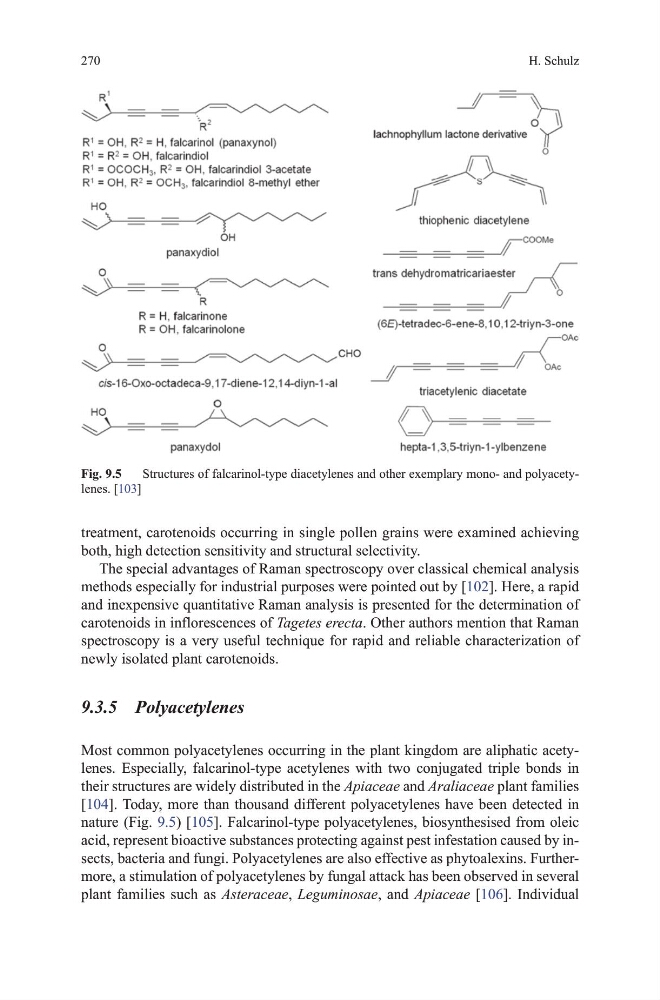
most common polyacetylenes occurring in the plant kingdom are aliphatic acetylenes. Especially, falcarinol-type acetylenes with two conjugated triple bonds in
their structures are widely distributed in the Apiaceae and Araliaceae plant families
[104]. today, more than thousand different polyacetylenes have been detected in
nature (Fig. 9.5) [105]. Falcarinol-type polyacetylenes, biosynthesised from oleic
acid, represent bioactive substances protecting against pest infestation caused by insects, bacteria and fungi. Polyacetylenes are also effective as phytoalexins. Furthermore, a stimulation of polyacetylenes by fungal attack has been observed in several
plant families such as Asteraceae, Leguminosae, and Apiaceae [106]. Individual
Fig. 9.5
Structures of falcarinol-type diacetylenes and other exemplary mono- and polyacetylenes. [103]
H. Schulz
treatment, carotenoids occurring in single pollen grains were examined achieving
both, high detection sensitivity and structural selectivity.
the special advantages of Raman spectroscopy over classical chemical analysis
methods especially for industrial purposes were pointed out by [102]. here, a rapid
and inexpensive quantitative Raman analysis is presented for the determination of
carotenoids in inflorescences of Tagetes erecta. other authors mention that Raman
spectroscopy is a very useful technique for rapid and reliable characterization of
newly isolated plant carotenoids.
9.3.5 Polyacetylenes
most common polyacetylenes occurring in the plant kingdom are aliphatic acetylenes. Especially, falcarinol-type acetylenes with two conjugated triple bonds in
their structures are widely distributed in the Apiaceae and Araliaceae plant families
[104]. today, more than thousand different polyacetylenes have been detected in
nature (Fig. 9.5) [105]. Falcarinol-type polyacetylenes, biosynthesised from oleic
acid, represent bioactive substances protecting against pest infestation caused by insects, bacteria and fungi. Polyacetylenes are also effective as phytoalexins. Furthermore, a stimulation of polyacetylenes by fungal attack has been observed in several
plant families such as Asteraceae, Leguminosae, and Apiaceae [106]. Individual
Fig. 9.5
Structures of falcarinol-type diacetylenes and other exemplary mono- and polyacetylenes. [103]