

263
9 Qualitative and Quantitative FT-Raman Analysis of Plants
Besides the qualitative aspects of signal assignment and comparison to appropriate AtR-Ft infrared measurements, the Raman spectrum of dihydro indigo, an
important intermediate in the indigo dying process, is presented for the first time
and discussed with regard to its spectroscopic behaviour. during textile dying, the
insoluble blue indigo is reduced to the yellow coloured leuco indigo, which immediately oxidizes back to indigo in the presence of air oxygen [61]. this oxygensensitive intermediate of indigo reduction allows the bonding to the dyed strands
and hence causes the colour fastness of the textile. the Raman spectra of in situ
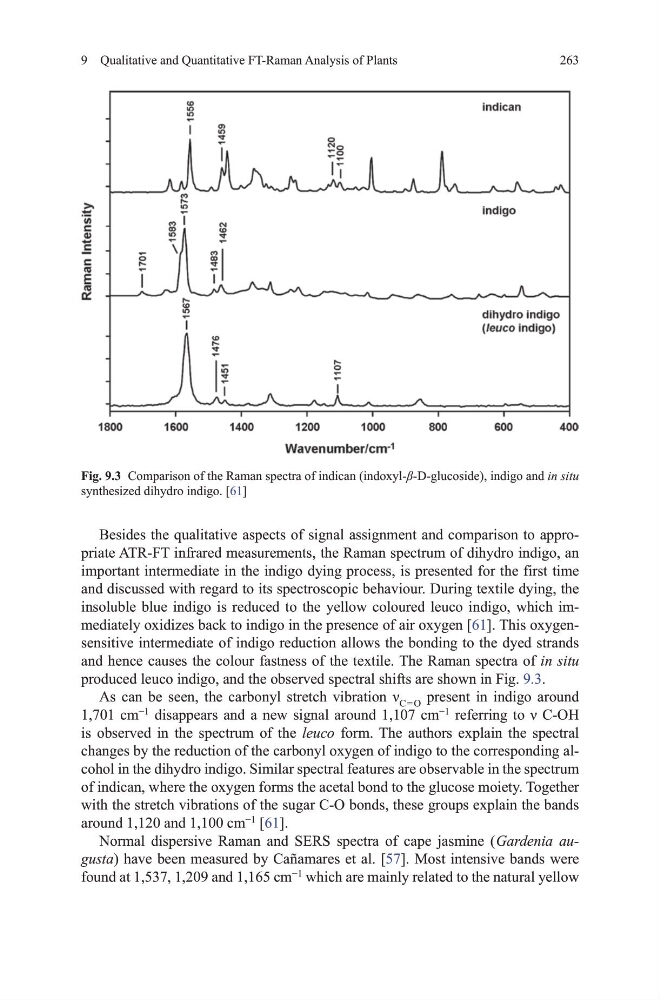
produced leuco indigo, and the observed spectral shifts are shown in Fig. 9.3.
As can be seen, the carbonyl stretch vibration ν C = o present in indigo around
1,701 cm
−1
disappears and a new signal around 1,107 cm
−1
referring to ν C-OH
is observed in the spectrum of the leuco form. the authors explain the spectral
changes by the reduction of the carbonyl oxygen of indigo to the corresponding alcohol in the dihydro indigo. Similar spectral features are observable in the spectrum
of indican, where the oxygen forms the acetal bond to the glucose moiety. together
with the stretch vibrations of the sugar C-o bonds, these groups explain the bands
around 1,120 and 1,100 cm
−1
[61].
Normal dispersive Raman and SERS spectra of cape jasmine ( Gardenia augusta) have been measured by Cañamares et al. [57]. most intensive bands were
found at 1,537, 1,209 and 1,165 cm
−1
which are mainly related to the natural yellow
Fig. 9.3 Comparison of the Raman spectra of indican (indoxyl-β-d-glucoside), indigo and in situ
synthesized dihydro indigo. [61]
9 Qualitative and Quantitative FT-Raman Analysis of Plants
Besides the qualitative aspects of signal assignment and comparison to appropriate AtR-Ft infrared measurements, the Raman spectrum of dihydro indigo, an
important intermediate in the indigo dying process, is presented for the first time
and discussed with regard to its spectroscopic behaviour. during textile dying, the
insoluble blue indigo is reduced to the yellow coloured leuco indigo, which immediately oxidizes back to indigo in the presence of air oxygen [61]. this oxygensensitive intermediate of indigo reduction allows the bonding to the dyed strands
and hence causes the colour fastness of the textile. the Raman spectra of in situ
produced leuco indigo, and the observed spectral shifts are shown in Fig. 9.3.
As can be seen, the carbonyl stretch vibration ν C = o present in indigo around
1,701 cm
−1
disappears and a new signal around 1,107 cm
−1
referring to ν C-OH
is observed in the spectrum of the leuco form. the authors explain the spectral
changes by the reduction of the carbonyl oxygen of indigo to the corresponding alcohol in the dihydro indigo. Similar spectral features are observable in the spectrum
of indican, where the oxygen forms the acetal bond to the glucose moiety. together
with the stretch vibrations of the sugar C-o bonds, these groups explain the bands
around 1,120 and 1,100 cm
−1
[61].
Normal dispersive Raman and SERS spectra of cape jasmine ( Gardenia augusta) have been measured by Cañamares et al. [57]. most intensive bands were
found at 1,537, 1,209 and 1,165 cm
−1
which are mainly related to the natural yellow
Fig. 9.3 Comparison of the Raman spectra of indican (indoxyl-β-d-glucoside), indigo and in situ
synthesized dihydro indigo. [61]