

162
M. Pecul and W. Dzwolak
insightful experimental approach in time-resolved studies of protein folding, as well
as in the field of protein-ligand interactions.
there are plenty of excellent reviews on applications of Cd in protein chemistry and biophysics—either as book chapters [7–15] or up-to-date review papers
[16–20]. out of necessity, in this concise work, we will focus on some general
aspects of applications of Cd in broadly understood bioscience. First, we discuss
briefly the quantum chemical theory underlying the spectroscopic phenomenon and
the main computational methods used for modeling the spectra. then, we proceed
to outlining the use of Cd in obtaining structural information on peptides, proteins
and nucleic acids. the main emphasis is on new developements in this area, and in
particular on the use of Synchrotron Radiation Circular dichroism on the one hand,
and on induced Cd of achiral chromophores (in near uv or visible range) on the
other. Although the main applications of Cd in bioscience are in the studies of biopolymers, we have decided to devote some attention also to the use of Cd in establishing absolute configuration of small chiral molecules, since many of these studies concern drugs or potential drugs, and therefore are relevant to the topic. Finally,
we discuss an emerging technique related to Cd—circularly polarized luminscence
(CPL)—which enables probing the structure of excited states of chiral molecules.
6.2 Theory and Modelling of CD
Along with extending the range of biochemical applications of electronic Cd spectra, understanding of the relationship between structural properties and Cd spectrum has also been deepened by relatively recent developements in theoretical modelling of Cd spectra.
the quantum chemical theory of the Cd phenomenon has been described as
early as in 1928 by L. Rosenfeld [21], who related the difference between the molar
extinction coefficients for left and right circularly-polarized light, e L (A)—e R (A),
to the rotatory strength
n
R of the transition between the ground state 0 and the nth
excited state. the rotatory strength
n
R was shown for isotropic samples to be given
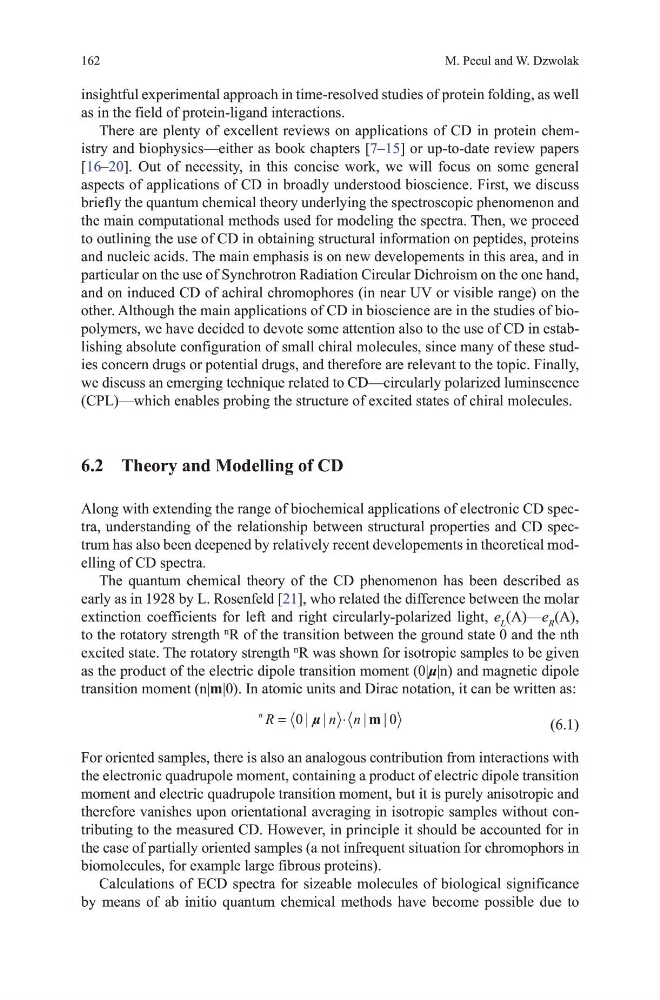
as the product of the electric dipole transition moment (0|μ|n) and magnetic dipole
transition moment (n|m|0). In atomic units and dirac notation, it can be written as:
n R
n n
=
⋅
0
0
| |
| |
µ
m
(6.1)
For oriented samples, there is also an analogous contribution from interactions with
the electronic quadrupole moment, containing a product of electric dipole transition
moment and electric quadrupole transition moment, but it is purely anisotropic and
therefore vanishes upon orientational averaging in isotropic samples without contributing to the measured Cd. however, in principle it should be accounted for in
the case of partially oriented samples (a not infrequent situation for chromophors in
biomolecules, for example large fibrous proteins).
Calculations of ECd spectra for sizeable molecules of biological significance
by means of ab initio quantum chemical methods have become possible due to
M. Pecul and W. Dzwolak
insightful experimental approach in time-resolved studies of protein folding, as well
as in the field of protein-ligand interactions.
there are plenty of excellent reviews on applications of Cd in protein chemistry and biophysics—either as book chapters [7–15] or up-to-date review papers
[16–20]. out of necessity, in this concise work, we will focus on some general
aspects of applications of Cd in broadly understood bioscience. First, we discuss
briefly the quantum chemical theory underlying the spectroscopic phenomenon and
the main computational methods used for modeling the spectra. then, we proceed
to outlining the use of Cd in obtaining structural information on peptides, proteins
and nucleic acids. the main emphasis is on new developements in this area, and in
particular on the use of Synchrotron Radiation Circular dichroism on the one hand,
and on induced Cd of achiral chromophores (in near uv or visible range) on the
other. Although the main applications of Cd in bioscience are in the studies of biopolymers, we have decided to devote some attention also to the use of Cd in establishing absolute configuration of small chiral molecules, since many of these studies concern drugs or potential drugs, and therefore are relevant to the topic. Finally,
we discuss an emerging technique related to Cd—circularly polarized luminscence
(CPL)—which enables probing the structure of excited states of chiral molecules.
6.2 Theory and Modelling of CD
Along with extending the range of biochemical applications of electronic Cd spectra, understanding of the relationship between structural properties and Cd spectrum has also been deepened by relatively recent developements in theoretical modelling of Cd spectra.
the quantum chemical theory of the Cd phenomenon has been described as
early as in 1928 by L. Rosenfeld [21], who related the difference between the molar
extinction coefficients for left and right circularly-polarized light, e L (A)—e R (A),
to the rotatory strength
n
R of the transition between the ground state 0 and the nth
excited state. the rotatory strength
n
R was shown for isotropic samples to be given
as the product of the electric dipole transition moment (0|μ|n) and magnetic dipole
transition moment (n|m|0). In atomic units and dirac notation, it can be written as:
n R
n n
=
⋅
0
0
| |
| |
µ
m
(6.1)
For oriented samples, there is also an analogous contribution from interactions with
the electronic quadrupole moment, containing a product of electric dipole transition
moment and electric quadrupole transition moment, but it is purely anisotropic and
therefore vanishes upon orientational averaging in isotropic samples without contributing to the measured Cd. however, in principle it should be accounted for in
the case of partially oriented samples (a not infrequent situation for chromophors in
biomolecules, for example large fibrous proteins).
Calculations of ECd spectra for sizeable molecules of biological significance
by means of ab initio quantum chemical methods have become possible due to