

5 α-Amino Acids In Water: A Review of VCD and ROA Spectra
95
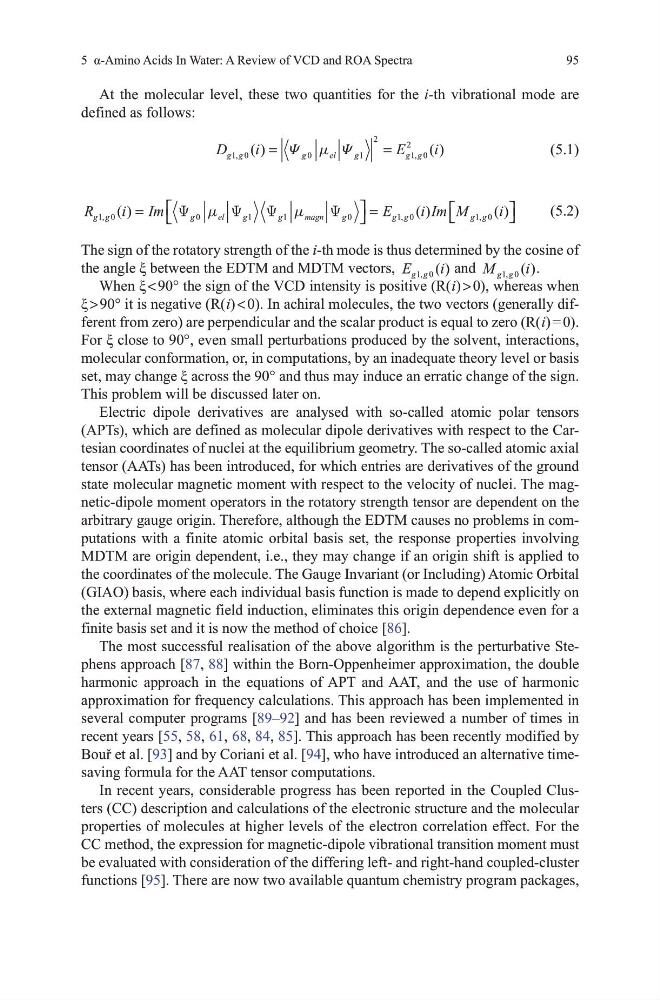
At the molecular level, these two quantities for the i-th vibrational mode are
defined as follows:
D
i
E
i
g g
g
e l
g
g g
1 0
0
1
2
1 0
2
,
,
( )
( )
=
=
Ψ µ Ψ
(5.1)
R
i Im
E
i Im M
i
g g
g
e l
g
g
m agn
g
gg
g g
1 0
0
1
1
0
1 0
1 0
,
,
,
( )
( )
( )
=
=
Ψ
Ψ
Ψ
Ψ
µ
µ
(5.2)
the sign of the rotatory strength of the i-th mode is thus determined by the cosine of
the angle ξ between the EDTM and MDTM vectors, E
i
g g
1 0
, ( ) and M
i
g g
1 0
, ( ).
When ξ < 90° the sign of the vCd intensity is positive (R( i) > 0), whereas when
ξ > 90° it is negative (R( i) < 0). In achiral molecules, the two vectors (generally different from zero) are perpendicular and the scalar product is equal to zero (R( i) = 0).
For ξ close to 90°, even small perturbations produced by the solvent, interactions,
molecular conformation, or, in computations, by an inadequate theory level or basis
set, may change ξ across the 90° and thus may induce an erratic change of the sign.
this problem will be discussed later on.
Electric dipole derivatives are analysed with so-called atomic polar tensors
(APts), which are defined as molecular dipole derivatives with respect to the Cartesian coordinates of nuclei at the equilibrium geometry. the so-called atomic axial
tensor (AAts) has been introduced, for which entries are derivatives of the ground
state molecular magnetic moment with respect to the velocity of nuclei. the magnetic-dipole moment operators in the rotatory strength tensor are dependent on the
arbitrary gauge origin. therefore, although the Edtm causes no problems in computations with a finite atomic orbital basis set, the response properties involving
mdtm are origin dependent, i.e., they may change if an origin shift is applied to
the coordinates of the molecule. the gauge Invariant (or Including) Atomic orbital
(gIAo) basis, where each individual basis function is made to depend explicitly on
the external magnetic field induction, eliminates this origin dependence even for a
finite basis set and it is now the method of choice [86].
the most successful realisation of the above algorithm is the perturbative Stephens approach [87, 88] within the Born-oppenheimer approximation, the double
harmonic approach in the equations of APt and AAt, and the use of harmonic
approximation for frequency calculations. this approach has been implemented in
several computer programs [89–92] and has been reviewed a number of times in
recent years [55, 58, 61, 68, 84, 85]. this approach has been recently modified by
Bouř et al. [93] and by Coriani et al. [94], who have introduced an alternative timesaving formula for the AAt tensor computations.
In recent years, considerable progress has been reported in the Coupled Clusters (CC) description and calculations of the electronic structure and the molecular
properties of molecules at higher levels of the electron correlation effect. For the
CC method, the expression for magnetic-dipole vibrational transition moment must
be evaluated with consideration of the differing left- and right-hand coupled-cluster
functions [95]. there are now two available quantum chemistry program packages,
95
At the molecular level, these two quantities for the i-th vibrational mode are
defined as follows:
D
i
E
i
g g
g
e l
g
g g
1 0
0
1
2
1 0
2
,
,
( )
( )
=
=
Ψ µ Ψ
(5.1)
R
i Im
E
i Im M
i
g g
g
e l
g
g
m agn
g
gg
g g
1 0
0
1
1
0
1 0
1 0
,
,
,
( )
( )
( )
=
=
Ψ
Ψ
Ψ
Ψ
µ
µ
(5.2)
the sign of the rotatory strength of the i-th mode is thus determined by the cosine of
the angle ξ between the EDTM and MDTM vectors, E
i
g g
1 0
, ( ) and M
i
g g
1 0
, ( ).
When ξ < 90° the sign of the vCd intensity is positive (R( i) > 0), whereas when
ξ > 90° it is negative (R( i) < 0). In achiral molecules, the two vectors (generally different from zero) are perpendicular and the scalar product is equal to zero (R( i) = 0).
For ξ close to 90°, even small perturbations produced by the solvent, interactions,
molecular conformation, or, in computations, by an inadequate theory level or basis
set, may change ξ across the 90° and thus may induce an erratic change of the sign.
this problem will be discussed later on.
Electric dipole derivatives are analysed with so-called atomic polar tensors
(APts), which are defined as molecular dipole derivatives with respect to the Cartesian coordinates of nuclei at the equilibrium geometry. the so-called atomic axial
tensor (AAts) has been introduced, for which entries are derivatives of the ground
state molecular magnetic moment with respect to the velocity of nuclei. the magnetic-dipole moment operators in the rotatory strength tensor are dependent on the
arbitrary gauge origin. therefore, although the Edtm causes no problems in computations with a finite atomic orbital basis set, the response properties involving
mdtm are origin dependent, i.e., they may change if an origin shift is applied to
the coordinates of the molecule. the gauge Invariant (or Including) Atomic orbital
(gIAo) basis, where each individual basis function is made to depend explicitly on
the external magnetic field induction, eliminates this origin dependence even for a
finite basis set and it is now the method of choice [86].
the most successful realisation of the above algorithm is the perturbative Stephens approach [87, 88] within the Born-oppenheimer approximation, the double
harmonic approach in the equations of APt and AAt, and the use of harmonic
approximation for frequency calculations. this approach has been implemented in
several computer programs [89–92] and has been reviewed a number of times in
recent years [55, 58, 61, 68, 84, 85]. this approach has been recently modified by
Bouř et al. [93] and by Coriani et al. [94], who have introduced an alternative timesaving formula for the AAt tensor computations.
In recent years, considerable progress has been reported in the Coupled Clusters (CC) description and calculations of the electronic structure and the molecular
properties of molecules at higher levels of the electron correlation effect. For the
CC method, the expression for magnetic-dipole vibrational transition moment must
be evaluated with consideration of the differing left- and right-hand coupled-cluster
functions [95]. there are now two available quantum chemistry program packages,