

transition. It may well be that the activation energy for fragmentation is of the same
order, but likely lower [29]. A B3LYP/6-311++G(d,p) calculation yields ~2.1 eV,
when corrected for differences in zero-point energies. Therefore, statistical fragmentation is expected to dominate over delayed electron emission in the decay of
the hot ground state. Importantly, both statistical channels, which facilitate either
thermionic emission or bond fragmentation, should appear in the delayed channel,
and branching ratios in the S 1 state are not affected by possible multiple pathways in
the hot S 0 state.
Photodetachment may proceed directly into the electronic continuum, nonresonantly, or indirectly, resonantly via autodetachment from the S 1 excited state
of the anion (here together termed photodetachment, PD). Such electronic
resonances embedded in the continuum was initially treated by Fano, who showed
that one might expect effects of the continuum on the line shape as well as on the
resonance position [42]. The resonant PD channel may also be open for an electronically bound excited state, when a molecular anion has a particularly small
electron affinity in this state. In such a case, PD may occur through vibrational
resonances embedded in the electronic continuum. Distorted Fano profiles have
indeed been observed for excited vibrational levels, which are strongly coupled to
the electronic continuum for negatively charged small water clusters in the gas
phase [40, 43]. In the case of the GFP chromophore anion, recent photoelectron
spectroscopy studies strongly suggest that S 1 has indeed a bound character in the
Franck-Condon region [33–35]. Therefore, photo-electron emission below the
vertical detachment energy, which is observed indirectly via the prompt channel
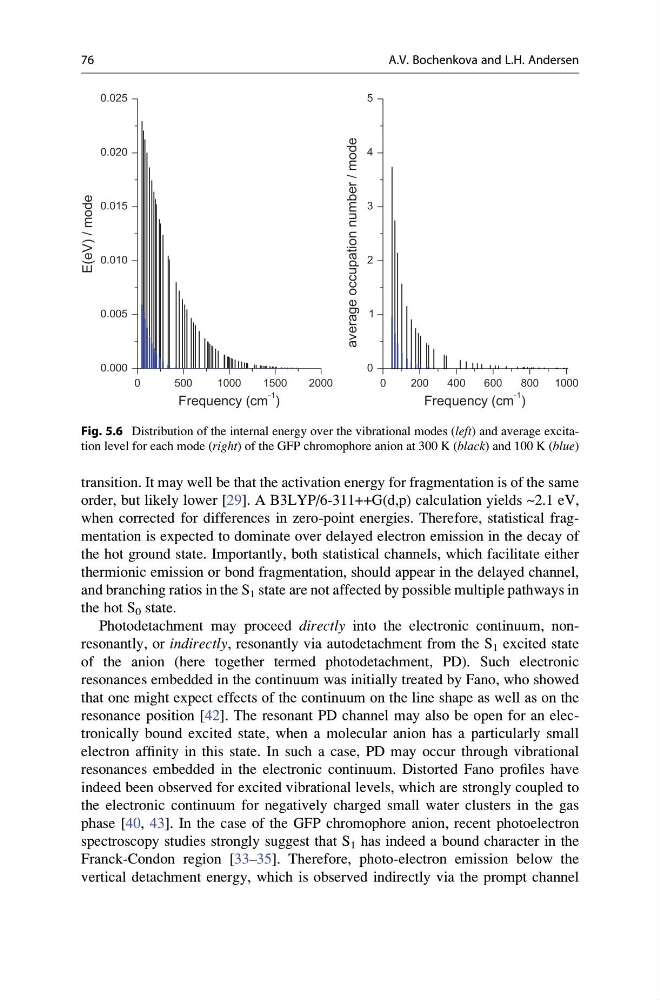
Fig. 5.6 Distribution of the internal energy over the vibrational modes (left) and average excitation level for each mode (right) of the GFP chromophore anion at 300 K (black) and 100 K (blue)
76
A.V. Bochenkova and L.H. Andersen
order, but likely lower [29]. A B3LYP/6-311++G(d,p) calculation yields ~2.1 eV,
when corrected for differences in zero-point energies. Therefore, statistical fragmentation is expected to dominate over delayed electron emission in the decay of
the hot ground state. Importantly, both statistical channels, which facilitate either
thermionic emission or bond fragmentation, should appear in the delayed channel,
and branching ratios in the S 1 state are not affected by possible multiple pathways in
the hot S 0 state.
Photodetachment may proceed directly into the electronic continuum, nonresonantly, or indirectly, resonantly via autodetachment from the S 1 excited state
of the anion (here together termed photodetachment, PD). Such electronic
resonances embedded in the continuum was initially treated by Fano, who showed
that one might expect effects of the continuum on the line shape as well as on the
resonance position [42]. The resonant PD channel may also be open for an electronically bound excited state, when a molecular anion has a particularly small
electron affinity in this state. In such a case, PD may occur through vibrational
resonances embedded in the electronic continuum. Distorted Fano profiles have
indeed been observed for excited vibrational levels, which are strongly coupled to
the electronic continuum for negatively charged small water clusters in the gas
phase [40, 43]. In the case of the GFP chromophore anion, recent photoelectron
spectroscopy studies strongly suggest that S 1 has indeed a bound character in the
Franck-Condon region [33–35]. Therefore, photo-electron emission below the
vertical detachment energy, which is observed indirectly via the prompt channel
Fig. 5.6 Distribution of the internal energy over the vibrational modes (left) and average excitation level for each mode (right) of the GFP chromophore anion at 300 K (black) and 100 K (blue)
76
A.V. Bochenkova and L.H. Andersen