

of the ion-trap temperature (in the ion source) from 300 K to 100 K reduces the
internal energy from 0.3 eV to about 0.03 eV. Inhomogeneous broadening due to
structural variations around a minimum on the ground state potential energy surface
may play a significant role for the width and shape of action-absorption profiles, in
particular, if the ground-state potential has a rather shallow minimum. Cooling of
the chromophore prior to injection into the storage ring may help in eliminating this
effect. However, the absorption profiles for electronic transitions of relatively large
biological chromophores are often quite broad because there may be a reasonable
Franck-Condon overlap to a rather dense band of vibrationally excited levels of
many degrees of freedom in the electronically excited state. Such broadening will
occur even with initially cold chromophore molecules.
5.2.2 Decay Channels
Before proceeding with more experimental details we discuss possible ways the
chromophore anion may respond to excitation in the present wavelength region.
The situation is illustrated in Fig. 5.7. A vibrationally hot ground state anion (S 0 )
may be formed by fast internal conversion (IC) from the electronically excited
singlet state. Being transferred to the ground state, the anion with high internal
energy undergoes a fast intra-molecular internal energy redistribution (IVR) on the
Detector
(MCP)
Laser-power
meter
HV platform
with ion source
Magnet
Pulsed laser
Detector arrangement (SED)
light
neutral particles
electrons
grid
channeltron
detector
glass plate
Ion bunch
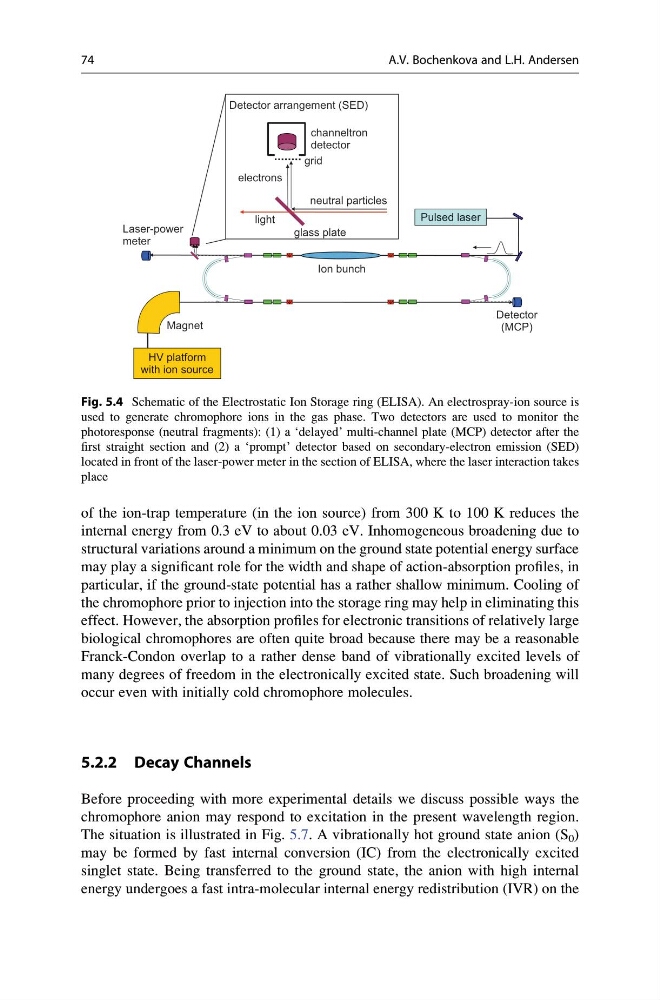
Fig. 5.4 Schematic of the Electrostatic Ion Storage ring (ELISA). An electrospray-ion source is
used to generate chromophore ions in the gas phase. Two detectors are used to monitor the
photoresponse (neutral fragments): (1) a ‘delayed’ multi-channel plate (MCP) detector after the
first straight section and (2) a ‘prompt’ detector based on secondary-electron emission (SED)
located in front of the laser-power meter in the section of ELISA, where the laser interaction takes
place
74
A.V. Bochenkova and L.H. Andersen
internal energy from 0.3 eV to about 0.03 eV. Inhomogeneous broadening due to
structural variations around a minimum on the ground state potential energy surface
may play a significant role for the width and shape of action-absorption profiles, in
particular, if the ground-state potential has a rather shallow minimum. Cooling of
the chromophore prior to injection into the storage ring may help in eliminating this
effect. However, the absorption profiles for electronic transitions of relatively large
biological chromophores are often quite broad because there may be a reasonable
Franck-Condon overlap to a rather dense band of vibrationally excited levels of
many degrees of freedom in the electronically excited state. Such broadening will
occur even with initially cold chromophore molecules.
5.2.2 Decay Channels
Before proceeding with more experimental details we discuss possible ways the
chromophore anion may respond to excitation in the present wavelength region.
The situation is illustrated in Fig. 5.7. A vibrationally hot ground state anion (S 0 )
may be formed by fast internal conversion (IC) from the electronically excited
singlet state. Being transferred to the ground state, the anion with high internal
energy undergoes a fast intra-molecular internal energy redistribution (IVR) on the
Detector
(MCP)
Laser-power
meter
HV platform
with ion source
Magnet
Pulsed laser
Detector arrangement (SED)
light
neutral particles
electrons
grid
channeltron
detector
glass plate
Ion bunch
Fig. 5.4 Schematic of the Electrostatic Ion Storage ring (ELISA). An electrospray-ion source is
used to generate chromophore ions in the gas phase. Two detectors are used to monitor the
photoresponse (neutral fragments): (1) a ‘delayed’ multi-channel plate (MCP) detector after the
first straight section and (2) a ‘prompt’ detector based on secondary-electron emission (SED)
located in front of the laser-power meter in the section of ELISA, where the laser interaction takes
place
74
A.V. Bochenkova and L.H. Andersen