

motion of an ion within the trap is more complicated than described above due to
the axial trapping in the electric field which introduces a second radial motion
called magnetron motion that occurs at another frequency.
3.3
Cryogenically Cooled Instruments
Spectroscopy experiments on biomolecular ions have primarily been performed at
room temperature. However, vibrational fine structure is often hidden in absorption
spectra for room-temperature ions, and instead broad bands are seen. Hence, spectra
from cold ions which display less spectral congestion would provide better
benchmarks for theory. Such spectra also probe the lifetimes of the excited states,
with broad bands indicating a short excited-state lifetime (cf., Heisenberg’s uncertainty principle). This is a direction which is currently being pursued, with
instruments under construction in Heidelberg [34], Stockholm (Fig. 3.21) [19],
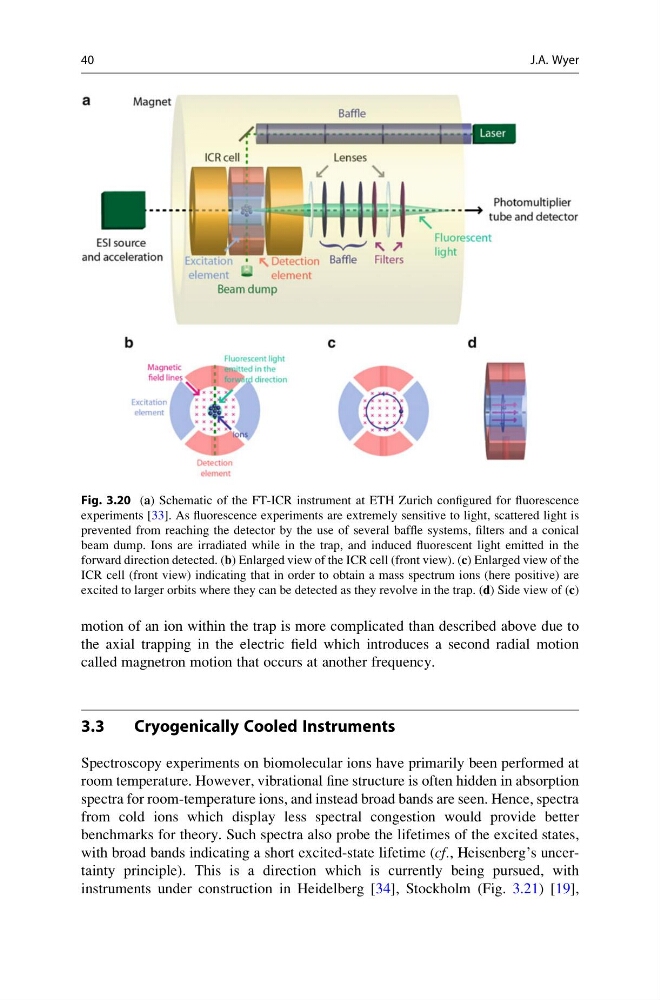
Fig. 3.20 (a) Schematic of the FT-ICR instrument at ETH Zurich configured for fluorescence
experiments [33]. As fluorescence experiments are extremely sensitive to light, scattered light is
prevented from reaching the detector by the use of several baffle systems, filters and a conical
beam dump. Ions are irradiated while in the trap, and induced fluorescent light emitted in the
forward direction detected. (b) Enlarged view of the ICR cell (front view). (c) Enlarged view of the
ICR cell (front view) indicating that in order to obtain a mass spectrum ions (here positive) are
excited to larger orbits where they can be detected as they revolve in the trap. (d) Side view of (c)
40
J.A. Wyer
the axial trapping in the electric field which introduces a second radial motion
called magnetron motion that occurs at another frequency.
3.3
Cryogenically Cooled Instruments
Spectroscopy experiments on biomolecular ions have primarily been performed at
room temperature. However, vibrational fine structure is often hidden in absorption
spectra for room-temperature ions, and instead broad bands are seen. Hence, spectra
from cold ions which display less spectral congestion would provide better
benchmarks for theory. Such spectra also probe the lifetimes of the excited states,
with broad bands indicating a short excited-state lifetime (cf., Heisenberg’s uncertainty principle). This is a direction which is currently being pursued, with
instruments under construction in Heidelberg [34], Stockholm (Fig. 3.21) [19],
Fig. 3.20 (a) Schematic of the FT-ICR instrument at ETH Zurich configured for fluorescence
experiments [33]. As fluorescence experiments are extremely sensitive to light, scattered light is
prevented from reaching the detector by the use of several baffle systems, filters and a conical
beam dump. Ions are irradiated while in the trap, and induced fluorescent light emitted in the
forward direction detected. (b) Enlarged view of the ICR cell (front view). (c) Enlarged view of the
ICR cell (front view) indicating that in order to obtain a mass spectrum ions (here positive) are
excited to larger orbits where they can be detected as they revolve in the trap. (d) Side view of (c)
40
J.A. Wyer