

In order to fit the data, a number of exponentials are sometimes required with one
representing the background decay of the ions due to collision-induced dissociation.
The requirement of more than one exponential to describe the decay ascribed to
photoexcitation is due to one of the following reasons:
1. Ions may have absorbed a different number of photons, with ions which have
absorbed more photons decaying over a faster timescale than ions which have
absorbed less.
2. The width of the internal energy distribution: a time constant for dissociation
should be associated with each internal energy of the ions, determined by the
activation energy E 0 and pre-exponential factor A for the statistical dissociation
process [6]. A simple expression for the rate constant is obtained from QuasiEquilibrium Theory (QET) [7] and is k(E) ¼ A (1 À E 0 /E)
sÀ1 . A is the limit at
high internal energy E, and s ¼ 3N À 6 (5) is the degrees of freedom of a nonlinear (linear) molecule with N atoms. Note that k is the inverse of the time
constant for dissociation. In the extreme, the decay follows a power-law decay,
t
Àn (n % 1) [6].
3. Some photoexcited ions undergo an intersystem crossing to e.g. a triplet state:
such a crossing would introduce a bottleneck for dissociation as a rate-limiting
spin flip is required to reach the electronic ground state [8, 9].
From the pre-exponential factors and time constants a number proportional to
the total number of photoexcited ions can be calculated and the absorption-cross
sections resulting in dissociation calculated (Fig. 3.6) [10]. These are equal to the
real absorption-cross sections (on a relative scale) if luminescence is not a
0
1
2
3
4
5
6
7
8
9 10
0.0
0.2
0.4
0.6
0.8
1.0
1.2
Measurement window
Time (ms)
Counts (arb. units)
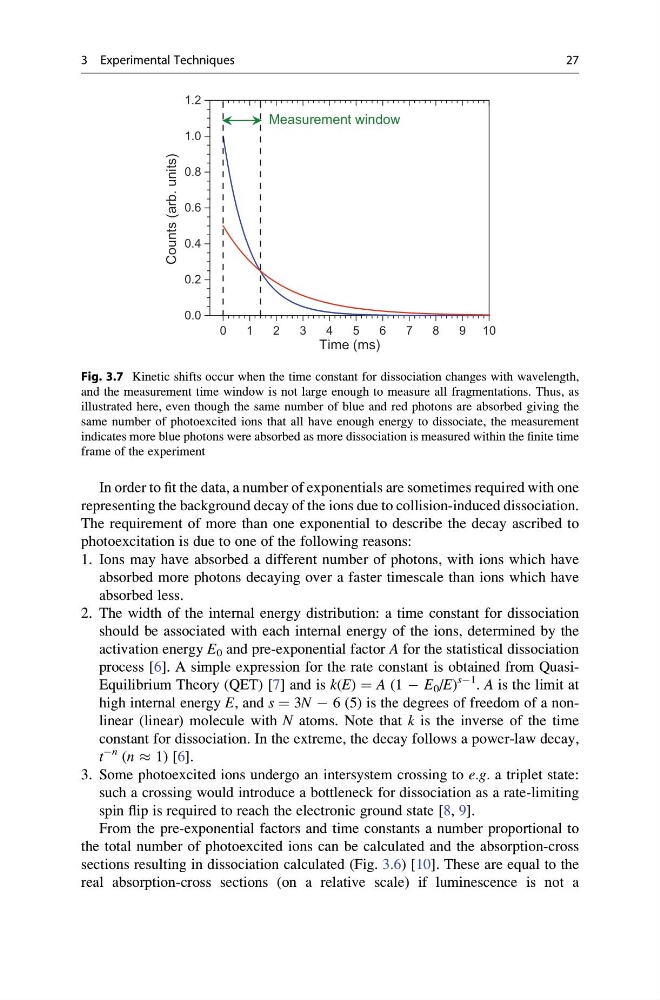
Fig. 3.7 Kinetic shifts occur when the time constant for dissociation changes with wavelength,
and the measurement time window is not large enough to measure all fragmentations. Thus, as
illustrated here, even though the same number of blue and red photons are absorbed giving the
same number of photoexcited ions that all have enough energy to dissociate, the measurement
indicates more blue photons were absorbed as more dissociation is measured within the finite time
frame of the experiment
3 Experimental Techniques
27
representing the background decay of the ions due to collision-induced dissociation.
The requirement of more than one exponential to describe the decay ascribed to
photoexcitation is due to one of the following reasons:
1. Ions may have absorbed a different number of photons, with ions which have
absorbed more photons decaying over a faster timescale than ions which have
absorbed less.
2. The width of the internal energy distribution: a time constant for dissociation
should be associated with each internal energy of the ions, determined by the
activation energy E 0 and pre-exponential factor A for the statistical dissociation
process [6]. A simple expression for the rate constant is obtained from QuasiEquilibrium Theory (QET) [7] and is k(E) ¼ A (1 À E 0 /E)
sÀ1 . A is the limit at
high internal energy E, and s ¼ 3N À 6 (5) is the degrees of freedom of a nonlinear (linear) molecule with N atoms. Note that k is the inverse of the time
constant for dissociation. In the extreme, the decay follows a power-law decay,
t
Àn (n % 1) [6].
3. Some photoexcited ions undergo an intersystem crossing to e.g. a triplet state:
such a crossing would introduce a bottleneck for dissociation as a rate-limiting
spin flip is required to reach the electronic ground state [8, 9].
From the pre-exponential factors and time constants a number proportional to
the total number of photoexcited ions can be calculated and the absorption-cross
sections resulting in dissociation calculated (Fig. 3.6) [10]. These are equal to the
real absorption-cross sections (on a relative scale) if luminescence is not a
0
1
2
3
4
5
6
7
8
9 10
0.0
0.2
0.4
0.6
0.8
1.0
1.2
Measurement window
Time (ms)
Counts (arb. units)
Fig. 3.7 Kinetic shifts occur when the time constant for dissociation changes with wavelength,
and the measurement time window is not large enough to measure all fragmentations. Thus, as
illustrated here, even though the same number of blue and red photons are absorbed giving the
same number of photoexcited ions that all have enough energy to dissociate, the measurement
indicates more blue photons were absorbed as more dissociation is measured within the finite time
frame of the experiment
3 Experimental Techniques
27