

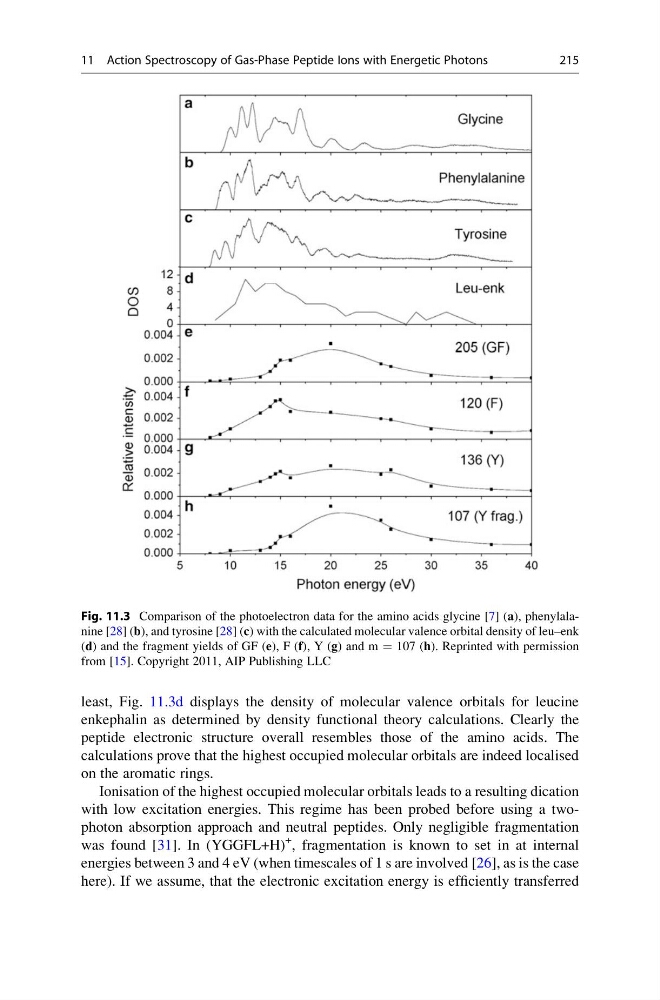
least, Fig. 11.3d displays the density of molecular valence orbitals for leucine
enkephalin as determined by density functional theory calculations. Clearly the
peptide electronic structure overall resembles those of the amino acids. The
calculations prove that the highest occupied molecular orbitals are indeed localised
on the aromatic rings.
Ionisation of the highest occupied molecular orbitals leads to a resulting dication
with low excitation energies. This regime has been probed before using a twophoton absorption approach and neutral peptides. Only negligible fragmentation
was found [31]. In (YGGFL+H)
+ , fragmentation is known to set in at internal
energies between 3 and 4 eV (when timescales of 1 s are involved [26], as is the case
here). If we assume, that the electronic excitation energy is efficiently transferred
Fig. 11.3 Comparison of the photoelectron data for the amino acids glycine [7] (a), phenylalanine [28] (b), and tyrosine [28] (c) with the calculated molecular valence orbital density of leu–enk
(d) and the fragment yields of GF (e), F (f), Y (g) and m ¼ 107 (h). Reprinted with permission
from [15]. Copyright 2011, AIP Publishing LLC
11 Action Spectroscopy of Gas-Phase Peptide Ions with Energetic Photons
215
enkephalin as determined by density functional theory calculations. Clearly the
peptide electronic structure overall resembles those of the amino acids. The
calculations prove that the highest occupied molecular orbitals are indeed localised
on the aromatic rings.
Ionisation of the highest occupied molecular orbitals leads to a resulting dication
with low excitation energies. This regime has been probed before using a twophoton absorption approach and neutral peptides. Only negligible fragmentation
was found [31]. In (YGGFL+H)
+ , fragmentation is known to set in at internal
energies between 3 and 4 eV (when timescales of 1 s are involved [26], as is the case
here). If we assume, that the electronic excitation energy is efficiently transferred
Fig. 11.3 Comparison of the photoelectron data for the amino acids glycine [7] (a), phenylalanine [28] (b), and tyrosine [28] (c) with the calculated molecular valence orbital density of leu–enk
(d) and the fragment yields of GF (e), F (f), Y (g) and m ¼ 107 (h). Reprinted with permission
from [15]. Copyright 2011, AIP Publishing LLC
11 Action Spectroscopy of Gas-Phase Peptide Ions with Energetic Photons
215