

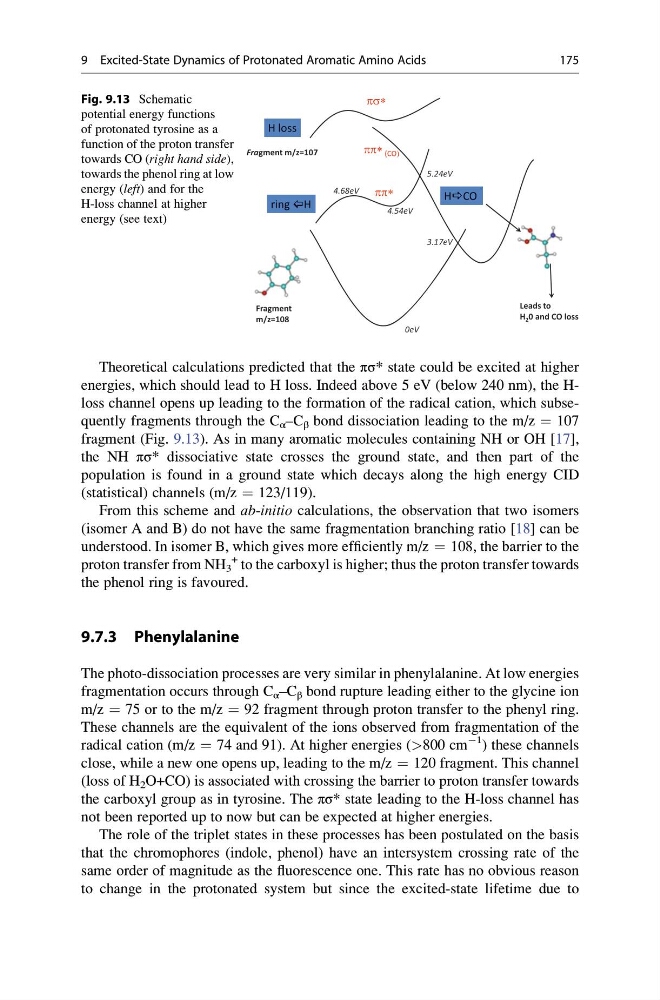
Theoretical calculations predicted that the πσ* state could be excited at higher
energies, which should lead to H loss. Indeed above 5 eV (below 240 nm), the Hloss channel opens up leading to the formation of the radical cation, which subsequently fragments through the C α –C β bond dissociation leading to the m/z ¼ 107
fragment (Fig. 9.13). As in many aromatic molecules containing NH or OH [17],
the NH πσ* dissociative state crosses the ground state, and then part of the
population is found in a ground state which decays along the high energy CID
(statistical) channels (m/z ¼ 123/119).
From this scheme and ab-initio calculations, the observation that two isomers
(isomer A and B) do not have the same fragmentation branching ratio [18] can be
understood. In isomer B, which gives more efficiently m/z ¼ 108, the barrier to the
proton transfer from NH 3
+ to the carboxyl is higher; thus the proton transfer towards
the phenol ring is favoured.
9.7.3 Phenylalanine
The photo-dissociation processes are very similar in phenylalanine. At low energies
fragmentation occurs through C α –C β bond rupture leading either to the glycine ion
m/z ¼ 75 or to the m/z ¼ 92 fragment through proton transfer to the phenyl ring.
These channels are the equivalent of the ions observed from fragmentation of the
radical cation (m/z ¼ 74 and 91). At higher energies (>800 cm
À1 ) these channels
close, while a new one opens up, leading to the m/z ¼ 120 fragment. This channel
(loss of H 2 O+CO) is associated with crossing the barrier to proton transfer towards
the carboxyl group as in tyrosine. The πσ* state leading to the H-loss channel has
not been reported up to now but can be expected at higher energies.
The role of the triplet states in these processes has been postulated on the basis
that the chromophores (indole, phenol) have an intersystem crossing rate of the
same order of magnitude as the fluorescence one. This rate has no obvious reason
to change in the protonated system but since the excited-state lifetime due to
ππ∗
ππ∗ (CO)
πσ∗
ring H
H loss
H CO
Fragment
m/z=108
Leads to
H 2 0 and CO loss
4.54eV
0eV
3.17eV
5.24eV
4.68eV
Fragment m/z=107
Fig. 9.13 Schematic
potential energy functions
of protonated tyrosine as a
function of the proton transfer
towards CO (right hand side),
towards the phenol ring at low
energy (left) and for the
H-loss channel at higher
energy (see text)
9 Excited-State Dynamics of Protonated Aromatic Amino Acids
175
energies, which should lead to H loss. Indeed above 5 eV (below 240 nm), the Hloss channel opens up leading to the formation of the radical cation, which subsequently fragments through the C α –C β bond dissociation leading to the m/z ¼ 107
fragment (Fig. 9.13). As in many aromatic molecules containing NH or OH [17],
the NH πσ* dissociative state crosses the ground state, and then part of the
population is found in a ground state which decays along the high energy CID
(statistical) channels (m/z ¼ 123/119).
From this scheme and ab-initio calculations, the observation that two isomers
(isomer A and B) do not have the same fragmentation branching ratio [18] can be
understood. In isomer B, which gives more efficiently m/z ¼ 108, the barrier to the
proton transfer from NH 3
+ to the carboxyl is higher; thus the proton transfer towards
the phenol ring is favoured.
9.7.3 Phenylalanine
The photo-dissociation processes are very similar in phenylalanine. At low energies
fragmentation occurs through C α –C β bond rupture leading either to the glycine ion
m/z ¼ 75 or to the m/z ¼ 92 fragment through proton transfer to the phenyl ring.
These channels are the equivalent of the ions observed from fragmentation of the
radical cation (m/z ¼ 74 and 91). At higher energies (>800 cm
À1 ) these channels
close, while a new one opens up, leading to the m/z ¼ 120 fragment. This channel
(loss of H 2 O+CO) is associated with crossing the barrier to proton transfer towards
the carboxyl group as in tyrosine. The πσ* state leading to the H-loss channel has
not been reported up to now but can be expected at higher energies.
The role of the triplet states in these processes has been postulated on the basis
that the chromophores (indole, phenol) have an intersystem crossing rate of the
same order of magnitude as the fluorescence one. This rate has no obvious reason
to change in the protonated system but since the excited-state lifetime due to
ππ∗
ππ∗ (CO)
πσ∗
ring H
H loss
H CO
Fragment
m/z=108
Leads to
H 2 0 and CO loss
4.54eV
0eV
3.17eV
5.24eV
4.68eV
Fragment m/z=107
Fig. 9.13 Schematic
potential energy functions
of protonated tyrosine as a
function of the proton transfer
towards CO (right hand side),
towards the phenol ring at low
energy (left) and for the
H-loss channel at higher
energy (see text)
9 Excited-State Dynamics of Protonated Aromatic Amino Acids
175