

9.6.3 Comparison between TrpH
+
and TyrH
+
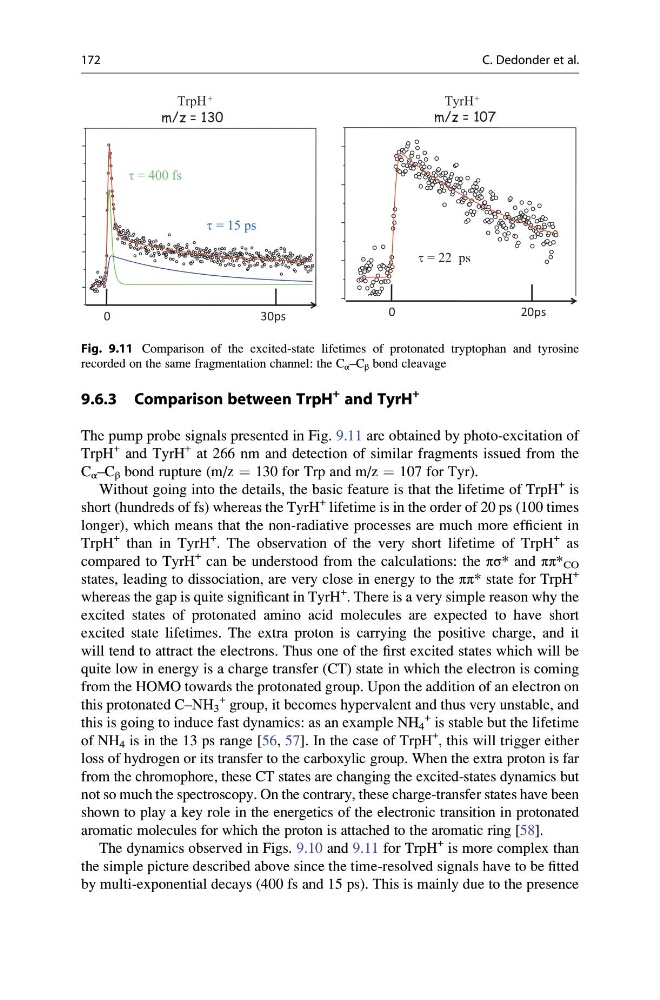
The pump probe signals presented in Fig. 9.11 are obtained by photo-excitation of
TrpH
+ and TyrH
+ at 266 nm and detection of similar fragments issued from the
C α –C β bond rupture (m/z ¼ 130 for Trp and m/z ¼ 107 for Tyr).
Without going into the details, the basic feature is that the lifetime of TrpH
+ is
short (hundreds of fs) whereas the TyrH
+ lifetime is in the order of 20 ps (100 times
longer), which means that the non-radiative processes are much more efficient in
TrpH
+ than in TyrH
+ . The observation of the very short lifetime of TrpH
+ as
compared to TyrH
+ can be understood from the calculations: the πσ* and ππ* CO
states, leading to dissociation, are very close in energy to the ππ* state for TrpH
+
whereas the gap is quite significant in TyrH
+
. There is a very simple reason why the
excited states of protonated amino acid molecules are expected to have short
excited state lifetimes. The extra proton is carrying the positive charge, and it
will tend to attract the electrons. Thus one of the first excited states which will be
quite low in energy is a charge transfer (CT) state in which the electron is coming
from the HOMO towards the protonated group. Upon the addition of an electron on
this protonated C–NH 3
+ group, it becomes hypervalent and thus very unstable, and
this is going to induce fast dynamics: as an example NH 4
+ is stable but the lifetime
of NH 4 is in the 13 ps range [56, 57]. In the case of TrpH
+
, this will trigger either
loss of hydrogen or its transfer to the carboxylic group. When the extra proton is far
from the chromophore, these CT states are changing the excited-states dynamics but
not so much the spectroscopy. On the contrary, these charge-transfer states have been
shown to play a key role in the energetics of the electronic transition in protonated
aromatic molecules for which the proton is attached to the aromatic ring [58].
The dynamics observed in Figs. 9.10 and 9.11 for TrpH
+ is more complex than
the simple picture described above since the time-resolved signals have to be fitted
by multi-exponential decays (400 fs and 15 ps). This is mainly due to the presence
-5000
0
5000
10000
15000
20000
25000
0
5000
10000
15000
20000
25000
30000
35000
TrpH +
TyrH +
7
0
1
=
z
/
m
0
3
1
=
z
/
m
τ = 400 fs
τ = 22 ps
τ = 15 ps
s
p
0
3
0
0
2 0 p s
Fig. 9.11 Comparison of the excited-state lifetimes of protonated tryptophan and tyrosine
recorded on the same fragmentation channel: the C α –C β bond cleavage
172
C. Dedonder et al.
+
and TyrH
+
The pump probe signals presented in Fig. 9.11 are obtained by photo-excitation of
TrpH
+ and TyrH
+ at 266 nm and detection of similar fragments issued from the
C α –C β bond rupture (m/z ¼ 130 for Trp and m/z ¼ 107 for Tyr).
Without going into the details, the basic feature is that the lifetime of TrpH
+ is
short (hundreds of fs) whereas the TyrH
+ lifetime is in the order of 20 ps (100 times
longer), which means that the non-radiative processes are much more efficient in
TrpH
+ than in TyrH
+ . The observation of the very short lifetime of TrpH
+ as
compared to TyrH
+ can be understood from the calculations: the πσ* and ππ* CO
states, leading to dissociation, are very close in energy to the ππ* state for TrpH
+
whereas the gap is quite significant in TyrH
+
. There is a very simple reason why the
excited states of protonated amino acid molecules are expected to have short
excited state lifetimes. The extra proton is carrying the positive charge, and it
will tend to attract the electrons. Thus one of the first excited states which will be
quite low in energy is a charge transfer (CT) state in which the electron is coming
from the HOMO towards the protonated group. Upon the addition of an electron on
this protonated C–NH 3
+ group, it becomes hypervalent and thus very unstable, and
this is going to induce fast dynamics: as an example NH 4
+ is stable but the lifetime
of NH 4 is in the 13 ps range [56, 57]. In the case of TrpH
+
, this will trigger either
loss of hydrogen or its transfer to the carboxylic group. When the extra proton is far
from the chromophore, these CT states are changing the excited-states dynamics but
not so much the spectroscopy. On the contrary, these charge-transfer states have been
shown to play a key role in the energetics of the electronic transition in protonated
aromatic molecules for which the proton is attached to the aromatic ring [58].
The dynamics observed in Figs. 9.10 and 9.11 for TrpH
+ is more complex than
the simple picture described above since the time-resolved signals have to be fitted
by multi-exponential decays (400 fs and 15 ps). This is mainly due to the presence
-5000
0
5000
10000
15000
20000
25000
0
5000
10000
15000
20000
25000
30000
35000
TrpH +
TyrH +
7
0
1
=
z
/
m
0
3
1
=
z
/
m
τ = 400 fs
τ = 22 ps
τ = 15 ps
s
p
0
3
0
0
2 0 p s
Fig. 9.11 Comparison of the excited-state lifetimes of protonated tryptophan and tyrosine
recorded on the same fragmentation channel: the C α –C β bond cleavage
172
C. Dedonder et al.