

complexes in a controlled way, mimicking the heme protein pocket, is still a
dream but certainly worth pursuing.
How the absorption changes upon cooling is another interesting direction to
take. Not only will such work provide better data for benchmarking theory, it
may also directly shed light on excited state lifetimes, i.e., information on the
time-evolution of the electronically excited states.
Finally, gas-phase spectroscopy of whole protein anions allows one to test the
much debated issue of whether or not the original protein structure is preserved
when transferred from solution phase to gas phase. The constituent heme is an
excellent reporter on protein unfolding as its absorption spectrum strongly
depends on its microenvironment. In short, there are many unanswered questions
relating to gas-phase spectroscopy of heme and we hope to give the answers to
some of these.
References
1. Berg, J.M., Tymoczko, J.L., Stryer, L.: Biochemistry, 6th edn. W.H. Freeman, New York
(2007)
2. Makinen, M.W., Churg, A.K.: Structural and analytical aspects of the electronic spectra of
heme proteins. In: Lever, A.B.P., Gray, H.B. (eds.) Iron Porphyrins, Part 1. Addison-Wesley,
Reading, MA (1983)
3. Kalyanasundaram, K.: Photochemistry of polypyridine and porphyrin complexes. Academic
Press, London (1997)
4. Gouterman, M.: Optical spectra and electronic structure of porphyrins and related rings. In:
Dolphin, D. (ed.) The Porphyrins. Physical Chemistry, Part A, vol. III. Academic Press,
London (1978)
5. Edwards, L., Dolphin, D.H., Gouterman, M., Adler, A.D.: Porphyrins. 17. Vapor absorption
spectra and redox reactions - Tetraphenylporphins and porphin. J. Mol. Spectrosc. 38, 16–32
(1971)
6. McCleverty, J.A.: Chemistry of nitric oxide relevant to biology. Chem. Rev. 104, 403–418
(2004)
7. Murad, F.: Discovery of some of the biological effects of nitric oxide and its role in cell
signaling (Nobel lecture). Angew. Chem. Int. Ed. 38, 1856–1868 (1999)
8. Richter-Addo, G.B., Legzdins, P., Burstyn, J.: Introduction: Nitric oxide chemistry. Chem.
Rev. 102, 857–859 (2002)
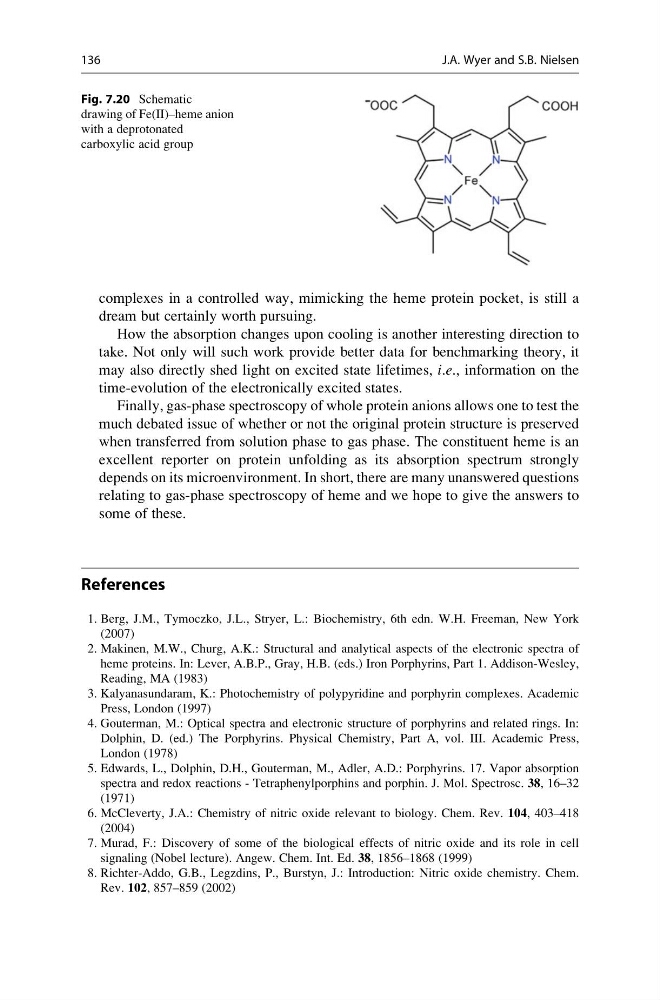
Fig. 7.20 Schematic
drawing of Fe(II)–heme anion
with a deprotonated
carboxylic acid group
136
J.A. Wyer and S.B. Nielsen
dream but certainly worth pursuing.
How the absorption changes upon cooling is another interesting direction to
take. Not only will such work provide better data for benchmarking theory, it
may also directly shed light on excited state lifetimes, i.e., information on the
time-evolution of the electronically excited states.
Finally, gas-phase spectroscopy of whole protein anions allows one to test the
much debated issue of whether or not the original protein structure is preserved
when transferred from solution phase to gas phase. The constituent heme is an
excellent reporter on protein unfolding as its absorption spectrum strongly
depends on its microenvironment. In short, there are many unanswered questions
relating to gas-phase spectroscopy of heme and we hope to give the answers to
some of these.
References
1. Berg, J.M., Tymoczko, J.L., Stryer, L.: Biochemistry, 6th edn. W.H. Freeman, New York
(2007)
2. Makinen, M.W., Churg, A.K.: Structural and analytical aspects of the electronic spectra of
heme proteins. In: Lever, A.B.P., Gray, H.B. (eds.) Iron Porphyrins, Part 1. Addison-Wesley,
Reading, MA (1983)
3. Kalyanasundaram, K.: Photochemistry of polypyridine and porphyrin complexes. Academic
Press, London (1997)
4. Gouterman, M.: Optical spectra and electronic structure of porphyrins and related rings. In:
Dolphin, D. (ed.) The Porphyrins. Physical Chemistry, Part A, vol. III. Academic Press,
London (1978)
5. Edwards, L., Dolphin, D.H., Gouterman, M., Adler, A.D.: Porphyrins. 17. Vapor absorption
spectra and redox reactions - Tetraphenylporphins and porphin. J. Mol. Spectrosc. 38, 16–32
(1971)
6. McCleverty, J.A.: Chemistry of nitric oxide relevant to biology. Chem. Rev. 104, 403–418
(2004)
7. Murad, F.: Discovery of some of the biological effects of nitric oxide and its role in cell
signaling (Nobel lecture). Angew. Chem. Int. Ed. 38, 1856–1868 (1999)
8. Richter-Addo, G.B., Legzdins, P., Burstyn, J.: Introduction: Nitric oxide chemistry. Chem.
Rev. 102, 857–859 (2002)
Fig. 7.20 Schematic
drawing of Fe(II)–heme anion
with a deprotonated
carboxylic acid group
136
J.A. Wyer and S.B. Nielsen