

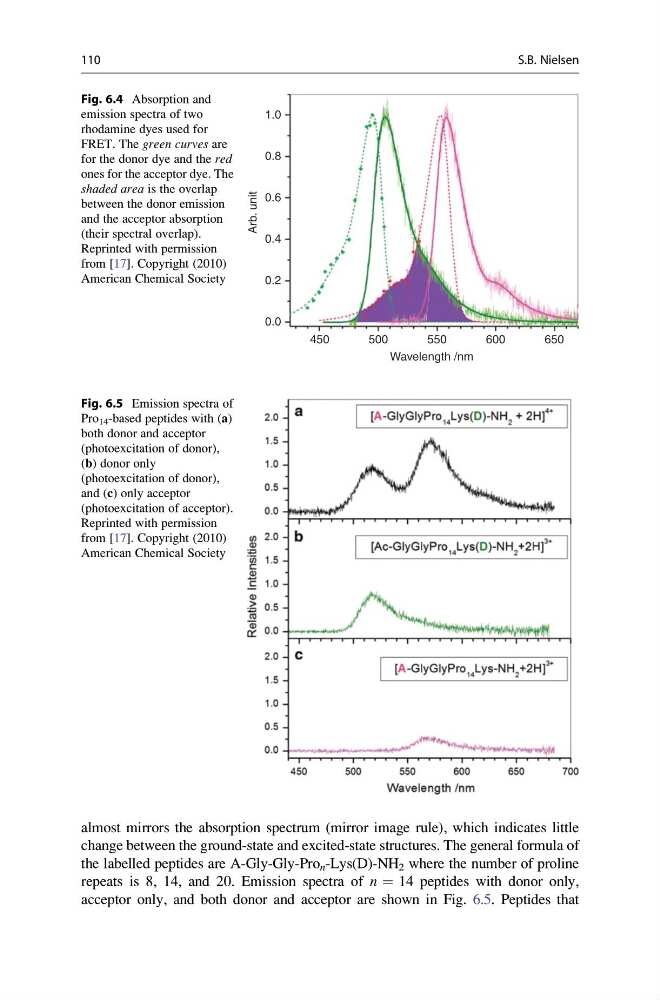
almost mirrors the absorption spectrum (mirror image rule), which indicates little
change between the ground-state and excited-state structures. The general formula of
the labelled peptides are A-Gly-Gly-Pro n -Lys(D)-NH 2 where the number of proline
repeats is 8, 14, and 20. Emission spectra of n ¼ 14 peptides with donor only,
acceptor only, and both donor and acceptor are shown in Fig. 6.5. Peptides that
450
1.0
0.8
0.6
0.4
Arb. unit
0.2
0.0
500
550
Wavelength /nm
600
650
Fig. 6.4 Absorption and
emission spectra of two
rhodamine dyes used for
FRET. The green curves are
for the donor dye and the red
ones for the acceptor dye. The
shaded area is the overlap
between the donor emission
and the acceptor absorption
(their spectral overlap).
Reprinted with permission
from [17]. Copyright (2010)
American Chemical Society
Fig. 6.5 Emission spectra of
Pro 14 -based peptides with (a)
both donor and acceptor
(photoexcitation of donor),
(b) donor only
(photoexcitation of donor),
and (c) only acceptor
(photoexcitation of acceptor).
Reprinted with permission
from [17]. Copyright (2010)
American Chemical Society
110
S.B. Nielsen
change between the ground-state and excited-state structures. The general formula of
the labelled peptides are A-Gly-Gly-Pro n -Lys(D)-NH 2 where the number of proline
repeats is 8, 14, and 20. Emission spectra of n ¼ 14 peptides with donor only,
acceptor only, and both donor and acceptor are shown in Fig. 6.5. Peptides that
450
1.0
0.8
0.6
0.4
Arb. unit
0.2
0.0
500
550
Wavelength /nm
600
650
Fig. 6.4 Absorption and
emission spectra of two
rhodamine dyes used for
FRET. The green curves are
for the donor dye and the red
ones for the acceptor dye. The
shaded area is the overlap
between the donor emission
and the acceptor absorption
(their spectral overlap).
Reprinted with permission
from [17]. Copyright (2010)
American Chemical Society
Fig. 6.5 Emission spectra of
Pro 14 -based peptides with (a)
both donor and acceptor
(photoexcitation of donor),
(b) donor only
(photoexcitation of donor),
and (c) only acceptor
(photoexcitation of acceptor).
Reprinted with permission
from [17]. Copyright (2010)
American Chemical Society
110
S.B. Nielsen