

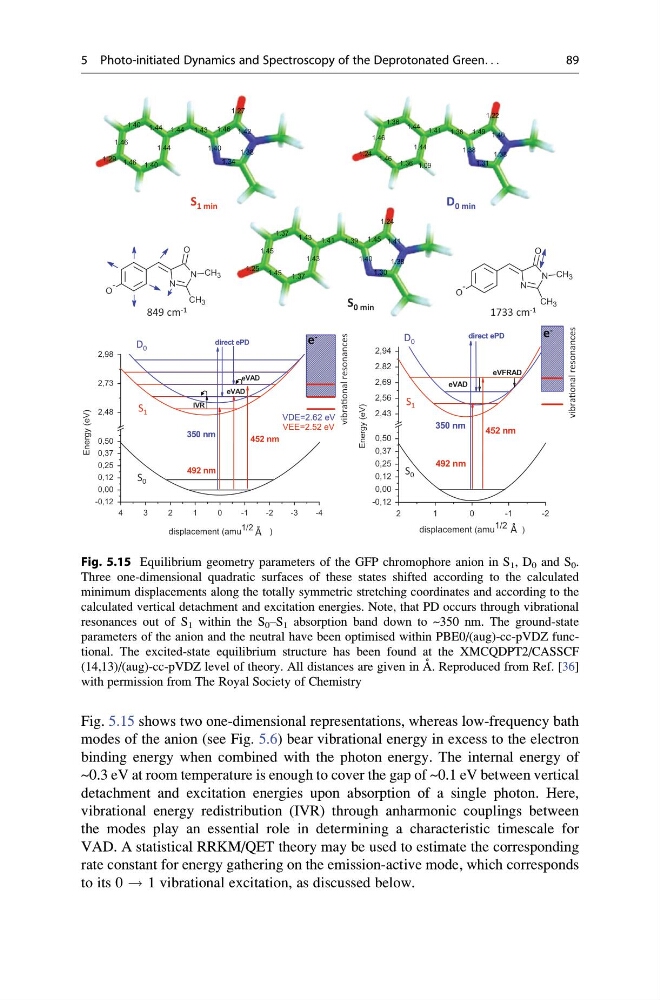
Fig. 5.15 shows two one-dimensional representations, whereas low-frequency bath
modes of the anion (see Fig. 5.6) bear vibrational energy in excess to the electron
binding energy when combined with the photon energy. The internal energy of
~0.3 eV at room temperature is enough to cover the gap of ~0.1 eV between vertical
detachment and excitation energies upon absorption of a single photon. Here,
vibrational energy redistribution (IVR) through anharmonic couplings between
the modes play an essential role in determining a characteristic timescale for
VAD. A statistical RRKM/QET theory may be used to estimate the corresponding
rate constant for energy gathering on the emission-active mode, which corresponds
to its 0 ! 1 vibrational excitation, as discussed below.
1.34
1.38
1.40
1.43 1.46
1.44
1.44
1.44
1.40
1.40
1.46
1.46
1.29
1.27
1.42
1.30
1.38
1.40
1.39 1.45
1.41
1.43
1.43
1.37
1.37
1.45
1.45
1.25
1.24
1.41
4
3
2
1
0
- 1
- 2
- 3
- 4
-0,12
0,00
0,12
0,25
0,37
0,50
2,48
2,73
2,98
IVR
eVAD
eVAD
direct ePD
350 nm
452 nm
VDE=2.62 eV
Energy (eV)
displacement (amu 1/2
)
VEE=2.52 eV
492 nm
O
-
N
N
O
CH 3
CH 3
Å
1.31
1.38
1.38
1.38 1.49
1.41
1.44
1.44
1.36
1.09
1.36
1.46
1.46
1.24
1.22
1.40
S 1 min
D 0 min
S 0 min
S 0
S 1
D 0
849 cm 1
2
1
0
- 1
- 2
-0,12
0,00
0,12
0,25
0,37
0,50
2,43
2,56
2,69
2,82
2,94
eVFRAD
Energy (eV)
displacement (amu 1/2
)
492 nm
350 nm
452 nm
direct ePD
eVAD
Å
O
-
N
N
O
CH 3
CH 3
1733 cm 1
vibraƟonal resonances
vibraƟonal resonances
S 0
S 1
D 0
e
e
Fig. 5.15 Equilibrium geometry parameters of the GFP chromophore anion in S 1 , D 0 and S 0 .
Three one-dimensional quadratic surfaces of these states shifted according to the calculated
minimum displacements along the totally symmetric stretching coordinates and according to the
calculated vertical detachment and excitation energies. Note, that PD occurs through vibrational
resonances out of S 1 within the S 0 –S 1 absorption band down to ~350 nm. The ground-state
parameters of the anion and the neutral have been optimised within PBE0/(aug)-cc-pVDZ functional. The excited-state equilibrium structure has been found at the XMCQDPT2/CASSCF
(14,13)/(aug)-cc-pVDZ level of theory. All distances are given in A ˚ . Reproduced from Ref. [36]
with permission from The Royal Society of Chemistry
5 Photo-initiated Dynamics and Spectroscopy of the Deprotonated Green. . .
89
modes of the anion (see Fig. 5.6) bear vibrational energy in excess to the electron
binding energy when combined with the photon energy. The internal energy of
~0.3 eV at room temperature is enough to cover the gap of ~0.1 eV between vertical
detachment and excitation energies upon absorption of a single photon. Here,
vibrational energy redistribution (IVR) through anharmonic couplings between
the modes play an essential role in determining a characteristic timescale for
VAD. A statistical RRKM/QET theory may be used to estimate the corresponding
rate constant for energy gathering on the emission-active mode, which corresponds
to its 0 ! 1 vibrational excitation, as discussed below.
1.34
1.38
1.40
1.43 1.46
1.44
1.44
1.44
1.40
1.40
1.46
1.46
1.29
1.27
1.42
1.30
1.38
1.40
1.39 1.45
1.41
1.43
1.43
1.37
1.37
1.45
1.45
1.25
1.24
1.41
4
3
2
1
0
- 1
- 2
- 3
- 4
-0,12
0,00
0,12
0,25
0,37
0,50
2,48
2,73
2,98
IVR
eVAD
eVAD
direct ePD
350 nm
452 nm
VDE=2.62 eV
Energy (eV)
displacement (amu 1/2
)
VEE=2.52 eV
492 nm
O
-
N
N
O
CH 3
CH 3
Å
1.31
1.38
1.38
1.38 1.49
1.41
1.44
1.44
1.36
1.09
1.36
1.46
1.46
1.24
1.22
1.40
S 1 min
D 0 min
S 0 min
S 0
S 1
D 0
849 cm 1
2
1
0
- 1
- 2
-0,12
0,00
0,12
0,25
0,37
0,50
2,43
2,56
2,69
2,82
2,94
eVFRAD
Energy (eV)
displacement (amu 1/2
)
492 nm
350 nm
452 nm
direct ePD
eVAD
Å
O
-
N
N
O
CH 3
CH 3
1733 cm 1
vibraƟonal resonances
vibraƟonal resonances
S 0
S 1
D 0
e
e
Fig. 5.15 Equilibrium geometry parameters of the GFP chromophore anion in S 1 , D 0 and S 0 .
Three one-dimensional quadratic surfaces of these states shifted according to the calculated
minimum displacements along the totally symmetric stretching coordinates and according to the
calculated vertical detachment and excitation energies. Note, that PD occurs through vibrational
resonances out of S 1 within the S 0 –S 1 absorption band down to ~350 nm. The ground-state
parameters of the anion and the neutral have been optimised within PBE0/(aug)-cc-pVDZ functional. The excited-state equilibrium structure has been found at the XMCQDPT2/CASSCF
(14,13)/(aug)-cc-pVDZ level of theory. All distances are given in A ˚ . Reproduced from Ref. [36]
with permission from The Royal Society of Chemistry
5 Photo-initiated Dynamics and Spectroscopy of the Deprotonated Green. . .
89