

1 Nanoplasmonics: From Present into Future
83
1.5.8.1 Discussion of Spasing and Loss Compensation by Gain
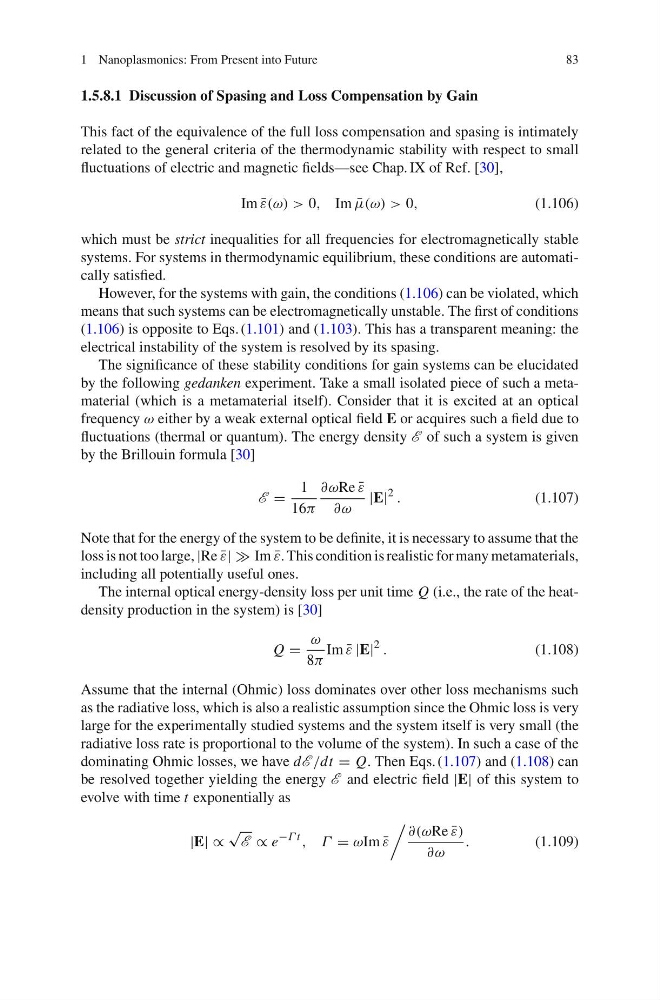
This fact of the equivalence of the full loss compensation and spasing is intimately
related to the general criteria of the thermodynamic stability with respect to small
fluctuations of electric and magnetic fields—see Chap. IX of Ref. [30],
Im ¯
ε(ω) > 0, Im ¯
μ(ω) > 0,
(1.106)
which must be strict inequalities for all frequencies for electromagnetically stable
systems. For systems in thermodynamic equilibrium, these conditions are automatically satisfied.
However, for the systems with gain, the conditions (1.106) can be violated, which
means that such systems can be electromagnetically unstable. The first of conditions
(1.106) is opposite to Eqs. (1.101) and (1.103). This has a transparent meaning: the
electrical instability of the system is resolved by its spasing.
The significance of these stability conditions for gain systems can be elucidated
by the following gedanken experiment. Take a small isolated piece of such a metamaterial (which is a metamaterial itself). Consider that it is excited at an optical
frequency ω either by a weak external optical field E or acquires such a field due to
fluctuations (thermal or quantum). The energy density E of such a system is given
by the Brillouin formula [30]
E =
1
16π
∂ωRe ¯
ε
∂ω
|E|
2
.
(1.107)
Note that for the energy of the system to be definite, it is necessary to assume that the
loss is not too large, |Re ¯
ε| | Im ¯
ε. This condition is realistic for many metamaterials,
including all potentially useful ones.
The internal optical energy-density loss per unit time Q (i.e., the rate of the heatdensity production in the system) is [30]
Q =
ω
8π
Im ¯
ε |E|
2
.
(1.108)
Assume that the internal (Ohmic) loss dominates over other loss mechanisms such
as the radiative loss, which is also a realistic assumption since the Ohmic loss is very
large for the experimentally studied systems and the system itself is very small (the
radiative loss rate is proportional to the volume of the system). In such a case of the
dominating Ohmic losses, we have dE /dt = Q. Then Eqs. (1.107) and (1.108) can
be resolved together yielding the energy E and electric field |E| of this system to
evolve with time t exponentially as
|E| ∝
√
E ∝ e
−Γ t
, Γ = ωIm ¯
ε
∂(ωRe ¯
ε)
∂ω
.
(1.109)
83
1.5.8.1 Discussion of Spasing and Loss Compensation by Gain
This fact of the equivalence of the full loss compensation and spasing is intimately
related to the general criteria of the thermodynamic stability with respect to small
fluctuations of electric and magnetic fields—see Chap. IX of Ref. [30],
Im ¯
ε(ω) > 0, Im ¯
μ(ω) > 0,
(1.106)
which must be strict inequalities for all frequencies for electromagnetically stable
systems. For systems in thermodynamic equilibrium, these conditions are automatically satisfied.
However, for the systems with gain, the conditions (1.106) can be violated, which
means that such systems can be electromagnetically unstable. The first of conditions
(1.106) is opposite to Eqs. (1.101) and (1.103). This has a transparent meaning: the
electrical instability of the system is resolved by its spasing.
The significance of these stability conditions for gain systems can be elucidated
by the following gedanken experiment. Take a small isolated piece of such a metamaterial (which is a metamaterial itself). Consider that it is excited at an optical
frequency ω either by a weak external optical field E or acquires such a field due to
fluctuations (thermal or quantum). The energy density E of such a system is given
by the Brillouin formula [30]
E =
1
16π
∂ωRe ¯
ε
∂ω
|E|
2
.
(1.107)
Note that for the energy of the system to be definite, it is necessary to assume that the
loss is not too large, |Re ¯
ε| | Im ¯
ε. This condition is realistic for many metamaterials,
including all potentially useful ones.
The internal optical energy-density loss per unit time Q (i.e., the rate of the heatdensity production in the system) is [30]
Q =
ω
8π
Im ¯
ε |E|
2
.
(1.108)
Assume that the internal (Ohmic) loss dominates over other loss mechanisms such
as the radiative loss, which is also a realistic assumption since the Ohmic loss is very
large for the experimentally studied systems and the system itself is very small (the
radiative loss rate is proportional to the volume of the system). In such a case of the
dominating Ohmic losses, we have dE /dt = Q. Then Eqs. (1.107) and (1.108) can
be resolved together yielding the energy E and electric field |E| of this system to
evolve with time t exponentially as
|E| ∝
√
E ∝ e
−Γ t
, Γ = ωIm ¯
ε
∂(ωRe ¯
ε)
∂ω
.
(1.109)