

1 Nanoplasmonics: From Present into Future
67
1.5.4.2 Equations for CW Regime
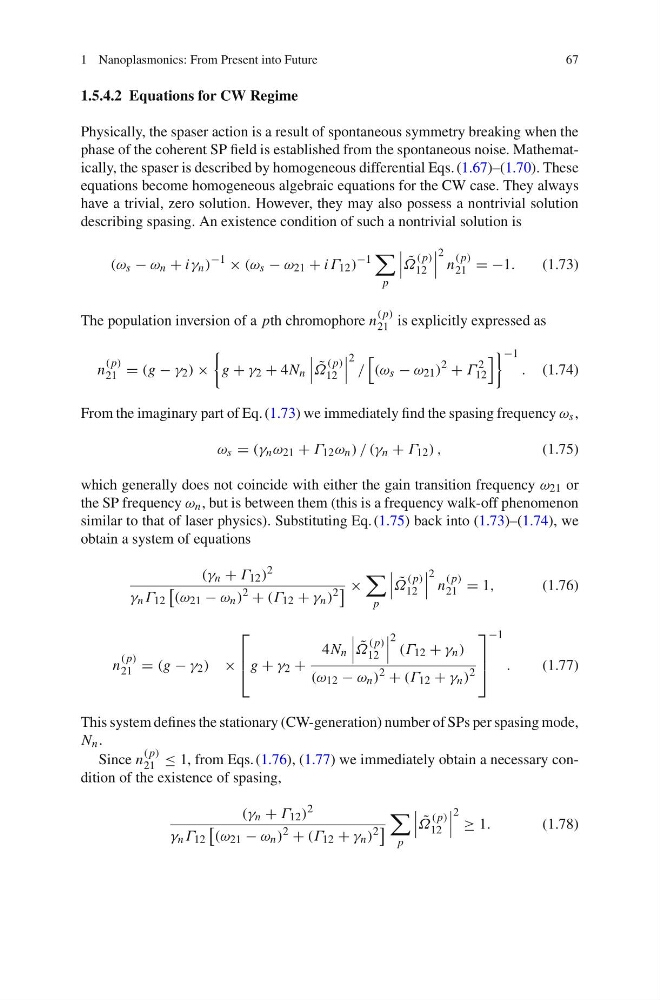
Physically, the spaser action is a result of spontaneous symmetry breaking when the
phase of the coherent SP field is established from the spontaneous noise. Mathematically, the spaser is described by homogeneous differential Eqs. (1.67)–(1.70). These
equations become homogeneous algebraic equations for the CW case. They always
have a trivial, zero solution. However, they may also possess a nontrivial solution
describing spasing. An existence condition of such a nontrivial solution is
(ω s − ω n + iγ n )
−1
× (ω s − ω 21 + iΓ 12 )
−1
p
˜
Ω
( p)
12
2
n
( p)
21 = −1.
(1.73)
The population inversion of a pth chromophore n
( p)
21 is explicitly expressed as
n
( p)
21 = (g − γ 2 ) ×
g + γ 2 + 4N n
˜
Ω
( p)
12
2 /
(ω s − ω 21 )
2
+ Γ
2
12
⎛ −1
. (1.74)
From the imaginary part of Eq. (1.73) we immediately find the spasing frequency ω s ,
ω s = (γ n ω 21 + Γ 12 ω n ) / (γ n + Γ 12 ) ,
(1.75)
which generally does not coincide with either the gain transition frequency ω 21 or
the SP frequency ω n , but is between them (this is a frequency walk-off phenomenon
similar to that of laser physics). Substituting Eq. (1.75) back into (1.73)–(1.74), we
obtain a system of equations
(γ n + Γ 12 )
2
γ n Γ 12
(ω 21 − ω n )
2
+ (Γ 12 + γ n )
2
×
p
˜
Ω
( p)
12
2
n
( p)
21 = 1,
(1.76)
n
( p)
21 = (g − γ 2 ) ×
⎡
⎢
⎣g + γ 2 +
4N n
˜
Ω
( p)
12
2 (Γ 12 + γ n )
(ω 12 − ω n )
2
+ (Γ 12 + γ n )
2
⎤
⎥
⎦
−1
.
(1.77)
This system defines the stationary (CW-generation) number of SPs per spasing mode,
N n .
Since n
( p)
21 ≤ 1, from Eqs. (1.76), (1.77) we immediately obtain a necessary condition of the existence of spasing,
(γ n + Γ 12 )
2
γ n Γ 12
(ω 21 − ω n )
2
+ (Γ 12 + γ n )
2
p
˜
Ω
( p)
12
2 ≥ 1.
(1.78)
67
1.5.4.2 Equations for CW Regime
Physically, the spaser action is a result of spontaneous symmetry breaking when the
phase of the coherent SP field is established from the spontaneous noise. Mathematically, the spaser is described by homogeneous differential Eqs. (1.67)–(1.70). These
equations become homogeneous algebraic equations for the CW case. They always
have a trivial, zero solution. However, they may also possess a nontrivial solution
describing spasing. An existence condition of such a nontrivial solution is
(ω s − ω n + iγ n )
−1
× (ω s − ω 21 + iΓ 12 )
−1
p
˜
Ω
( p)
12
2
n
( p)
21 = −1.
(1.73)
The population inversion of a pth chromophore n
( p)
21 is explicitly expressed as
n
( p)
21 = (g − γ 2 ) ×
g + γ 2 + 4N n
˜
Ω
( p)
12
2 /
(ω s − ω 21 )
2
+ Γ
2
12
⎛ −1
. (1.74)
From the imaginary part of Eq. (1.73) we immediately find the spasing frequency ω s ,
ω s = (γ n ω 21 + Γ 12 ω n ) / (γ n + Γ 12 ) ,
(1.75)
which generally does not coincide with either the gain transition frequency ω 21 or
the SP frequency ω n , but is between them (this is a frequency walk-off phenomenon
similar to that of laser physics). Substituting Eq. (1.75) back into (1.73)–(1.74), we
obtain a system of equations
(γ n + Γ 12 )
2
γ n Γ 12
(ω 21 − ω n )
2
+ (Γ 12 + γ n )
2
×
p
˜
Ω
( p)
12
2
n
( p)
21 = 1,
(1.76)
n
( p)
21 = (g − γ 2 ) ×
⎡
⎢
⎣g + γ 2 +
4N n
˜
Ω
( p)
12
2 (Γ 12 + γ n )
(ω 12 − ω n )
2
+ (Γ 12 + γ n )
2
⎤
⎥
⎦
−1
.
(1.77)
This system defines the stationary (CW-generation) number of SPs per spasing mode,
N n .
Since n
( p)
21 ≤ 1, from Eqs. (1.76), (1.77) we immediately obtain a necessary condition of the existence of spasing,
(γ n + Γ 12 )
2
γ n Γ 12
(ω 21 − ω n )
2
+ (Γ 12 + γ n )
2
p
˜
Ω
( p)
12
2 ≥ 1.
(1.78)