

1 Nanoplasmonics: From Present into Future
57
Energy transfer
e-h pairs
Exciton
Plasmon
Gain medium Nanoshell
(b)
(a)
(d)
(c)
(e)
N
a n o s h e l l
N
a n o s h e l l
G a in M e d iu m
G a in M e d iu m
< 50 nm
< 50 nm
0
cm
V
10 6
cm
V
1.5×10 6
0
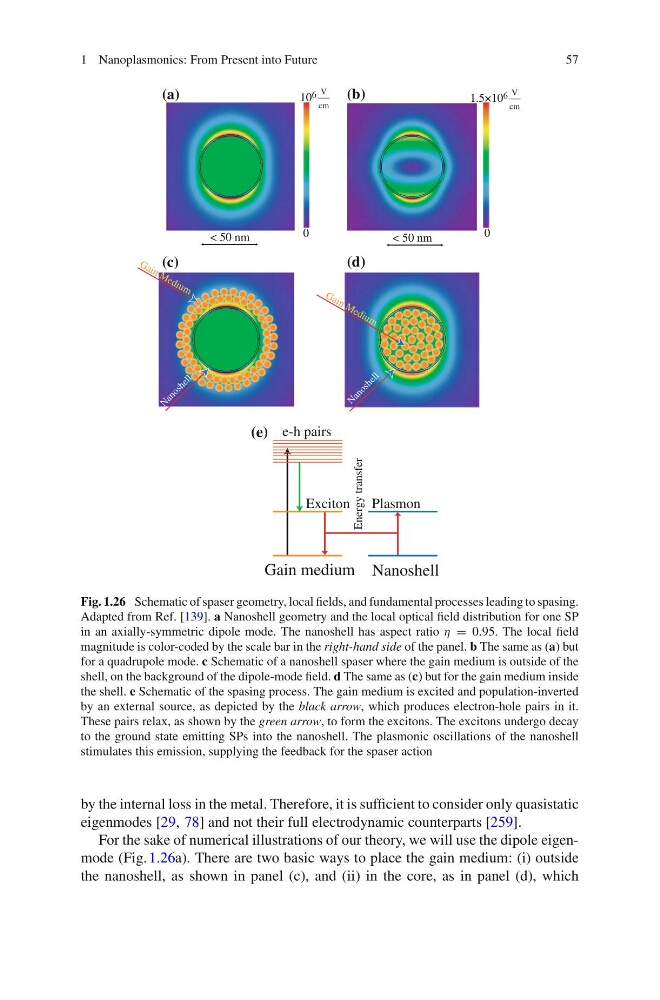
Fig. 1.26 Schematic of spaser geometry, local fields, and fundamental processes leading to spasing.
Adapted from Ref. [139]. a Nanoshell geometry and the local optical field distribution for one SP
in an axially-symmetric dipole mode. The nanoshell has aspect ratio η = 0.95. The local field
magnitude is color-coded by the scale bar in the right-hand side of the panel. b The same as (a) but
for a quadrupole mode. c Schematic of a nanoshell spaser where the gain medium is outside of the
shell, on the background of the dipole-mode field. d The same as (c) but for the gain medium inside
the shell. e Schematic of the spasing process. The gain medium is excited and population-inverted
by an external source, as depicted by the black arrow, which produces electron-hole pairs in it.
These pairs relax, as shown by the green arrow, to form the excitons. The excitons undergo decay
to the ground state emitting SPs into the nanoshell. The plasmonic oscillations of the nanoshell
stimulates this emission, supplying the feedback for the spaser action
by the internal loss in the metal. Therefore, it is sufficient to consider only quasistatic
eigenmodes [29, 78] and not their full electrodynamic counterparts [259].
For the sake of numerical illustrations of our theory, we will use the dipole eigenmode (Fig. 1.26a). There are two basic ways to place the gain medium: (i) outside
the nanoshell, as shown in panel (c), and (ii) in the core, as in panel (d), which
57
Energy transfer
e-h pairs
Exciton
Plasmon
Gain medium Nanoshell
(b)
(a)
(d)
(c)
(e)
N
a n o s h e l l
N
a n o s h e l l
G a in M e d iu m
G a in M e d iu m
< 50 nm
< 50 nm
0
cm
V
10 6
cm
V
1.5×10 6
0
Fig. 1.26 Schematic of spaser geometry, local fields, and fundamental processes leading to spasing.
Adapted from Ref. [139]. a Nanoshell geometry and the local optical field distribution for one SP
in an axially-symmetric dipole mode. The nanoshell has aspect ratio η = 0.95. The local field
magnitude is color-coded by the scale bar in the right-hand side of the panel. b The same as (a) but
for a quadrupole mode. c Schematic of a nanoshell spaser where the gain medium is outside of the
shell, on the background of the dipole-mode field. d The same as (c) but for the gain medium inside
the shell. e Schematic of the spasing process. The gain medium is excited and population-inverted
by an external source, as depicted by the black arrow, which produces electron-hole pairs in it.
These pairs relax, as shown by the green arrow, to form the excitons. The excitons undergo decay
to the ground state emitting SPs into the nanoshell. The plasmonic oscillations of the nanoshell
stimulates this emission, supplying the feedback for the spaser action
by the internal loss in the metal. Therefore, it is sufficient to consider only quasistatic
eigenmodes [29, 78] and not their full electrodynamic counterparts [259].
For the sake of numerical illustrations of our theory, we will use the dipole eigenmode (Fig. 1.26a). There are two basic ways to place the gain medium: (i) outside
the nanoshell, as shown in panel (c), and (ii) in the core, as in panel (d), which