

1 Nanoplasmonics: From Present into Future
51
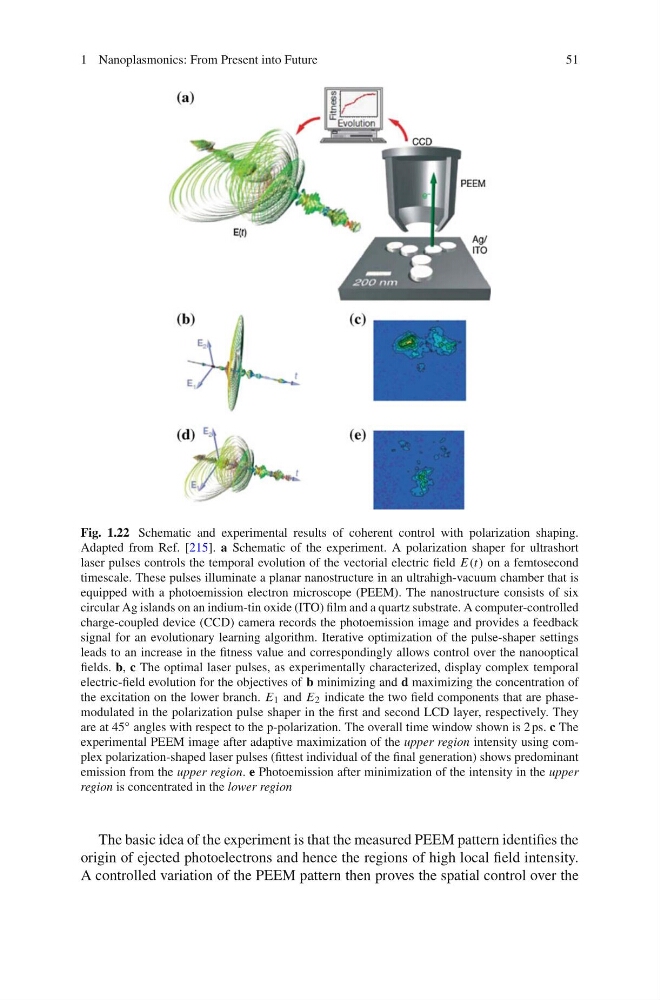
Fig. 1.22 Schematic and experimental results of coherent control with polarization shaping.
Adapted from Ref. [215]. a Schematic of the experiment. A polarization shaper for ultrashort
laser pulses controls the temporal evolution of the vectorial electric field E(t) on a femtosecond
timescale. These pulses illuminate a planar nanostructure in an ultrahigh-vacuum chamber that is
equipped with a photoemission electron microscope (PEEM). The nanostructure consists of six
circular Ag islands on an indium-tin oxide (ITO) film and a quartz substrate. A computer-controlled
charge-coupled device (CCD) camera records the photoemission image and provides a feedback
signal for an evolutionary learning algorithm. Iterative optimization of the pulse-shaper settings
leads to an increase in the fitness value and correspondingly allows control over the nanooptical
fields. b, c The optimal laser pulses, as experimentally characterized, display complex temporal
electric-field evolution for the objectives of b minimizing and d maximizing the concentration of
the excitation on the lower branch. E 1 and E 2 indicate the two field components that are phasemodulated in the polarization pulse shaper in the first and second LCD layer, respectively. They
are at 45 ◦ angles with respect to the p-polarization. The overall time window shown is 2 ps. c The
experimental PEEM image after adaptive maximization of the upper region intensity using complex polarization-shaped laser pulses (fittest individual of the final generation) shows predominant
emission from the upper region. e Photoemission after minimization of the intensity in the upper
region is concentrated in the lower region
The basic idea of the experiment is that the measured PEEM pattern identifies the
origin of ejected photoelectrons and hence the regions of high local field intensity.
A controlled variation of the PEEM pattern then proves the spatial control over the
51
Fig. 1.22 Schematic and experimental results of coherent control with polarization shaping.
Adapted from Ref. [215]. a Schematic of the experiment. A polarization shaper for ultrashort
laser pulses controls the temporal evolution of the vectorial electric field E(t) on a femtosecond
timescale. These pulses illuminate a planar nanostructure in an ultrahigh-vacuum chamber that is
equipped with a photoemission electron microscope (PEEM). The nanostructure consists of six
circular Ag islands on an indium-tin oxide (ITO) film and a quartz substrate. A computer-controlled
charge-coupled device (CCD) camera records the photoemission image and provides a feedback
signal for an evolutionary learning algorithm. Iterative optimization of the pulse-shaper settings
leads to an increase in the fitness value and correspondingly allows control over the nanooptical
fields. b, c The optimal laser pulses, as experimentally characterized, display complex temporal
electric-field evolution for the objectives of b minimizing and d maximizing the concentration of
the excitation on the lower branch. E 1 and E 2 indicate the two field components that are phasemodulated in the polarization pulse shaper in the first and second LCD layer, respectively. They
are at 45 ◦ angles with respect to the p-polarization. The overall time window shown is 2 ps. c The
experimental PEEM image after adaptive maximization of the upper region intensity using complex polarization-shaped laser pulses (fittest individual of the final generation) shows predominant
emission from the upper region. e Photoemission after minimization of the intensity in the upper
region is concentrated in the lower region
The basic idea of the experiment is that the measured PEEM pattern identifies the
origin of ejected photoelectrons and hence the regions of high local field intensity.
A controlled variation of the PEEM pattern then proves the spatial control over the