

1 Nanoplasmonics: From Present into Future
49
1
2
3
4
5
1
2
3
4
5
6
y (µm)
t (fs)
×1/100
x
(µm)
t (fs)
(c)
t (fs)
(d)
(e)
(a)
-0.5
-0.25
0.5
0.25
0
(eV)
1.5
3.5
0.5
-0.5
0
0.5
-0.5
0
0.5
-0.5
0
t (fs)
E (b)
||
E ||
E ||
E ||
30
60
90
120
150
30 60 90 120 150
30 60 90 120 150
30 60 90 120 150
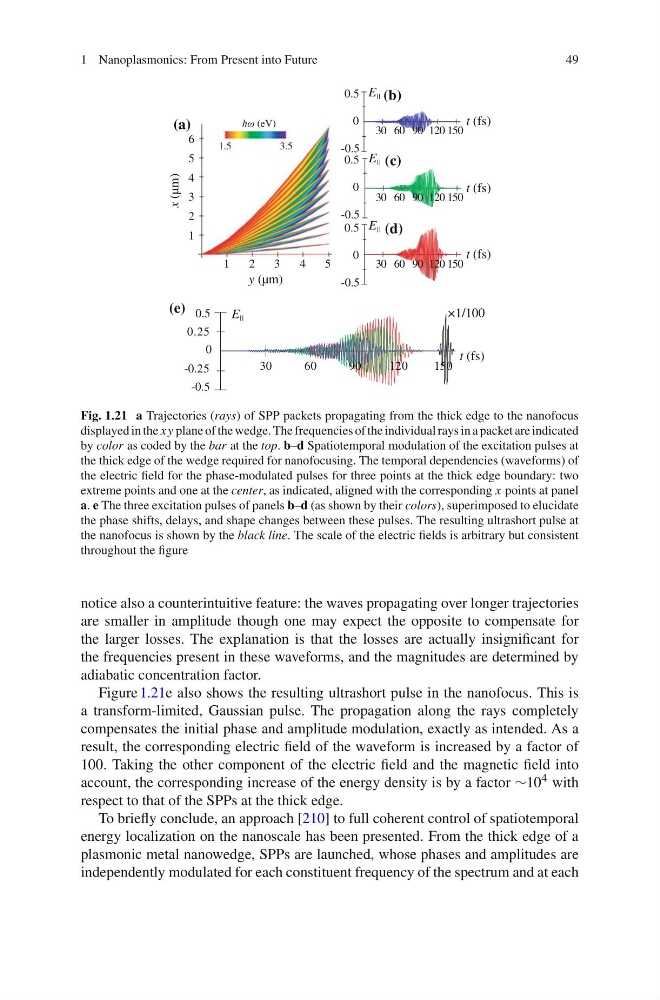
Fig. 1.21 a Trajectories (rays) of SPP packets propagating from the thick edge to the nanofocus
displayed in the xy plane of the wedge. The frequencies of the individual rays in a packet are indicated
by color as coded by the bar at the top. b–d Spatiotemporal modulation of the excitation pulses at
the thick edge of the wedge required for nanofocusing. The temporal dependencies (waveforms) of
the electric field for the phase-modulated pulses for three points at the thick edge boundary: two
extreme points and one at the center, as indicated, aligned with the corresponding x points at panel
a. e The three excitation pulses of panels b–d (as shown by their colors), superimposed to elucidate
the phase shifts, delays, and shape changes between these pulses. The resulting ultrashort pulse at
the nanofocus is shown by the black line. The scale of the electric fields is arbitrary but consistent
throughout the figure
notice also a counterintuitive feature: the waves propagating over longer trajectories
are smaller in amplitude though one may expect the opposite to compensate for
the larger losses. The explanation is that the losses are actually insignificant for
the frequencies present in these waveforms, and the magnitudes are determined by
adiabatic concentration factor.
Figure 1.21e also shows the resulting ultrashort pulse in the nanofocus. This is
a transform-limited, Gaussian pulse. The propagation along the rays completely
compensates the initial phase and amplitude modulation, exactly as intended. As a
result, the corresponding electric field of the waveform is increased by a factor of
100. Taking the other component of the electric field and the magnetic field into
account, the corresponding increase of the energy density is by a factor ∼10 4 with
respect to that of the SPPs at the thick edge.
To briefly conclude, an approach [210] to full coherent control of spatiotemporal
energy localization on the nanoscale has been presented. From the thick edge of a
plasmonic metal nanowedge, SPPs are launched, whose phases and amplitudes are
independently modulated for each constituent frequency of the spectrum and at each
49
1
2
3
4
5
1
2
3
4
5
6
y (µm)
t (fs)
×1/100
x
(µm)
t (fs)
(c)
t (fs)
(d)
(e)
(a)
-0.5
-0.25
0.5
0.25
0
(eV)
1.5
3.5
0.5
-0.5
0
0.5
-0.5
0
0.5
-0.5
0
t (fs)
E (b)
||
E ||
E ||
E ||
30
60
90
120
150
30 60 90 120 150
30 60 90 120 150
30 60 90 120 150
Fig. 1.21 a Trajectories (rays) of SPP packets propagating from the thick edge to the nanofocus
displayed in the xy plane of the wedge. The frequencies of the individual rays in a packet are indicated
by color as coded by the bar at the top. b–d Spatiotemporal modulation of the excitation pulses at
the thick edge of the wedge required for nanofocusing. The temporal dependencies (waveforms) of
the electric field for the phase-modulated pulses for three points at the thick edge boundary: two
extreme points and one at the center, as indicated, aligned with the corresponding x points at panel
a. e The three excitation pulses of panels b–d (as shown by their colors), superimposed to elucidate
the phase shifts, delays, and shape changes between these pulses. The resulting ultrashort pulse at
the nanofocus is shown by the black line. The scale of the electric fields is arbitrary but consistent
throughout the figure
notice also a counterintuitive feature: the waves propagating over longer trajectories
are smaller in amplitude though one may expect the opposite to compensate for
the larger losses. The explanation is that the losses are actually insignificant for
the frequencies present in these waveforms, and the magnitudes are determined by
adiabatic concentration factor.
Figure 1.21e also shows the resulting ultrashort pulse in the nanofocus. This is
a transform-limited, Gaussian pulse. The propagation along the rays completely
compensates the initial phase and amplitude modulation, exactly as intended. As a
result, the corresponding electric field of the waveform is increased by a factor of
100. Taking the other component of the electric field and the magnetic field into
account, the corresponding increase of the energy density is by a factor ∼10 4 with
respect to that of the SPPs at the thick edge.
To briefly conclude, an approach [210] to full coherent control of spatiotemporal
energy localization on the nanoscale has been presented. From the thick edge of a
plasmonic metal nanowedge, SPPs are launched, whose phases and amplitudes are
independently modulated for each constituent frequency of the spectrum and at each