

15 Cooperative Effects in Plasmonics
561
Acknowledgments This work was supported in part through NSF under Grant DMR-1206975,
CREST Center, and EPSCOR program.
Appendix
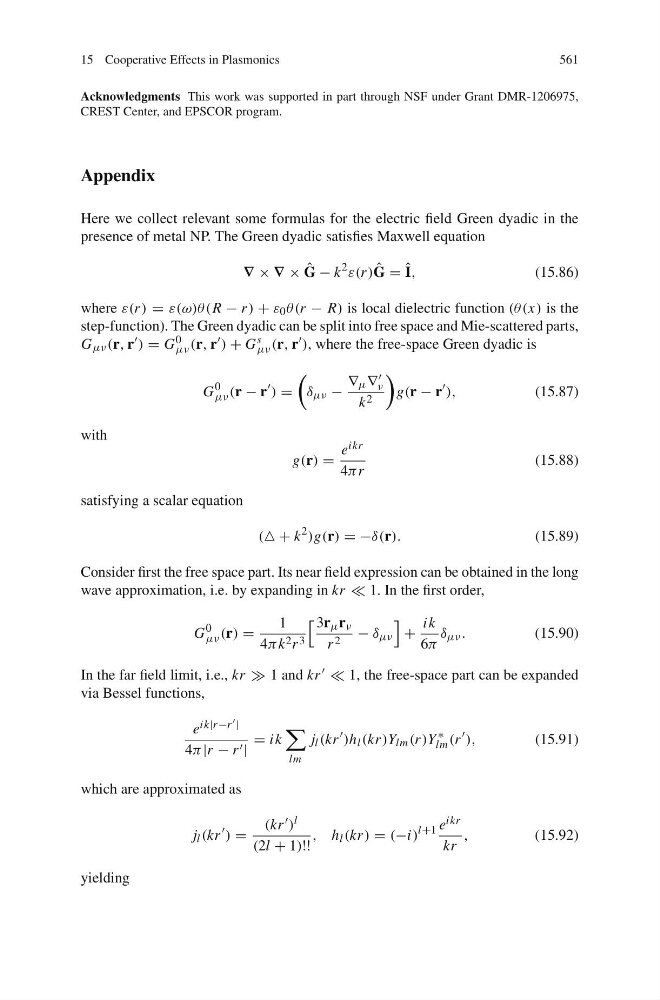
Here we collect relevant some formulas for the electric field Green dyadic in the
presence of metal NP. The Green dyadic satisfies Maxwell equation
∇ × ∇ × ˆ
G − k
2
ε(r ) ˆ
G = ˆ
I,
(15.86)
where ε(r ) = ε(ω)θ(R − r ) + ε 0 θ(r − R) is local dielectric function (θ(x) is the
step-function). The Green dyadic can be split into free space and Mie-scattered parts,
G μν (r, r √ ) = G 0
μν (r, r √ ) + G s
μν (r, r √ ), where the free-space Green dyadic is
G
0
μν (r − r
√
) =
δ μν −
∞ μ ∞ √
ν
k 2
g(r − r
√
),
(15.87)
with
g(r) =
e ikr
4πr
(15.88)
satisfying a scalar equation
( + k
2
)g(r) = −δ(r).
(15.89)
Consider first the free space part. Its near field expression can be obtained in the long
wave approximation, i.e. by expanding in kr ∝ 1. In the first order,
G
0
μν (r) =
1
4π k 2 r 3
3r μ r ν
r 2 − δ μν
+
ik
6π
δ μν .
(15.90)
In the far field limit, i.e., kr ≈ 1 and kr √ ∝ 1, the free-space part can be expanded
via Bessel functions,
e ik|r −r √ |
4π |r − r √ |
= ik
lm
j l (kr
√
)h l (kr)Y lm (r )Y
∗
lm (r
√
),
(15.91)
which are approximated as
j l (kr
√
) =
(kr √ ) l
(2l + 1)!!
, h l (kr) = (−i)
l+1 e ikr
kr
,
(15.92)
yielding
561
Acknowledgments This work was supported in part through NSF under Grant DMR-1206975,
CREST Center, and EPSCOR program.
Appendix
Here we collect relevant some formulas for the electric field Green dyadic in the
presence of metal NP. The Green dyadic satisfies Maxwell equation
∇ × ∇ × ˆ
G − k
2
ε(r ) ˆ
G = ˆ
I,
(15.86)
where ε(r ) = ε(ω)θ(R − r ) + ε 0 θ(r − R) is local dielectric function (θ(x) is the
step-function). The Green dyadic can be split into free space and Mie-scattered parts,
G μν (r, r √ ) = G 0
μν (r, r √ ) + G s
μν (r, r √ ), where the free-space Green dyadic is
G
0
μν (r − r
√
) =
δ μν −
∞ μ ∞ √
ν
k 2
g(r − r
√
),
(15.87)
with
g(r) =
e ikr
4πr
(15.88)
satisfying a scalar equation
( + k
2
)g(r) = −δ(r).
(15.89)
Consider first the free space part. Its near field expression can be obtained in the long
wave approximation, i.e. by expanding in kr ∝ 1. In the first order,
G
0
μν (r) =
1
4π k 2 r 3
3r μ r ν
r 2 − δ μν
+
ik
6π
δ μν .
(15.90)
In the far field limit, i.e., kr ≈ 1 and kr √ ∝ 1, the free-space part can be expanded
via Bessel functions,
e ik|r −r √ |
4π |r − r √ |
= ik
lm
j l (kr
√
)h l (kr)Y lm (r )Y
∗
lm (r
√
),
(15.91)
which are approximated as
j l (kr
√
) =
(kr √ ) l
(2l + 1)!!
, h l (kr) = (−i)
l+1 e ikr
kr
,
(15.92)
yielding