

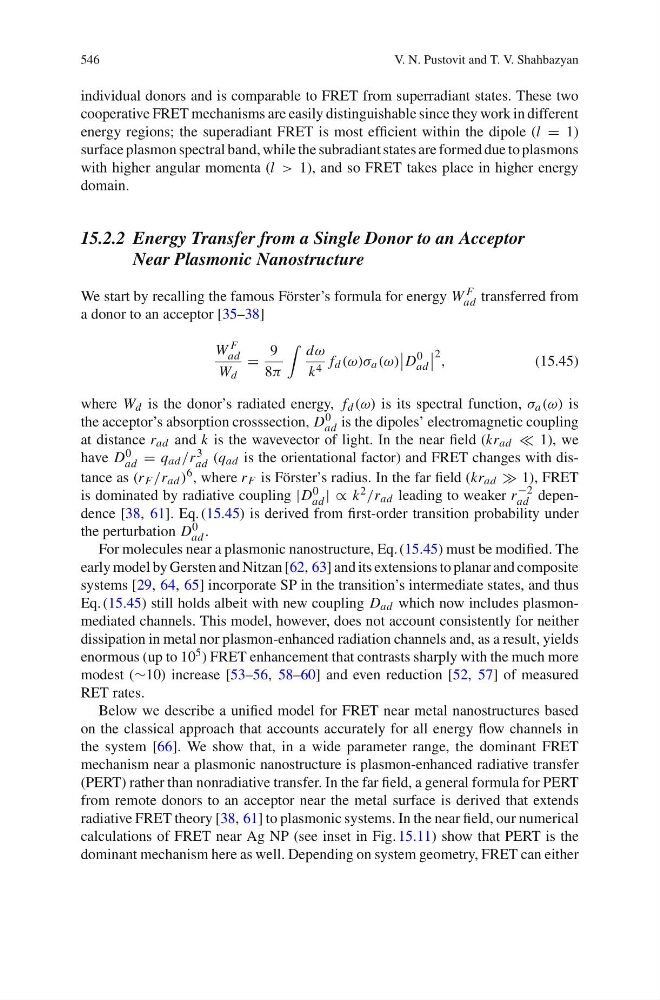
546
V. N. Pustovit and T. V. Shahbazyan
individual donors and is comparable to FRET from superradiant states. These two
cooperative FRET mechanisms are easily distinguishable since they work in different
energy regions; the superadiant FRET is most efficient within the dipole (l = 1)
surface plasmon spectral band, while the subradiant states are formed due to plasmons
with higher angular momenta (l > 1), and so FRET takes place in higher energy
domain.
15.2.2 Energy Transfer from a Single Donor to an Acceptor
Near Plasmonic Nanostructure
We start by recalling the famous Förster’s formula for energy W F
ad transferred from
a donor to an acceptor [35–38]
W F
ad
W d
=
9
8π
dω
k 4 f d (ω)σ a (ω)
D
0
ad
2 ,
(15.45)
where W d is the donor’s radiated energy, f d (ω) is its spectral function, σ a (ω) is
the acceptor’s absorption crosssection, D 0
ad is the dipoles’ electromagnetic coupling
at distance r ad and k is the wavevector of light. In the near field (kr ad ∝ 1), we
have D 0
ad = q ad /r 3
ad (q ad is the orientational factor) and FRET changes with distance as (r F /r ad )
6 , where r F is Förster’s radius. In the far field (kr ad ≈ 1), FRET
is dominated by radiative coupling |D 0
ad | ∼ k 2 /r ad leading to weaker r
−2
ad dependence [38, 61]. Eq. (15.45) is derived from first-order transition probability under
the perturbation D 0
ad .
For molecules near a plasmonic nanostructure, Eq. (15.45) must be modified. The
early model by Gersten and Nitzan [62, 63] and its extensions to planar and composite
systems [29, 64, 65] incorporate SP in the transition’s intermediate states, and thus
Eq. (15.45) still holds albeit with new coupling D ad which now includes plasmonmediated channels. This model, however, does not account consistently for neither
dissipation in metal nor plasmon-enhanced radiation channels and, as a result, yields
enormous (up to 10 5 ) FRET enhancement that contrasts sharply with the much more
modest (∪10) increase [53–56, 58–60] and even reduction [52, 57] of measured
RET rates.
Below we describe a unified model for FRET near metal nanostructures based
on the classical approach that accounts accurately for all energy flow channels in
the system [66]. We show that, in a wide parameter range, the dominant FRET
mechanism near a plasmonic nanostructure is plasmon-enhanced radiative transfer
(PERT) rather than nonradiative transfer. In the far field, a general formula for PERT
from remote donors to an acceptor near the metal surface is derived that extends
radiative FRET theory [38, 61] to plasmonic systems. In the near field, our numerical
calculations of FRET near Ag NP (see inset in Fig. 15.11) show that PERT is the
dominant mechanism here as well. Depending on system geometry, FRET can either
V. N. Pustovit and T. V. Shahbazyan
individual donors and is comparable to FRET from superradiant states. These two
cooperative FRET mechanisms are easily distinguishable since they work in different
energy regions; the superadiant FRET is most efficient within the dipole (l = 1)
surface plasmon spectral band, while the subradiant states are formed due to plasmons
with higher angular momenta (l > 1), and so FRET takes place in higher energy
domain.
15.2.2 Energy Transfer from a Single Donor to an Acceptor
Near Plasmonic Nanostructure
We start by recalling the famous Förster’s formula for energy W F
ad transferred from
a donor to an acceptor [35–38]
W F
ad
W d
=
9
8π
dω
k 4 f d (ω)σ a (ω)
D
0
ad
2 ,
(15.45)
where W d is the donor’s radiated energy, f d (ω) is its spectral function, σ a (ω) is
the acceptor’s absorption crosssection, D 0
ad is the dipoles’ electromagnetic coupling
at distance r ad and k is the wavevector of light. In the near field (kr ad ∝ 1), we
have D 0
ad = q ad /r 3
ad (q ad is the orientational factor) and FRET changes with distance as (r F /r ad )
6 , where r F is Förster’s radius. In the far field (kr ad ≈ 1), FRET
is dominated by radiative coupling |D 0
ad | ∼ k 2 /r ad leading to weaker r
−2
ad dependence [38, 61]. Eq. (15.45) is derived from first-order transition probability under
the perturbation D 0
ad .
For molecules near a plasmonic nanostructure, Eq. (15.45) must be modified. The
early model by Gersten and Nitzan [62, 63] and its extensions to planar and composite
systems [29, 64, 65] incorporate SP in the transition’s intermediate states, and thus
Eq. (15.45) still holds albeit with new coupling D ad which now includes plasmonmediated channels. This model, however, does not account consistently for neither
dissipation in metal nor plasmon-enhanced radiation channels and, as a result, yields
enormous (up to 10 5 ) FRET enhancement that contrasts sharply with the much more
modest (∪10) increase [53–56, 58–60] and even reduction [52, 57] of measured
RET rates.
Below we describe a unified model for FRET near metal nanostructures based
on the classical approach that accounts accurately for all energy flow channels in
the system [66]. We show that, in a wide parameter range, the dominant FRET
mechanism near a plasmonic nanostructure is plasmon-enhanced radiative transfer
(PERT) rather than nonradiative transfer. In the far field, a general formula for PERT
from remote donors to an acceptor near the metal surface is derived that extends
radiative FRET theory [38, 61] to plasmonic systems. In the near field, our numerical
calculations of FRET near Ag NP (see inset in Fig. 15.11) show that PERT is the
dominant mechanism here as well. Depending on system geometry, FRET can either