

544
V. N. Pustovit and T. V. Shahbazyan
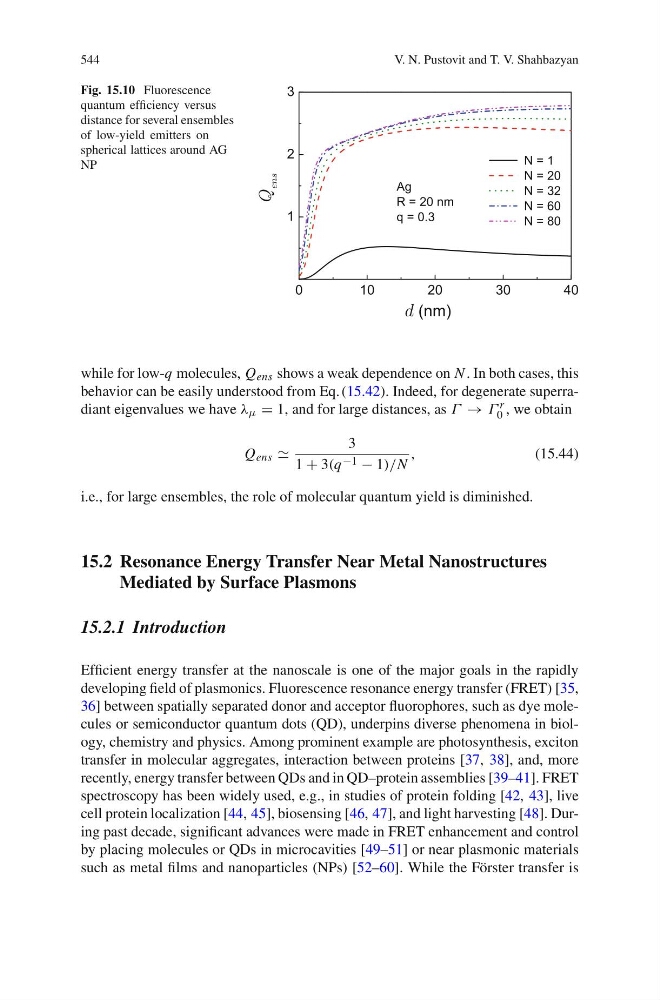
Fig. 15.10 Fluorescence
quantum efficiency versus
distance for several ensembles
of low-yield emitters on
spherical lattices around AG
NP
while for low-q molecules, Q ens shows a weak dependence on N . In both cases, this
behavior can be easily understood from Eq. (15.42). Indeed, for degenerate superradiant eigenvalues we have λ μ = 1, and for large distances, as Γ → Γ r
0 , we obtain
Q ens
3
1 + 3(q −1 − 1)/N
,
(15.44)
i.e., for large ensembles, the role of molecular quantum yield is diminished.
15.2 Resonance Energy Transfer Near Metal Nanostructures
Mediated by Surface Plasmons
15.2.1 Introduction
Efficient energy transfer at the nanoscale is one of the major goals in the rapidly
developing field of plasmonics. Fluorescence resonance energy transfer (FRET) [35,
36] between spatially separated donor and acceptor fluorophores, such as dye molecules or semiconductor quantum dots (QD), underpins diverse phenomena in biology, chemistry and physics. Among prominent example are photosynthesis, exciton
transfer in molecular aggregates, interaction between proteins [37, 38], and, more
recently, energy transfer between QDs and in QD–protein assemblies [39–41]. FRET
spectroscopy has been widely used, e.g., in studies of protein folding [42, 43], live
cell protein localization [44, 45], biosensing [46, 47], and light harvesting [48]. During past decade, significant advances were made in FRET enhancement and control
by placing molecules or QDs in microcavities [49–51] or near plasmonic materials
such as metal films and nanoparticles (NPs) [52–60]. While the Förster transfer is
V. N. Pustovit and T. V. Shahbazyan
Fig. 15.10 Fluorescence
quantum efficiency versus
distance for several ensembles
of low-yield emitters on
spherical lattices around AG
NP
while for low-q molecules, Q ens shows a weak dependence on N . In both cases, this
behavior can be easily understood from Eq. (15.42). Indeed, for degenerate superradiant eigenvalues we have λ μ = 1, and for large distances, as Γ → Γ r
0 , we obtain
Q ens
3
1 + 3(q −1 − 1)/N
,
(15.44)
i.e., for large ensembles, the role of molecular quantum yield is diminished.
15.2 Resonance Energy Transfer Near Metal Nanostructures
Mediated by Surface Plasmons
15.2.1 Introduction
Efficient energy transfer at the nanoscale is one of the major goals in the rapidly
developing field of plasmonics. Fluorescence resonance energy transfer (FRET) [35,
36] between spatially separated donor and acceptor fluorophores, such as dye molecules or semiconductor quantum dots (QD), underpins diverse phenomena in biology, chemistry and physics. Among prominent example are photosynthesis, exciton
transfer in molecular aggregates, interaction between proteins [37, 38], and, more
recently, energy transfer between QDs and in QD–protein assemblies [39–41]. FRET
spectroscopy has been widely used, e.g., in studies of protein folding [42, 43], live
cell protein localization [44, 45], biosensing [46, 47], and light harvesting [48]. During past decade, significant advances were made in FRET enhancement and control
by placing molecules or QDs in microcavities [49–51] or near plasmonic materials
such as metal films and nanoparticles (NPs) [52–60]. While the Förster transfer is