

526
V. N. Pustovit and T. V. Shahbazyan
than the radiation wavelength λ 0 = 2π/ω 0 . Then radiation of the ensemble is a
cooperative process in which the emission of a photon is accompanied by virtual
photon exchange between individual emitters. This near field radiative coupling
between the dipoles leads to formation of new system eigenstates, each comprised
of all individual dipoles. The eigenstates with angular momentum l = 1 that are
coupled to far field are superradiant, i.e., their radiative lifetimes are very short,
∪ τ/N , where τ is radiative lifetime of an individual dipole; the remaining states are
subradiant with much longer decay times, ∪ τ (λ 0 /L) 2 ≈ τ .
Since the appearance of Dicke paper, cooperative effects based on Dicke radiative
coupling mechanism have been extensively studied in atomic and semiconductor
systems (see, e.g., reviews in Refs. [2–4]). Two different decay times corresponding
to superradiant and subradiant states were observed in a system of two laser-trapped
ions [5] and, more recently, in laterally arranged quantum dots with sizes randomly
distributed in a narrow interval [6]. In the later case, suparradiance takes place from an
ensemble of emitters with weak disorder in excitation energies [7, 8]. Other examples
of cooperative behavior analogous to the Dicke effect include, e.g., electron tunneling
through a system of quantum dots [9, 10] and spontaneous phonon emission by
coupled quantum dots [4, 11].
Recently, we have extended the Dicke effect to plasmonic systems comprised of N
dipoles located in the vicinity of a metal nanostructure, e.g., metal nanoparticle (NP),
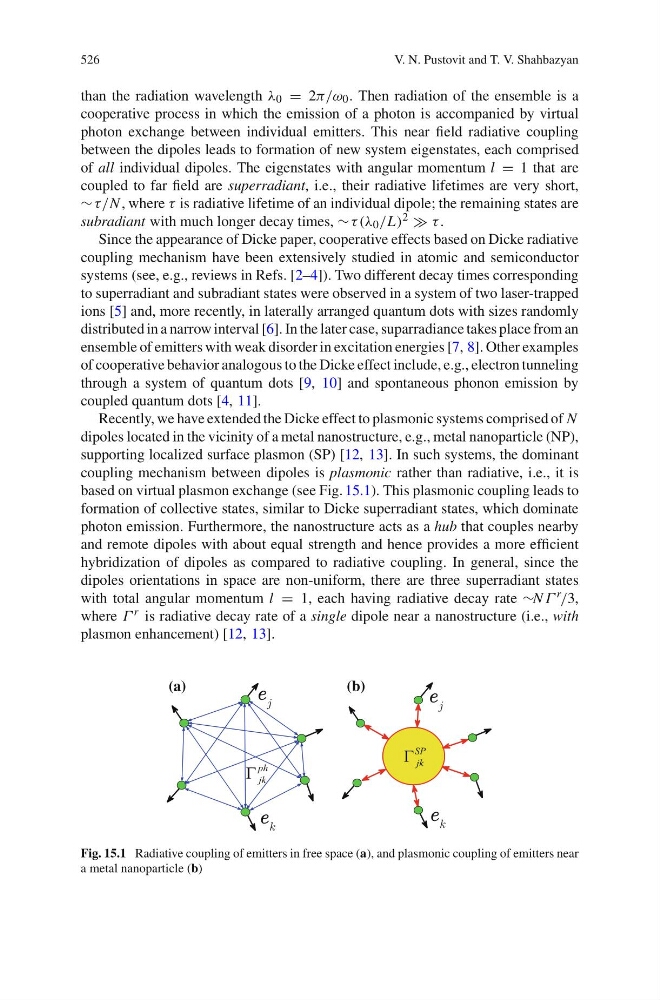
supporting localized surface plasmon (SP) [12, 13]. In such systems, the dominant
coupling mechanism between dipoles is plasmonic rather than radiative, i.e., it is
based on virtual plasmon exchange (see Fig. 15.1). This plasmonic coupling leads to
formation of collective states, similar to Dicke superradiant states, which dominate
photon emission. Furthermore, the nanostructure acts as a hub that couples nearby
and remote dipoles with about equal strength and hence provides a more efficient
hybridization of dipoles as compared to radiative coupling. In general, since the
dipoles orientations in space are non-uniform, there are three superradiant states
with total angular momentum l = 1, each having radiative decay rate ∪N Γ r /3,
where Γ r is radiative decay rate of a single dipole near a nanostructure (i.e., with
plasmon enhancement) [12, 13].
(a)
(b)
Fig. 15.1 Radiative coupling of emitters in free space (a), and plasmonic coupling of emitters near
a metal nanoparticle (b)
V. N. Pustovit and T. V. Shahbazyan
than the radiation wavelength λ 0 = 2π/ω 0 . Then radiation of the ensemble is a
cooperative process in which the emission of a photon is accompanied by virtual
photon exchange between individual emitters. This near field radiative coupling
between the dipoles leads to formation of new system eigenstates, each comprised
of all individual dipoles. The eigenstates with angular momentum l = 1 that are
coupled to far field are superradiant, i.e., their radiative lifetimes are very short,
∪ τ/N , where τ is radiative lifetime of an individual dipole; the remaining states are
subradiant with much longer decay times, ∪ τ (λ 0 /L) 2 ≈ τ .
Since the appearance of Dicke paper, cooperative effects based on Dicke radiative
coupling mechanism have been extensively studied in atomic and semiconductor
systems (see, e.g., reviews in Refs. [2–4]). Two different decay times corresponding
to superradiant and subradiant states were observed in a system of two laser-trapped
ions [5] and, more recently, in laterally arranged quantum dots with sizes randomly
distributed in a narrow interval [6]. In the later case, suparradiance takes place from an
ensemble of emitters with weak disorder in excitation energies [7, 8]. Other examples
of cooperative behavior analogous to the Dicke effect include, e.g., electron tunneling
through a system of quantum dots [9, 10] and spontaneous phonon emission by
coupled quantum dots [4, 11].
Recently, we have extended the Dicke effect to plasmonic systems comprised of N
dipoles located in the vicinity of a metal nanostructure, e.g., metal nanoparticle (NP),
supporting localized surface plasmon (SP) [12, 13]. In such systems, the dominant
coupling mechanism between dipoles is plasmonic rather than radiative, i.e., it is
based on virtual plasmon exchange (see Fig. 15.1). This plasmonic coupling leads to
formation of collective states, similar to Dicke superradiant states, which dominate
photon emission. Furthermore, the nanostructure acts as a hub that couples nearby
and remote dipoles with about equal strength and hence provides a more efficient
hybridization of dipoles as compared to radiative coupling. In general, since the
dipoles orientations in space are non-uniform, there are three superradiant states
with total angular momentum l = 1, each having radiative decay rate ∪N Γ r /3,
where Γ r is radiative decay rate of a single dipole near a nanostructure (i.e., with
plasmon enhancement) [12, 13].
(a)
(b)
Fig. 15.1 Radiative coupling of emitters in free space (a), and plasmonic coupling of emitters near
a metal nanoparticle (b)