

1 Nanoplasmonics: From Present into Future
37
originally been proposed and used to control the focusing of acoustic waves and
microwave radiation [219–221]. Some of these studies required use of a reverberating chamber to cause multiple interactions of the waves with the system needed to
transfer the information to the far field. The electromagnetic subwavelength focusing also required a subwavelength-scale metal structure (a metal wire brush) to be
positioned in the vicinity of the target system as a focusing antenna. In contrast, in
nanoplasmonics there is no need for the reverberating chamber or the metal brush
antenna, because the plasmonic nanosystem plays the roles of both of them. It confines the plasmonic modes for long times relative to their oscillation periods and also
nano-localizes these modes.
1.4.3 Qualitative Description of Time-Reversal Coherent Control
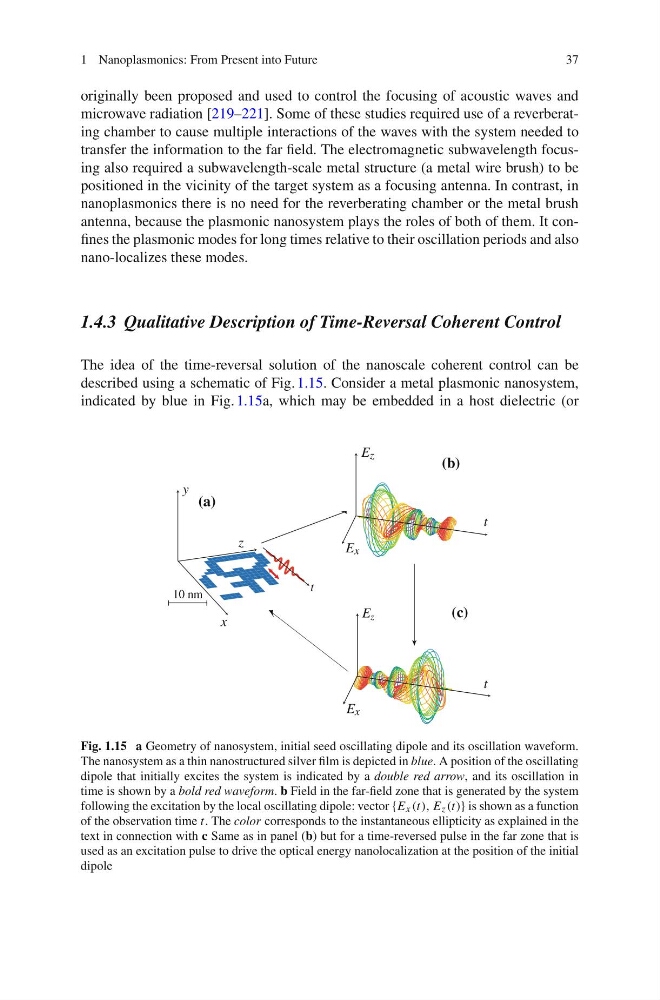
The idea of the time-reversal solution of the nanoscale coherent control can be
described using a schematic of Fig. 1.15. Consider a metal plasmonic nanosystem,
indicated by blue in Fig. 1.15a, which may be embedded in a host dielectric (or
t
t
E z
E x
E z
E x
t
10 nm
z
x
y
(a)
(b)
(c)
Fig. 1.15 a Geometry of nanosystem, initial seed oscillating dipole and its oscillation waveform.
The nanosystem as a thin nanostructured silver film is depicted in blue. A position of the oscillating
dipole that initially excites the system is indicated by a double red arrow, and its oscillation in
time is shown by a bold red waveform. b Field in the far-field zone that is generated by the system
following the excitation by the local oscillating dipole: vector {E x (t), E z (t)} is shown as a function
of the observation time t. The color corresponds to the instantaneous ellipticity as explained in the
text in connection with c Same as in panel (b) but for a time-reversed pulse in the far zone that is
used as an excitation pulse to drive the optical energy nanolocalization at the position of the initial
dipole
37
originally been proposed and used to control the focusing of acoustic waves and
microwave radiation [219–221]. Some of these studies required use of a reverberating chamber to cause multiple interactions of the waves with the system needed to
transfer the information to the far field. The electromagnetic subwavelength focusing also required a subwavelength-scale metal structure (a metal wire brush) to be
positioned in the vicinity of the target system as a focusing antenna. In contrast, in
nanoplasmonics there is no need for the reverberating chamber or the metal brush
antenna, because the plasmonic nanosystem plays the roles of both of them. It confines the plasmonic modes for long times relative to their oscillation periods and also
nano-localizes these modes.
1.4.3 Qualitative Description of Time-Reversal Coherent Control
The idea of the time-reversal solution of the nanoscale coherent control can be
described using a schematic of Fig. 1.15. Consider a metal plasmonic nanosystem,
indicated by blue in Fig. 1.15a, which may be embedded in a host dielectric (or
t
t
E z
E x
E z
E x
t
10 nm
z
x
y
(a)
(b)
(c)
Fig. 1.15 a Geometry of nanosystem, initial seed oscillating dipole and its oscillation waveform.
The nanosystem as a thin nanostructured silver film is depicted in blue. A position of the oscillating
dipole that initially excites the system is indicated by a double red arrow, and its oscillation in
time is shown by a bold red waveform. b Field in the far-field zone that is generated by the system
following the excitation by the local oscillating dipole: vector {E x (t), E z (t)} is shown as a function
of the observation time t. The color corresponds to the instantaneous ellipticity as explained in the
text in connection with c Same as in panel (b) but for a time-reversed pulse in the far zone that is
used as an excitation pulse to drive the optical energy nanolocalization at the position of the initial
dipole