

510
F. Gentile et al.
Let the surface be patterned as to reproduce a regular lattice described by d and ϕ,
where the significance of these symbols is given above. If d is fixed, then the system
would be determined given the sole ϕ. The aim here is to determine the optimal ϕ 0
that would induce large ε c still retaining the advantages of a small r min . To do this,
we introduce the function τ as the sum of the two non dimensional contributions
τ 1 and τ 2 , τ = τ 1 + τ 2 .
τ 1 accounts for the effects of the micro structure on the contact line. It is derived
from the radius of contact r as in Eq. 14.4, being τ 1 = r/R.τ 1 depends upon ε c and
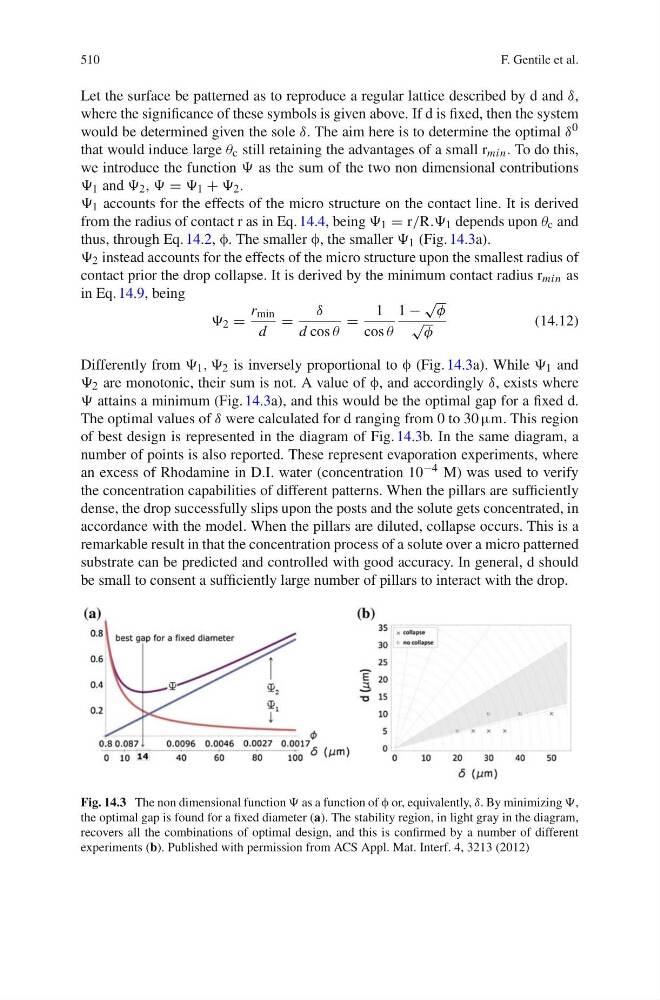
thus, through Eq. 14.2, φ. The smaller φ, the smaller τ 1 (Fig. 14.3a).
τ 2 instead accounts for the effects of the micro structure upon the smallest radius of
contact prior the drop collapse. It is derived by the minimum contact radius r min as
in Eq. 14.9, being
τ 2 =
r min
d
=
ϕ
d cos ε
=
1
cos ε
1 −
∈
λ
∈
λ
(14.12)
Differently from τ 1 , τ 2 is inversely proportional to φ (Fig. 14.3a). While τ 1 and
τ 2 are monotonic, their sum is not. A value of φ, and accordingly ϕ, exists where
τ attains a minimum (Fig. 14.3a), and this would be the optimal gap for a fixed d.
The optimal values of ϕ were calculated for d ranging from 0 to 30 μm. This region
of best design is represented in the diagram of Fig. 14.3b. In the same diagram, a
number of points is also reported. These represent evaporation experiments, where
an excess of Rhodamine in D.I. water (concentration 10 −4 M) was used to verify
the concentration capabilities of different patterns. When the pillars are sufficiently
dense, the drop successfully slips upon the posts and the solute gets concentrated, in
accordance with the model. When the pillars are diluted, collapse occurs. This is a
remarkable result in that the concentration process of a solute over a micro patterned
substrate can be predicted and controlled with good accuracy. In general, d should
be small to consent a sufficiently large number of pillars to interact with the drop.
Fig. 14.3 The non dimensional function τ as a function of φ or, equivalently, ϕ. By minimizing τ,
the optimal gap is found for a fixed diameter (a). The stability region, in light gray in the diagram,
recovers all the combinations of optimal design, and this is confirmed by a number of different
experiments (b). Published with permission from ACS Appl. Mat. Interf. 4, 3213 (2012)
F. Gentile et al.
Let the surface be patterned as to reproduce a regular lattice described by d and ϕ,
where the significance of these symbols is given above. If d is fixed, then the system
would be determined given the sole ϕ. The aim here is to determine the optimal ϕ 0
that would induce large ε c still retaining the advantages of a small r min . To do this,
we introduce the function τ as the sum of the two non dimensional contributions
τ 1 and τ 2 , τ = τ 1 + τ 2 .
τ 1 accounts for the effects of the micro structure on the contact line. It is derived
from the radius of contact r as in Eq. 14.4, being τ 1 = r/R.τ 1 depends upon ε c and
thus, through Eq. 14.2, φ. The smaller φ, the smaller τ 1 (Fig. 14.3a).
τ 2 instead accounts for the effects of the micro structure upon the smallest radius of
contact prior the drop collapse. It is derived by the minimum contact radius r min as
in Eq. 14.9, being
τ 2 =
r min
d
=
ϕ
d cos ε
=
1
cos ε
1 −
∈
λ
∈
λ
(14.12)
Differently from τ 1 , τ 2 is inversely proportional to φ (Fig. 14.3a). While τ 1 and
τ 2 are monotonic, their sum is not. A value of φ, and accordingly ϕ, exists where
τ attains a minimum (Fig. 14.3a), and this would be the optimal gap for a fixed d.
The optimal values of ϕ were calculated for d ranging from 0 to 30 μm. This region
of best design is represented in the diagram of Fig. 14.3b. In the same diagram, a
number of points is also reported. These represent evaporation experiments, where
an excess of Rhodamine in D.I. water (concentration 10 −4 M) was used to verify
the concentration capabilities of different patterns. When the pillars are sufficiently
dense, the drop successfully slips upon the posts and the solute gets concentrated, in
accordance with the model. When the pillars are diluted, collapse occurs. This is a
remarkable result in that the concentration process of a solute over a micro patterned
substrate can be predicted and controlled with good accuracy. In general, d should
be small to consent a sufficiently large number of pillars to interact with the drop.
Fig. 14.3 The non dimensional function τ as a function of φ or, equivalently, ϕ. By minimizing τ,
the optimal gap is found for a fixed diameter (a). The stability region, in light gray in the diagram,
recovers all the combinations of optimal design, and this is confirmed by a number of different
experiments (b). Published with permission from ACS Appl. Mat. Interf. 4, 3213 (2012)