

1 Nanoplasmonics: From Present into Future
35
100
E/E 0
30 nm
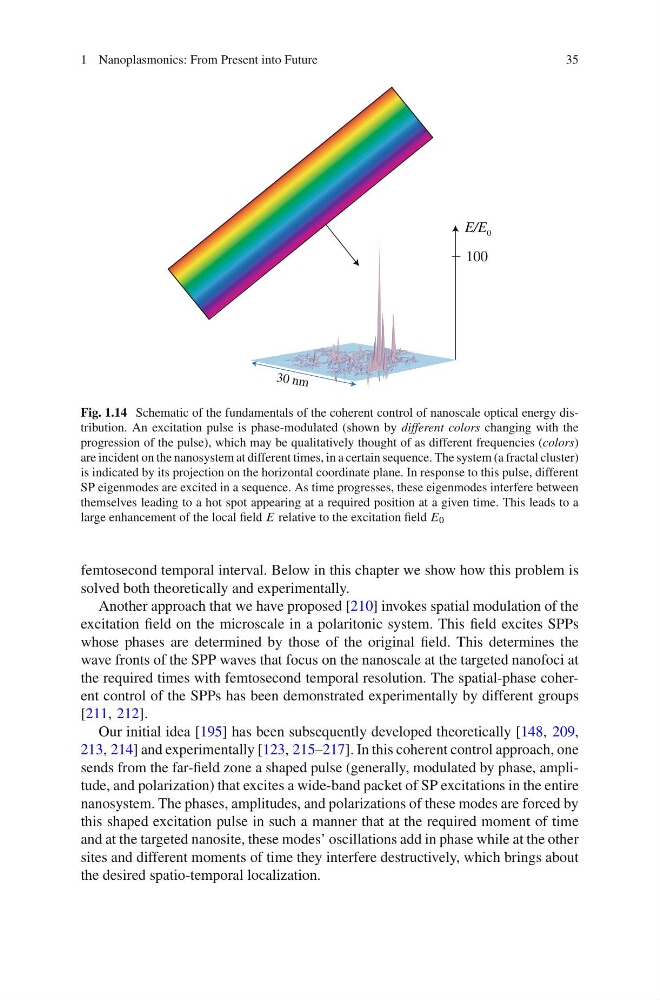
Fig. 1.14 Schematic of the fundamentals of the coherent control of nanoscale optical energy distribution. An excitation pulse is phase-modulated (shown by different colors changing with the
progression of the pulse), which may be qualitatively thought of as different frequencies (colors)
are incident on the nanosystem at different times, in a certain sequence. The system (a fractal cluster)
is indicated by its projection on the horizontal coordinate plane. In response to this pulse, different
SP eigenmodes are excited in a sequence. As time progresses, these eigenmodes interfere between
themselves leading to a hot spot appearing at a required position at a given time. This leads to a
large enhancement of the local field E relative to the excitation field E 0
femtosecond temporal interval. Below in this chapter we show how this problem is
solved both theoretically and experimentally.
Another approach that we have proposed [210] invokes spatial modulation of the
excitation field on the microscale in a polaritonic system. This field excites SPPs
whose phases are determined by those of the original field. This determines the
wave fronts of the SPP waves that focus on the nanoscale at the targeted nanofoci at
the required times with femtosecond temporal resolution. The spatial-phase coherent control of the SPPs has been demonstrated experimentally by different groups
[211, 212].
Our initial idea [195] has been subsequently developed theoretically [148, 209,
213, 214] and experimentally [123, 215–217]. In this coherent control approach, one
sends from the far-field zone a shaped pulse (generally, modulated by phase, amplitude, and polarization) that excites a wide-band packet of SP excitations in the entire
nanosystem. The phases, amplitudes, and polarizations of these modes are forced by
this shaped excitation pulse in such a manner that at the required moment of time
and at the targeted nanosite, these modes’ oscillations add in phase while at the other
sites and different moments of time they interfere destructively, which brings about
the desired spatio-temporal localization.
35
100
E/E 0
30 nm
Fig. 1.14 Schematic of the fundamentals of the coherent control of nanoscale optical energy distribution. An excitation pulse is phase-modulated (shown by different colors changing with the
progression of the pulse), which may be qualitatively thought of as different frequencies (colors)
are incident on the nanosystem at different times, in a certain sequence. The system (a fractal cluster)
is indicated by its projection on the horizontal coordinate plane. In response to this pulse, different
SP eigenmodes are excited in a sequence. As time progresses, these eigenmodes interfere between
themselves leading to a hot spot appearing at a required position at a given time. This leads to a
large enhancement of the local field E relative to the excitation field E 0
femtosecond temporal interval. Below in this chapter we show how this problem is
solved both theoretically and experimentally.
Another approach that we have proposed [210] invokes spatial modulation of the
excitation field on the microscale in a polaritonic system. This field excites SPPs
whose phases are determined by those of the original field. This determines the
wave fronts of the SPP waves that focus on the nanoscale at the targeted nanofoci at
the required times with femtosecond temporal resolution. The spatial-phase coherent control of the SPPs has been demonstrated experimentally by different groups
[211, 212].
Our initial idea [195] has been subsequently developed theoretically [148, 209,
213, 214] and experimentally [123, 215–217]. In this coherent control approach, one
sends from the far-field zone a shaped pulse (generally, modulated by phase, amplitude, and polarization) that excites a wide-band packet of SP excitations in the entire
nanosystem. The phases, amplitudes, and polarizations of these modes are forced by
this shaped excitation pulse in such a manner that at the required moment of time
and at the targeted nanosite, these modes’ oscillations add in phase while at the other
sites and different moments of time they interfere destructively, which brings about
the desired spatio-temporal localization.