

14 Plasmonics and Super-Hydrophobicity
503
time and lower process costs. In 2008, Coluccio et al. [23] devised a SERS sensor
constituted by electroless grown random assemblies of silver nanograins, where
electroless growth is a process whereby metal ions are reduced and deposited as
metals upon a silicon surface. Metal grains are obtained with an average size as
small as few nanometers, with an overall shape and dimension that can be regulated
with an extremely high precision and reproducibility. Despite the extremely high
enhancement factors that are achievable in theory, devices like this suffer from a
practical and serious limitation, that is, the huge time that the species of interest
would take to reach and interact with the active sites of the substrate. In a solution at
rest and under the effect of diffusion solely, a bio molecule with a Brownian diffusion
coefficient D = 10 −9 m 2 /s, would take some 60 h to travel the distance of 1 cm, that
is the typical length side of the device. And thus the performance of conventional,
2d SERS substrates would be dramatically limited by the bottleneck of diffusion.
To overcome this limit we have performed the integration of nano-photonic devices,
such as the ones previously described, with super-hydrophobic surfaces (SHSs). By
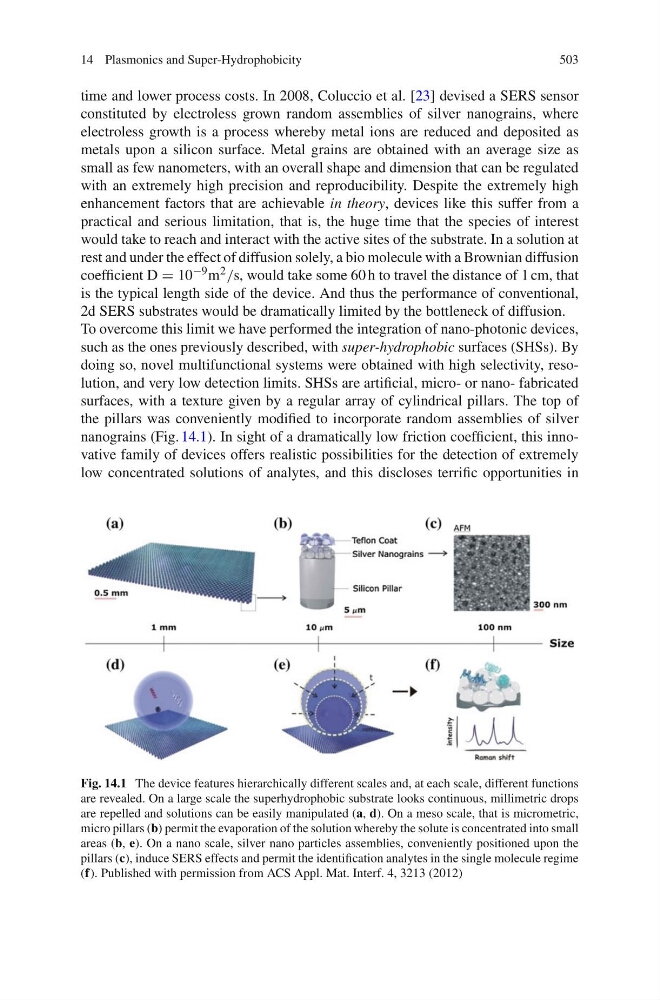
doing so, novel multifunctional systems were obtained with high selectivity, resolution, and very low detection limits. SHSs are artificial, micro- or nano- fabricated
surfaces, with a texture given by a regular array of cylindrical pillars. The top of
the pillars was conveniently modified to incorporate random assemblies of silver
nanograins (Fig. 14.1). In sight of a dramatically low friction coefficient, this innovative family of devices offers realistic possibilities for the detection of extremely
low concentrated solutions of analytes, and this discloses terrific opportunities in
Fig. 14.1 The device features hierarchically different scales and, at each scale, different functions
are revealed. On a large scale the superhydrophobic substrate looks continuous, millimetric drops
are repelled and solutions can be easily manipulated (a, d). On a meso scale, that is micrometric,
micro pillars (b) permit the evaporation of the solution whereby the solute is concentrated into small
areas (b, e). On a nano scale, silver nano particles assemblies, conveniently positioned upon the
pillars (c), induce SERS effects and permit the identification analytes in the single molecule regime
(f). Published with permission from ACS Appl. Mat. Interf. 4, 3213 (2012)
503
time and lower process costs. In 2008, Coluccio et al. [23] devised a SERS sensor
constituted by electroless grown random assemblies of silver nanograins, where
electroless growth is a process whereby metal ions are reduced and deposited as
metals upon a silicon surface. Metal grains are obtained with an average size as
small as few nanometers, with an overall shape and dimension that can be regulated
with an extremely high precision and reproducibility. Despite the extremely high
enhancement factors that are achievable in theory, devices like this suffer from a
practical and serious limitation, that is, the huge time that the species of interest
would take to reach and interact with the active sites of the substrate. In a solution at
rest and under the effect of diffusion solely, a bio molecule with a Brownian diffusion
coefficient D = 10 −9 m 2 /s, would take some 60 h to travel the distance of 1 cm, that
is the typical length side of the device. And thus the performance of conventional,
2d SERS substrates would be dramatically limited by the bottleneck of diffusion.
To overcome this limit we have performed the integration of nano-photonic devices,
such as the ones previously described, with super-hydrophobic surfaces (SHSs). By
doing so, novel multifunctional systems were obtained with high selectivity, resolution, and very low detection limits. SHSs are artificial, micro- or nano- fabricated
surfaces, with a texture given by a regular array of cylindrical pillars. The top of
the pillars was conveniently modified to incorporate random assemblies of silver
nanograins (Fig. 14.1). In sight of a dramatically low friction coefficient, this innovative family of devices offers realistic possibilities for the detection of extremely
low concentrated solutions of analytes, and this discloses terrific opportunities in
Fig. 14.1 The device features hierarchically different scales and, at each scale, different functions
are revealed. On a large scale the superhydrophobic substrate looks continuous, millimetric drops
are repelled and solutions can be easily manipulated (a, d). On a meso scale, that is micrometric,
micro pillars (b) permit the evaporation of the solution whereby the solute is concentrated into small
areas (b, e). On a nano scale, silver nano particles assemblies, conveniently positioned upon the
pillars (c), induce SERS effects and permit the identification analytes in the single molecule regime
(f). Published with permission from ACS Appl. Mat. Interf. 4, 3213 (2012)