

472
E. Hasman and V. Kleiner
The excitation of electromagnetic eigenmodes inside a nanoaperture by surface
waves is constrained by the AM selection rule, which is given by
l SM = l G M ,
(13.2)
where l SM and l G M are the normalized OAM of the surface mode and guided mode
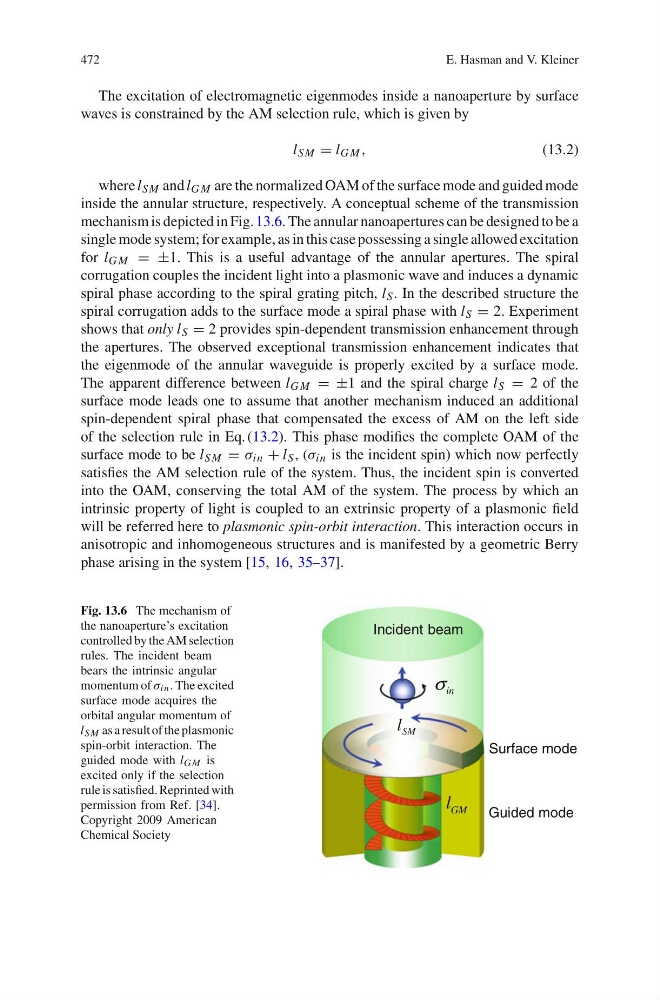
inside the annular structure, respectively. A conceptual scheme of the transmission
mechanism is depicted in Fig. 13.6. The annular nanoapertures can be designed to be a
single mode system; for example, as in this case possessing a single allowed excitation
for l G M = ±1. This is a useful advantage of the annular apertures. The spiral
corrugation couples the incident light into a plasmonic wave and induces a dynamic
spiral phase according to the spiral grating pitch, l S . In the described structure the
spiral corrugation adds to the surface mode a spiral phase with l S = 2. Experiment
shows that only l S = 2 provides spin-dependent transmission enhancement through
the apertures. The observed exceptional transmission enhancement indicates that
the eigenmode of the annular waveguide is properly excited by a surface mode.
The apparent difference between l G M = ±1 and the spiral charge l S = 2 of the
surface mode leads one to assume that another mechanism induced an additional
spin-dependent spiral phase that compensated the excess of AM on the left side
of the selection rule in Eq. (13.2). This phase modifies the complete OAM of the
surface mode to be l SM = λ in + l S , (λ in is the incident spin) which now perfectly
satisfies the AM selection rule of the system. Thus, the incident spin is converted
into the OAM, conserving the total AM of the system. The process by which an
intrinsic property of light is coupled to an extrinsic property of a plasmonic field
will be referred here to plasmonic spin-orbit interaction. This interaction occurs in
anisotropic and inhomogeneous structures and is manifested by a geometric Berry
phase arising in the system [15, 16, 35–37].
Fig. 13.6 The mechanism of
the nanoaperture’s excitation
controlled by the AM selection
rules. The incident beam
bears the intrinsic angular
momentum of λ in . The excited
surface mode acquires the
orbital angular momentum of
l SM as a result of the plasmonic
spin-orbit interaction. The
guided mode with l G M is
excited only if the selection
rule is satisfied. Reprinted with
permission from Ref. [34].
Copyright 2009 American
Chemical Society
Surface mode
Guided mode
in
σ
GM
l
Incident beam
SM
l
E. Hasman and V. Kleiner
The excitation of electromagnetic eigenmodes inside a nanoaperture by surface
waves is constrained by the AM selection rule, which is given by
l SM = l G M ,
(13.2)
where l SM and l G M are the normalized OAM of the surface mode and guided mode
inside the annular structure, respectively. A conceptual scheme of the transmission
mechanism is depicted in Fig. 13.6. The annular nanoapertures can be designed to be a
single mode system; for example, as in this case possessing a single allowed excitation
for l G M = ±1. This is a useful advantage of the annular apertures. The spiral
corrugation couples the incident light into a plasmonic wave and induces a dynamic
spiral phase according to the spiral grating pitch, l S . In the described structure the
spiral corrugation adds to the surface mode a spiral phase with l S = 2. Experiment
shows that only l S = 2 provides spin-dependent transmission enhancement through
the apertures. The observed exceptional transmission enhancement indicates that
the eigenmode of the annular waveguide is properly excited by a surface mode.
The apparent difference between l G M = ±1 and the spiral charge l S = 2 of the
surface mode leads one to assume that another mechanism induced an additional
spin-dependent spiral phase that compensated the excess of AM on the left side
of the selection rule in Eq. (13.2). This phase modifies the complete OAM of the
surface mode to be l SM = λ in + l S , (λ in is the incident spin) which now perfectly
satisfies the AM selection rule of the system. Thus, the incident spin is converted
into the OAM, conserving the total AM of the system. The process by which an
intrinsic property of light is coupled to an extrinsic property of a plasmonic field
will be referred here to plasmonic spin-orbit interaction. This interaction occurs in
anisotropic and inhomogeneous structures and is manifested by a geometric Berry
phase arising in the system [15, 16, 35–37].
Fig. 13.6 The mechanism of
the nanoaperture’s excitation
controlled by the AM selection
rules. The incident beam
bears the intrinsic angular
momentum of λ in . The excited
surface mode acquires the
orbital angular momentum of
l SM as a result of the plasmonic
spin-orbit interaction. The
guided mode with l G M is
excited only if the selection
rule is satisfied. Reprinted with
permission from Ref. [34].
Copyright 2009 American
Chemical Society
Surface mode
Guided mode
in
σ
GM
l
Incident beam
SM
l