

438
S. V. Boriskina
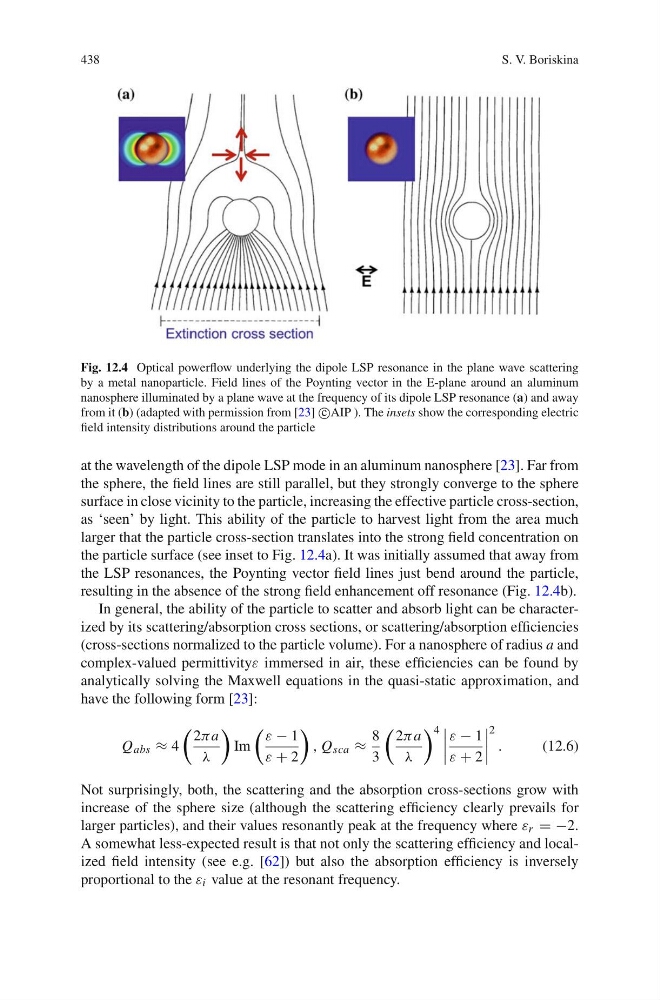
Fig. 12.4 Optical powerflow underlying the dipole LSP resonance in the plane wave scattering
by a metal nanoparticle. Field lines of the Poynting vector in the E-plane around an aluminum
nanosphere illuminated by a plane wave at the frequency of its dipole LSP resonance (a) and away
from it (b) (adapted with permission from [23] c
∪AIP ). The insets show the corresponding electric
field intensity distributions around the particle
at the wavelength of the dipole LSP mode in an aluminum nanosphere [23]. Far from
the sphere, the field lines are still parallel, but they strongly converge to the sphere
surface in close vicinity to the particle, increasing the effective particle cross-section,
as ‘seen’ by light. This ability of the particle to harvest light from the area much
larger that the particle cross-section translates into the strong field concentration on
the particle surface (see inset to Fig. 12.4a). It was initially assumed that away from
the LSP resonances, the Poynting vector field lines just bend around the particle,
resulting in the absence of the strong field enhancement off resonance (Fig. 12.4b).
In general, the ability of the particle to scatter and absorb light can be characterized by its scattering/absorption cross sections, or scattering/absorption efficiencies
(cross-sections normalized to the particle volume). For a nanosphere of radius a and
complex-valued permittivityλ immersed in air, these efficiencies can be found by
analytically solving the Maxwell equations in the quasi-static approximation, and
have the following form [23]:
Q abs ∝ 4
2∂a
Δ
Im
λ − 1
λ + 2
, Q sca ∝
8
3
2∂a
Δ
4
λ − 1
λ + 2
2
.
(12.6)
Not surprisingly, both, the scattering and the absorption cross-sections grow with
increase of the sphere size (although the scattering efficiency clearly prevails for
larger particles), and their values resonantly peak at the frequency where λ r = −2.
A somewhat less-expected result is that not only the scattering efficiency and localized field intensity (see e.g. [62]) but also the absorption efficiency is inversely
proportional to the λ i value at the resonant frequency.
S. V. Boriskina
Fig. 12.4 Optical powerflow underlying the dipole LSP resonance in the plane wave scattering
by a metal nanoparticle. Field lines of the Poynting vector in the E-plane around an aluminum
nanosphere illuminated by a plane wave at the frequency of its dipole LSP resonance (a) and away
from it (b) (adapted with permission from [23] c
∪AIP ). The insets show the corresponding electric
field intensity distributions around the particle
at the wavelength of the dipole LSP mode in an aluminum nanosphere [23]. Far from
the sphere, the field lines are still parallel, but they strongly converge to the sphere
surface in close vicinity to the particle, increasing the effective particle cross-section,
as ‘seen’ by light. This ability of the particle to harvest light from the area much
larger that the particle cross-section translates into the strong field concentration on
the particle surface (see inset to Fig. 12.4a). It was initially assumed that away from
the LSP resonances, the Poynting vector field lines just bend around the particle,
resulting in the absence of the strong field enhancement off resonance (Fig. 12.4b).
In general, the ability of the particle to scatter and absorb light can be characterized by its scattering/absorption cross sections, or scattering/absorption efficiencies
(cross-sections normalized to the particle volume). For a nanosphere of radius a and
complex-valued permittivityλ immersed in air, these efficiencies can be found by
analytically solving the Maxwell equations in the quasi-static approximation, and
have the following form [23]:
Q abs ∝ 4
2∂a
Δ
Im
λ − 1
λ + 2
, Q sca ∝
8
3
2∂a
Δ
4
λ − 1
λ + 2
2
.
(12.6)
Not surprisingly, both, the scattering and the absorption cross-sections grow with
increase of the sphere size (although the scattering efficiency clearly prevails for
larger particles), and their values resonantly peak at the frequency where λ r = −2.
A somewhat less-expected result is that not only the scattering efficiency and localized field intensity (see e.g. [62]) but also the absorption efficiency is inversely
proportional to the λ i value at the resonant frequency.