

11 Plasmonic Functionalities Based on Detuned Electrical Dipoles
417
environmental changes. Note that in a related study the scattering asymmetry of a
bimetallic DED configuration has been used as a nanoscale-sized directional color
router [48]
The above conceptual discussion has been cooperated further in [14] by considering two interacting ellipsoids with detuned resonance wavelengths in the point-dipole
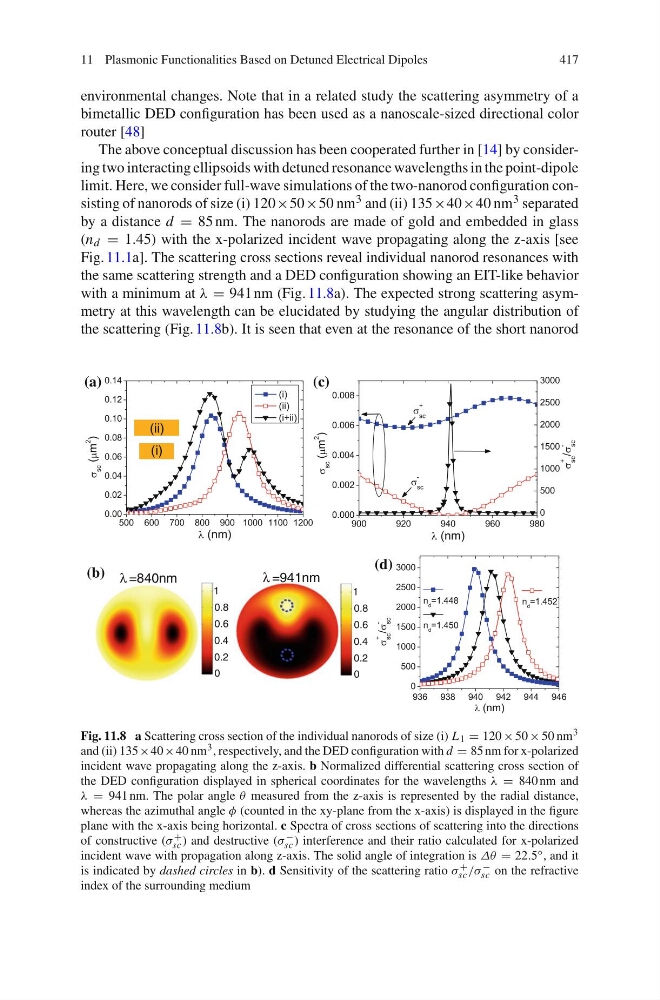
limit. Here, we consider full-wave simulations of the two-nanorod configuration consisting of nanorods of size (i) 120×50×50 nm 3 and (ii) 135×40×40 nm 3 separated
by a distance d = 85 nm. The nanorods are made of gold and embedded in glass
(n d = 1.45) with the x-polarized incident wave propagating along the z-axis [see
Fig. 11.1a]. The scattering cross sections reveal individual nanorod resonances with
the same scattering strength and a DED configuration showing an EIT-like behavior
with a minimum at ϕ = 941 nm (Fig. 11.8a). The expected strong scattering asymmetry at this wavelength can be elucidated by studying the angular distribution of
the scattering (Fig. 11.8b). It is seen that even at the resonance of the short nanorod
1
0.6
0
0.8
0.4
0.2
1
0.6
0
0.8
0.4
0.2
λ =941nm
λ =840nm
(i)
(ii)
(a)
(c)
(d)
(b)
Fig. 11.8 a Scattering cross section of the individual nanorods of size (i) L 1 = 120 × 50 × 50 nm 3
and (ii) 135×40×40 nm 3 , respectively, and the DED configuration with d = 85 nm for x-polarized
incident wave propagating along the z-axis. b Normalized differential scattering cross section of
the DED configuration displayed in spherical coordinates for the wavelengths ϕ = 840 nm and
ϕ = 941 nm. The polar angle σ measured from the z-axis is represented by the radial distance,
whereas the azimuthal angle ρ (counted in the xy-plane from the x-axis) is displayed in the figure
plane with the x-axis being horizontal. c Spectra of cross sections of scattering into the directions
of constructive (τ +
sc ) and destructive (τ −
sc ) interference and their ratio calculated for x-polarized
incident wave with propagation along z-axis. The solid angle of integration is πσ = 22.5 ◦ , and it
is indicated by dashed circles in b). d Sensitivity of the scattering ratio τ +
sc /τ −
sc on the refractive
index of the surrounding medium
417
environmental changes. Note that in a related study the scattering asymmetry of a
bimetallic DED configuration has been used as a nanoscale-sized directional color
router [48]
The above conceptual discussion has been cooperated further in [14] by considering two interacting ellipsoids with detuned resonance wavelengths in the point-dipole
limit. Here, we consider full-wave simulations of the two-nanorod configuration consisting of nanorods of size (i) 120×50×50 nm 3 and (ii) 135×40×40 nm 3 separated
by a distance d = 85 nm. The nanorods are made of gold and embedded in glass
(n d = 1.45) with the x-polarized incident wave propagating along the z-axis [see
Fig. 11.1a]. The scattering cross sections reveal individual nanorod resonances with
the same scattering strength and a DED configuration showing an EIT-like behavior
with a minimum at ϕ = 941 nm (Fig. 11.8a). The expected strong scattering asymmetry at this wavelength can be elucidated by studying the angular distribution of
the scattering (Fig. 11.8b). It is seen that even at the resonance of the short nanorod
1
0.6
0
0.8
0.4
0.2
1
0.6
0
0.8
0.4
0.2
λ =941nm
λ =840nm
(i)
(ii)
(a)
(c)
(d)
(b)
Fig. 11.8 a Scattering cross section of the individual nanorods of size (i) L 1 = 120 × 50 × 50 nm 3
and (ii) 135×40×40 nm 3 , respectively, and the DED configuration with d = 85 nm for x-polarized
incident wave propagating along the z-axis. b Normalized differential scattering cross section of
the DED configuration displayed in spherical coordinates for the wavelengths ϕ = 840 nm and
ϕ = 941 nm. The polar angle σ measured from the z-axis is represented by the radial distance,
whereas the azimuthal angle ρ (counted in the xy-plane from the x-axis) is displayed in the figure
plane with the x-axis being horizontal. c Spectra of cross sections of scattering into the directions
of constructive (τ +
sc ) and destructive (τ −
sc ) interference and their ratio calculated for x-polarized
incident wave with propagation along z-axis. The solid angle of integration is πσ = 22.5 ◦ , and it
is indicated by dashed circles in b). d Sensitivity of the scattering ratio τ +
sc /τ −
sc on the refractive
index of the surrounding medium