

11 Plasmonic Functionalities Based on Detuned Electrical Dipoles
411
700
750
800
850
900
950 1000
0
0.5
1
1.5
2
2.5
λ (nm)
n,
n
−20
−15
−10
−5
0
5
10
15
n
g
λ (nm)
Loss (dB/unit cell)
800
820
840
860
880
900
920
0
2
4
6
8
10
12
14
16
18
20
600
700
800
900
1000
1100
0
0.2
0.4
0.6
0.8
1
λ (nm)
Transmission
(b)
(d)
(c)
(a)
κ
κ
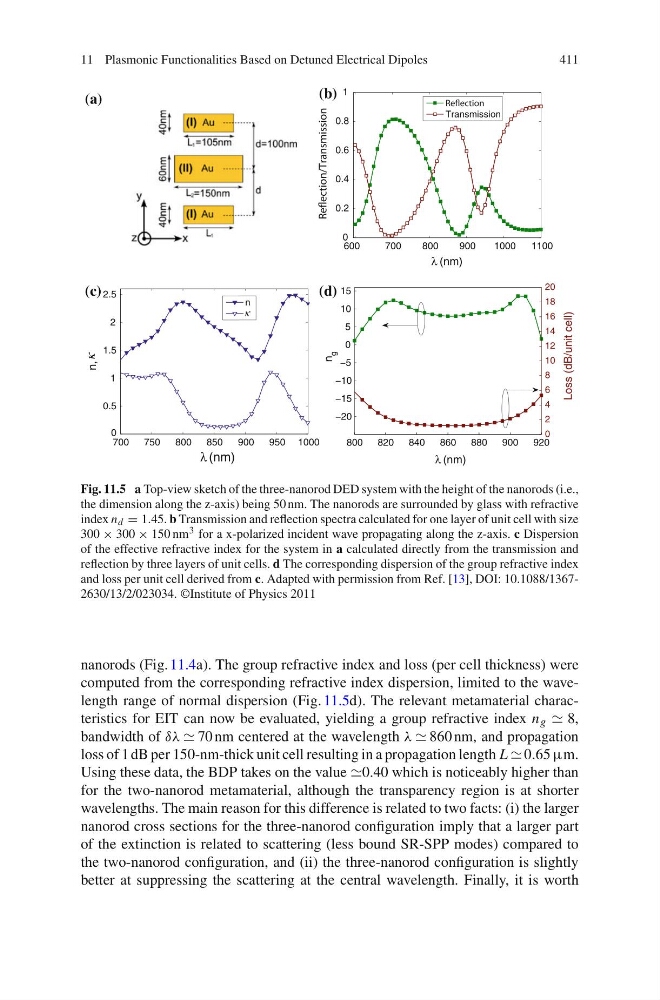
Fig. 11.5 a Top-view sketch of the three-nanorod DED system with the height of the nanorods (i.e.,
the dimension along the z-axis) being 50 nm. The nanorods are surrounded by glass with refractive
index n d = 1.45. b Transmission and reflection spectra calculated for one layer of unit cell with size
300 × 300 × 150 nm 3 for a x-polarized incident wave propagating along the z-axis. c Dispersion
of the effective refractive index for the system in a calculated directly from the transmission and
reflection by three layers of unit cells. d The corresponding dispersion of the group refractive index
and loss per unit cell derived from c. Adapted with permission from Ref. [13], DOI: 10.1088/13672630/13/2/023034. ©Institute of Physics 2011
nanorods (Fig. 11.4a). The group refractive index and loss (per cell thickness) were
computed from the corresponding refractive index dispersion, limited to the wavelength range of normal dispersion (Fig. 11.5d). The relevant metamaterial characteristics for EIT can now be evaluated, yielding a group refractive index n g ∼ 8,
bandwidth of αϕ ∼ 70 nm centered at the wavelength ϕ ∼ 860 nm, and propagation
loss of 1 dB per 150-nm-thick unit cell resulting in a propagation length L ∼ 0.65 µm.
Using these data, the BDP takes on the value ∼0.40 which is noticeably higher than
for the two-nanorod metamaterial, although the transparency region is at shorter
wavelengths. The main reason for this difference is related to two facts: (i) the larger
nanorod cross sections for the three-nanorod configuration imply that a larger part
of the extinction is related to scattering (less bound SR-SPP modes) compared to
the two-nanorod configuration, and (ii) the three-nanorod configuration is slightly
better at suppressing the scattering at the central wavelength. Finally, it is worth
411
700
750
800
850
900
950 1000
0
0.5
1
1.5
2
2.5
λ (nm)
n,
n
−20
−15
−10
−5
0
5
10
15
n
g
λ (nm)
Loss (dB/unit cell)
800
820
840
860
880
900
920
0
2
4
6
8
10
12
14
16
18
20
600
700
800
900
1000
1100
0
0.2
0.4
0.6
0.8
1
λ (nm)
Transmission
(b)
(d)
(c)
(a)
κ
κ
Fig. 11.5 a Top-view sketch of the three-nanorod DED system with the height of the nanorods (i.e.,
the dimension along the z-axis) being 50 nm. The nanorods are surrounded by glass with refractive
index n d = 1.45. b Transmission and reflection spectra calculated for one layer of unit cell with size
300 × 300 × 150 nm 3 for a x-polarized incident wave propagating along the z-axis. c Dispersion
of the effective refractive index for the system in a calculated directly from the transmission and
reflection by three layers of unit cells. d The corresponding dispersion of the group refractive index
and loss per unit cell derived from c. Adapted with permission from Ref. [13], DOI: 10.1088/13672630/13/2/023034. ©Institute of Physics 2011
nanorods (Fig. 11.4a). The group refractive index and loss (per cell thickness) were
computed from the corresponding refractive index dispersion, limited to the wavelength range of normal dispersion (Fig. 11.5d). The relevant metamaterial characteristics for EIT can now be evaluated, yielding a group refractive index n g ∼ 8,
bandwidth of αϕ ∼ 70 nm centered at the wavelength ϕ ∼ 860 nm, and propagation
loss of 1 dB per 150-nm-thick unit cell resulting in a propagation length L ∼ 0.65 µm.
Using these data, the BDP takes on the value ∼0.40 which is noticeably higher than
for the two-nanorod metamaterial, although the transparency region is at shorter
wavelengths. The main reason for this difference is related to two facts: (i) the larger
nanorod cross sections for the three-nanorod configuration imply that a larger part
of the extinction is related to scattering (less bound SR-SPP modes) compared to
the two-nanorod configuration, and (ii) the three-nanorod configuration is slightly
better at suppressing the scattering at the central wavelength. Finally, it is worth