

10 Waves on Subwalength Metallic Surfaces: A Microscopic View Point
389
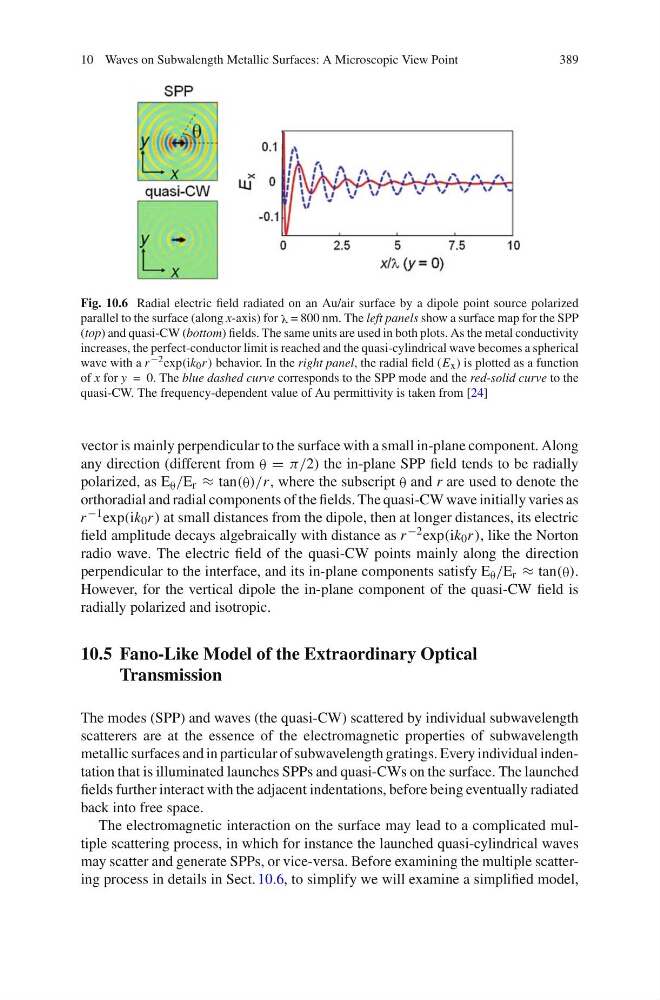
Fig. 10.6 Radial electric field radiated on an Au/air surface by a dipole point source polarized
parallel to the surface (along x-axis) for λ = 800 nm. The left panels show a surface map for the SPP
(top) and quasi-CW (bottom) fields. The same units are used in both plots. As the metal conductivity
increases, the perfect-conductor limit is reached and the quasi-cylindrical wave becomes a spherical
wave with a r −2 exp(ik 0 r ) behavior. In the right panel, the radial field (E x ) is plotted as a function
of x for y = 0. The blue dashed curve corresponds to the SPP mode and the red-solid curve to the
quasi-CW. The frequency-dependent value of Au permittivity is taken from [24]
vector is mainly perpendicular to the surface with a small in-plane component. Along
any direction (different from θ = ε/2) the in-plane SPP field tends to be radially
polarized, as E θ /E r ≈ tan(θ)/r , where the subscript θ and r are used to denote the
orthoradial and radial components of the fields. The quasi-CW wave initially varies as
r −1 exp(ik 0 r ) at small distances from the dipole, then at longer distances, its electric
field amplitude decays algebraically with distance as r −2 exp(ik 0 r ), like the Norton
radio wave. The electric field of the quasi-CW points mainly along the direction
perpendicular to the interface, and its in-plane components satisfy E θ /E r ≈ tan(θ).
However, for the vertical dipole the in-plane component of the quasi-CW field is
radially polarized and isotropic.
10.5 Fano-Like Model of the Extraordinary Optical
Transmission
The modes (SPP) and waves (the quasi-CW) scattered by individual subwavelength
scatterers are at the essence of the electromagnetic properties of subwavelength
metallic surfaces and in particular of subwavelength gratings. Every individual indentation that is illuminated launches SPPs and quasi-CWs on the surface. The launched
fields further interact with the adjacent indentations, before being eventually radiated
back into free space.
The electromagnetic interaction on the surface may lead to a complicated multiple scattering process, in which for instance the launched quasi-cylindrical waves
may scatter and generate SPPs, or vice-versa. Before examining the multiple scattering process in details in Sect. 10.6, to simplify we will examine a simplified model,
389
Fig. 10.6 Radial electric field radiated on an Au/air surface by a dipole point source polarized
parallel to the surface (along x-axis) for λ = 800 nm. The left panels show a surface map for the SPP
(top) and quasi-CW (bottom) fields. The same units are used in both plots. As the metal conductivity
increases, the perfect-conductor limit is reached and the quasi-cylindrical wave becomes a spherical
wave with a r −2 exp(ik 0 r ) behavior. In the right panel, the radial field (E x ) is plotted as a function
of x for y = 0. The blue dashed curve corresponds to the SPP mode and the red-solid curve to the
quasi-CW. The frequency-dependent value of Au permittivity is taken from [24]
vector is mainly perpendicular to the surface with a small in-plane component. Along
any direction (different from θ = ε/2) the in-plane SPP field tends to be radially
polarized, as E θ /E r ≈ tan(θ)/r , where the subscript θ and r are used to denote the
orthoradial and radial components of the fields. The quasi-CW wave initially varies as
r −1 exp(ik 0 r ) at small distances from the dipole, then at longer distances, its electric
field amplitude decays algebraically with distance as r −2 exp(ik 0 r ), like the Norton
radio wave. The electric field of the quasi-CW points mainly along the direction
perpendicular to the interface, and its in-plane components satisfy E θ /E r ≈ tan(θ).
However, for the vertical dipole the in-plane component of the quasi-CW field is
radially polarized and isotropic.
10.5 Fano-Like Model of the Extraordinary Optical
Transmission
The modes (SPP) and waves (the quasi-CW) scattered by individual subwavelength
scatterers are at the essence of the electromagnetic properties of subwavelength
metallic surfaces and in particular of subwavelength gratings. Every individual indentation that is illuminated launches SPPs and quasi-CWs on the surface. The launched
fields further interact with the adjacent indentations, before being eventually radiated
back into free space.
The electromagnetic interaction on the surface may lead to a complicated multiple scattering process, in which for instance the launched quasi-cylindrical waves
may scatter and generate SPPs, or vice-versa. Before examining the multiple scattering process in details in Sect. 10.6, to simplify we will examine a simplified model,