

346
L. D. Negro et al.
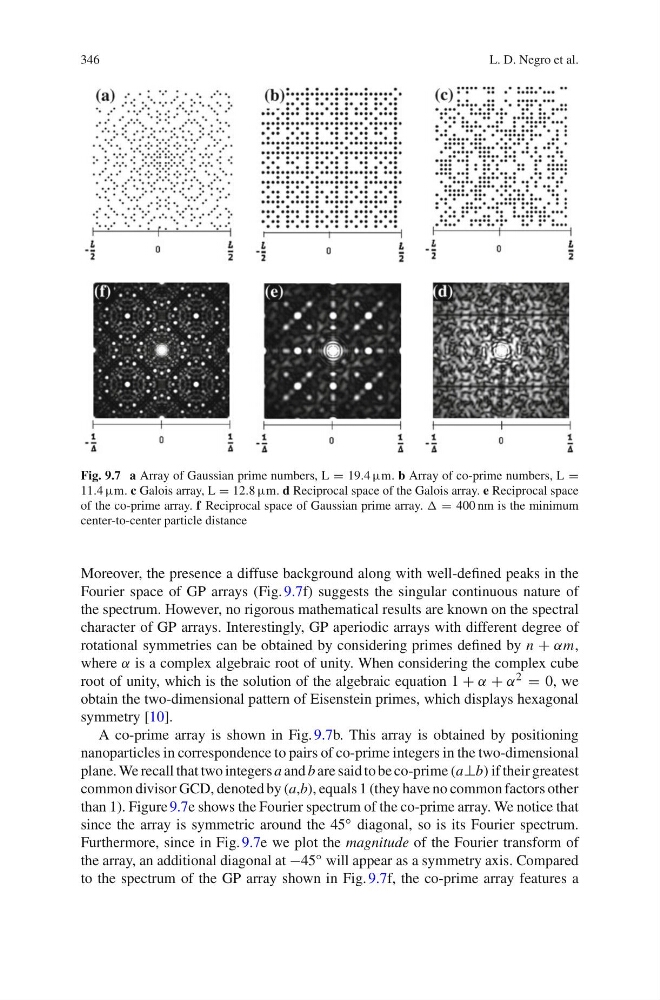
Fig. 9.7 a Array of Gaussian prime numbers, L = 19.4 μm. b Array of co-prime numbers, L =
11.4 μm. c Galois array, L = 12.8 μm. d Reciprocal space of the Galois array. e Reciprocal space
of the co-prime array. f Reciprocal space of Gaussian prime array. π = 400 nm is the minimum
center-to-center particle distance
Moreover, the presence a diffuse background along with well-defined peaks in the
Fourier space of GP arrays (Fig. 9.7f) suggests the singular continuous nature of
the spectrum. However, no rigorous mathematical results are known on the spectral
character of GP arrays. Interestingly, GP aperiodic arrays with different degree of
rotational symmetries can be obtained by considering primes defined by n + γm,
where γ is a complex algebraic root of unity. When considering the complex cube
root of unity, which is the solution of the algebraic equation 1 + γ + γ 2 = 0, we
obtain the two-dimensional pattern of Eisenstein primes, which displays hexagonal
symmetry [10].
A co-prime array is shown in Fig. 9.7b. This array is obtained by positioning
nanoparticles in correspondence to pairs of co-prime integers in the two-dimensional
plane. We recall that two integers a and b are said to be co-prime (a∈b) if their greatest
common divisor GCD, denoted by (a,b), equals 1 (they have no common factors other
than 1). Figure 9.7e shows the Fourier spectrum of the co-prime array. We notice that
since the array is symmetric around the 45 ◦ diagonal, so is its Fourier spectrum.
Furthermore, since in Fig. 9.7e we plot the magnitude of the Fourier transform of
the array, an additional diagonal at −45 ◦ will appear as a symmetry axis. Compared
to the spectrum of the GP array shown in Fig. 9.7f, the co-prime array features a
L. D. Negro et al.
Fig. 9.7 a Array of Gaussian prime numbers, L = 19.4 μm. b Array of co-prime numbers, L =
11.4 μm. c Galois array, L = 12.8 μm. d Reciprocal space of the Galois array. e Reciprocal space
of the co-prime array. f Reciprocal space of Gaussian prime array. π = 400 nm is the minimum
center-to-center particle distance
Moreover, the presence a diffuse background along with well-defined peaks in the
Fourier space of GP arrays (Fig. 9.7f) suggests the singular continuous nature of
the spectrum. However, no rigorous mathematical results are known on the spectral
character of GP arrays. Interestingly, GP aperiodic arrays with different degree of
rotational symmetries can be obtained by considering primes defined by n + γm,
where γ is a complex algebraic root of unity. When considering the complex cube
root of unity, which is the solution of the algebraic equation 1 + γ + γ 2 = 0, we
obtain the two-dimensional pattern of Eisenstein primes, which displays hexagonal
symmetry [10].
A co-prime array is shown in Fig. 9.7b. This array is obtained by positioning
nanoparticles in correspondence to pairs of co-prime integers in the two-dimensional
plane. We recall that two integers a and b are said to be co-prime (a∈b) if their greatest
common divisor GCD, denoted by (a,b), equals 1 (they have no common factors other
than 1). Figure 9.7e shows the Fourier spectrum of the co-prime array. We notice that
since the array is symmetric around the 45 ◦ diagonal, so is its Fourier spectrum.
Furthermore, since in Fig. 9.7e we plot the magnitude of the Fourier transform of
the array, an additional diagonal at −45 ◦ will appear as a symmetry axis. Compared
to the spectrum of the GP array shown in Fig. 9.7f, the co-prime array features a